Loading...
Done
This dyed straw is grown in Ban Dong Saen Suk, Sakon Nakhon province, Thailand on September 28, 2021. Sarawut Intharap, 38, an engineer who capture the image, said: “The straw is entwined together to make mats used for sleeping and eating and they are sold at around £2.50 (3.40 USD) a mat at the local market”. (Photo by Sarawut Intarob/Solent News)

This dyed straw is grown in Ban Dong Saen Suk, Sakon Nakhon province, Thailand on September 28, 2021. Sarawut Intharap, 38, an engineer who capture the image, said: “The straw is entwined together to make mats used for sleeping and eating and they are sold at around £2.50 (3.40 USD) a mat at the local market”. (Photo by Sarawut Intarob/Solent News)
Details
21 Oct 2021 08:43:00
Madras Engineers Group (MEG) soldiers perform “Kalaripayattu”, a traditional martial art from Kerala, during celebrations for the India's 74th Republic Day in Bengaluru on January 26, 2023. (Photo by Manjunath Kiran/AFP Photo)

Madras Engineers Group (MEG) soldiers perform “Kalaripayattu”, a traditional martial art from Kerala, during celebrations for the India's 74th Republic Day in Bengaluru on January 26, 2023. (Photo by Manjunath Kiran/AFP Photo)
Details
02 Feb 2023 00:24:00
The AMECA robot from the manufacturer Engineered Arts is in the Deutsches Museum Nuremberg (Future Museum), Bavaria on May 3, 2022. AMECA is a humanoid robot that will be presented to the general public for the first time in Europe as part of the Blue Night on May 7, 2022 in Nuremberg. (Photo by Daniel Karmann/dpa/Alamy Live News)

The AMECA robot from the manufacturer Engineered Arts is in the Deutsches Museum Nuremberg (Future Museum), Bavaria on May 3, 2022. AMECA is a humanoid robot that will be presented to the general public for the first time in Europe as part of the Blue Night on May 7, 2022 in Nuremberg. (Photo by Daniel Karmann/dpa/Alamy Live News)
Details
04 May 2022 05:18:00
Mahmoud El Komy, a 26-year-old Egyptian mechatronics engineer, stands beside Cira 3, a remote-controlled robot that runs tests on suspected coronavirus disease (COVID-19) patients, to limit the human exposure to the virus, amid a second wave of infections in Tanta, Egypt, November 18, 2020. (Photo by Mohamed Abd El Ghany/Reuters)

Mahmoud El Komy, a 26-year-old Egyptian mechatronics engineer, stands beside Cira 3, a remote-controlled robot that runs tests on suspected coronavirus disease (COVID-19) patients, to limit the human exposure to the virus, amid a second wave of infections in Tanta, Egypt, November 18, 2020. (Photo by Mohamed Abd El Ghany/Reuters)
Details
20 Dec 2020 00:01:00
Advanced Space Suit Engineer at NASA Kristine Davis wears the xEMU prototype space suit for the next astronaut to the moon by 2024, during its presentation at NASA headquarters in Washington, U.S., October 15, 2019. (Photo by Carlos Jasso/Reuters)

Advanced Space Suit Engineer at NASA Kristine Davis wears the xEMU prototype space suit for the next astronaut to the moon by 2024, during its presentation at NASA headquarters in Washington, U.S., October 15, 2019. (Photo by Carlos Jasso/Reuters)
Details
22 Oct 2019 00:03:00
The Sea Otter

The sea otter (Enhydra lutris) is a marine mammal native to the coasts of the northern and eastern North Pacific Ocean. Adult sea otters typically weigh between 14 and 45 kg (31 and 99 lb), making them the heaviest members of the weasel family, but among the smallest marine mammals. Unlike most marine mammals, the sea otter's primary form of insulation is an exceptionally thick coat of fur, the densest in the animal kingdom. Although it can walk on land, the sea otter lives mostly in the ocean.
Details
26 Jan 2014 12:20:00
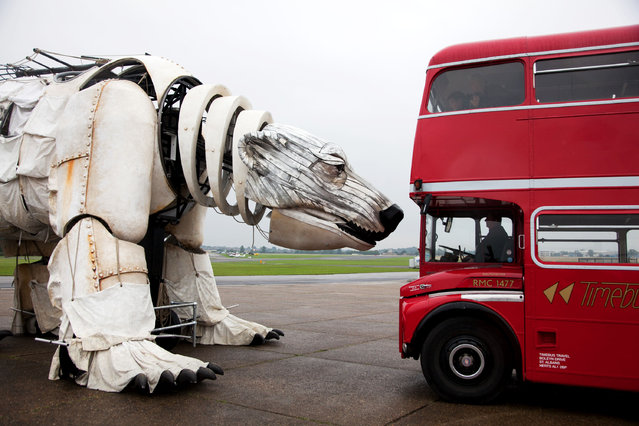
Giant Polar Bear Of London

Her name is Aurora, and she is the star of “Aurora's Parade”, the London chapter of ceride – Greenpeace’s global day of action to protest against Arctic destruction. According to DesignBoom, this giant people-powered super-puppet weighs about 3 tons and needs 15 puppeteers and 30 volunteers to operate. Aurora, described as “part protest, part performance”, has fur that includes the names of each supporter in the movement. Greenpeace hopes she will bring the voice and spirit of the Arctic to the public.
Details
13 Mar 2014 13:41:00
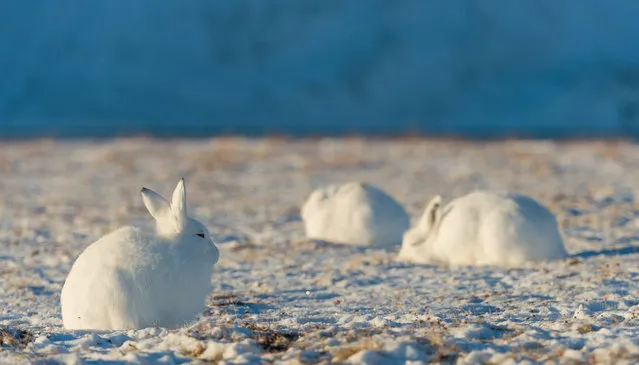
Arctic Hare

The arctic hare, or polar rabbit, is a species of hare which is adapted largely to polar and mountainous habitats. The arctic hare survives with a thick coat of fur and usually digs holes in the ground or under snow to keep warm and sleep. Arctic hares look like rabbits but have shorter ears, are taller when standing, and, unlike rabbits, can thrive in cold climates. They can travel together with many other hares, sometimes huddling with dozens or more, but are usually found alone, taking, in some cases, more than one partner. The arctic hare can run up to 60 kilometres per hour (40 mph). Its predators include the arctic wolf, arctic fox, and ermine.
Details
17 Mar 2014 13:56:00