Loading...
Done
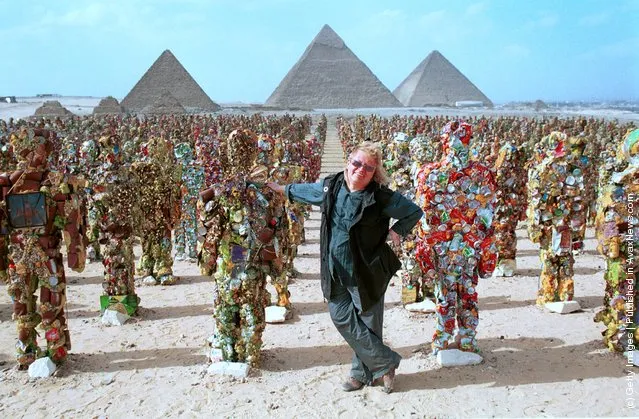
German artist Ha Schult stands with his trash people below the pyramids May 15, 2002 in Giza, Egypt

“HA Schult, born Hans-Jürgen Schult on June 24, 1939 in Parchim, Mecklenburg is a German installation, happening and conceptual artist known primarily for his object and performance art and more specifically his work with garbage”. – Wikipedia

Photo: German artist Ha Schult stands with his “trash people” below the pyramids May 15, 2002 in Giza, Egypt. Inspired by the statues of the terracotta army of Chinese Emperor Quin Shi Huangdi (247–206 B.C.), the thousand piece sulpture has stood in Red Square in Moscow, La Defense in Paris and the Great Wall in China. Schult, born in 1939 wants to bring the “trash war” to the world's attention beause trash is the greatest battle facing mankind. (Photo by Norbert Schiller/Getty Images)
Details
31 Jul 2011 13:37:00

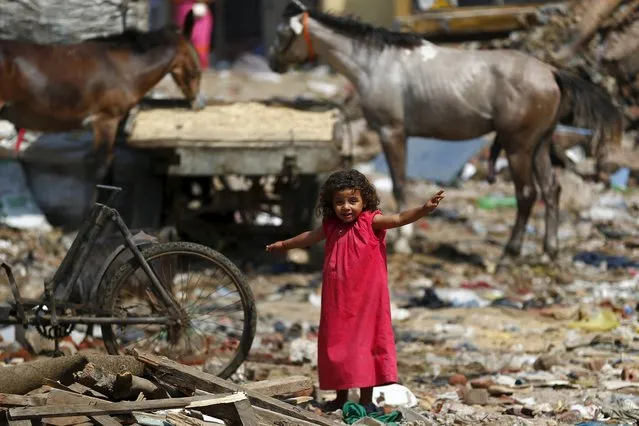
A girl plays in the Eshash el-Sudan slum in the Dokki neighbourhood of Giza, south of Cairo, Egypt September 2, 2015. (Photo by Amr Abdallah Dalsh/Reuters)

A girl plays in the Eshash el-Sudan slum in the Dokki neighbourhood of Giza, south of Cairo, Egypt September 2, 2015. Residents of the slum clashed with police in late August, when about 50 ramshackle huts were destroyed and at least 20 people were injured by teargas, local media reported, as authorities attempt to clear the area and rehouse residents. The slum dwellers, some of whom have called Eshash el-Sudan home for 50 years, say there are not enough apartments built nearby to house them. The residents of the slum eke out a living by disposing of rubbish or baking bread. Schooling is too expensive for most of their children, who play with salvaged rubbish amid shacks made out of discarded wood and leather. (Photo by Amr Abdallah Dalsh/Reuters)
Details
11 Sep 2015 12:47:00
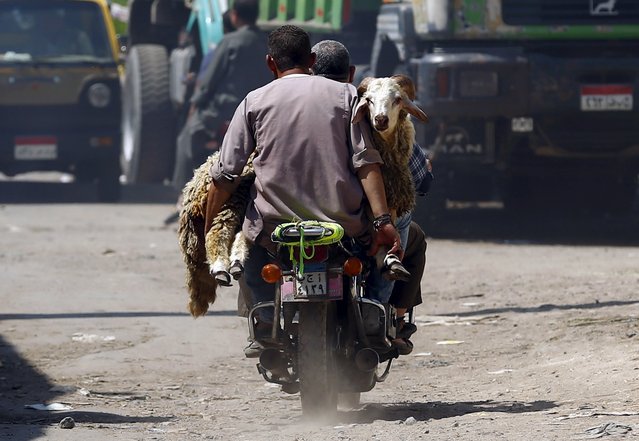
Men transport a sheep on their motorcycle after buying it at an old cattle market named “Al Emam Market” ahead of the Muslim festival Eid al-Adha in Cairo, Egypt, September 19, 2015. Muslims across the world are preparing to celebrate the annual festival of Eid al-Adha or the Festival of Sacrifice, which marks the end of the annual hajj pilgrimage, by slaughtering goats, sheep. (Photo by Amr Abdallah Dalsh/Reuters)

Men transport a sheep on their motorcycle after buying it at an old cattle market named “Al Emam Market” ahead of the Muslim festival Eid al-Adha in Cairo, Egypt, September 19, 2015. Muslims across the world are preparing to celebrate the annual festival of Eid al-Adha or the Festival of Sacrifice, which marks the end of the annual hajj pilgrimage, by slaughtering goats, sheep, cows and camels in commemoration of the Prophet Abraham's readiness to sacrifice his son to show obedience to Allah. (Photo by Amr Abdallah Dalsh/Reuters)
Details
22 Sep 2015 08:05:00
A tourist stands on the shore of a private beach in Naama Bay, Sharm el-Sheikh, south Sinai, Egypt, Sunday, November 8, 2015. Britain's foreign secretary says airport security in many cities will need to be overhauled if it is confirmed the Russian plane crash in the Sinai was caused by a bomb planted by the Islamic State group or someone inspired by the militants. (Photo by Vinciane Jacquet/AP Photo)

A tourist stands on the shore of a private beach in Naama Bay, Sharm el-Sheikh, south Sinai, Egypt, Sunday, November 8, 2015. Britain's foreign secretary says airport security in many cities will need to be overhauled if it is confirmed the Russian plane crash in the Sinai was caused by a bomb planted by the Islamic State group or someone inspired by the militants. (Photo by Vinciane Jacquet/AP Photo)
Details
10 Nov 2015 08:00:00
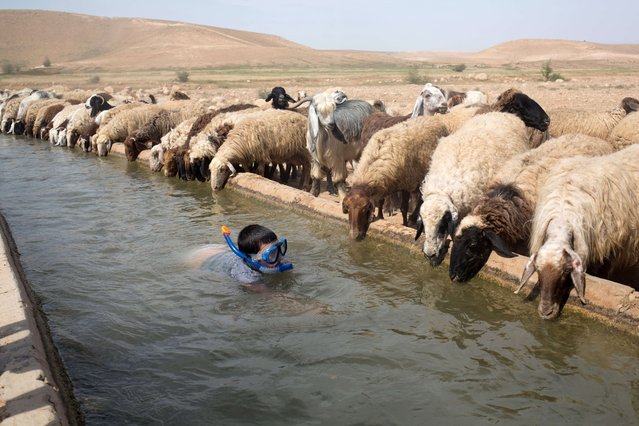
An Israeli boy swims next to sheep belonging to a Palestinian farmer in the West Bank village of Al-Auja in the Jordan Valley on April 8, 2015 during the Jewish Passover holiday. Thousands of Israelis spent the day outdoors, picnicking and touring the country during the eight-day Passover holiday, which commemorates the Israelites' exodus from Egypt some 3,500 years ago. (Photo by Menahem Kahana/AFP Photo)

An Israeli boy swims next to sheep belonging to a Palestinian farmer in the West Bank village of Al-Auja in the Jordan Valley on April 8, 2015 during the Jewish Passover holiday. Thousands of Israelis spent the day outdoors, picnicking and touring the country during the eight-day Passover holiday, which commemorates the Israelites' exodus from Egypt some 3,500 years ago. (Photo by Menahem Kahana/AFP Photo)
Details
11 Apr 2015 10:59:00
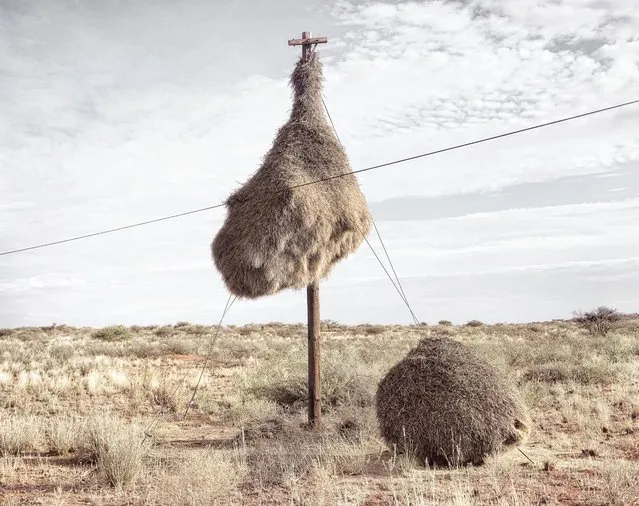
Assimilation By Dillon Marsh

Captured by South African photographer Dillon Marsh, these fantastic photographs depict the many designs employed by sociable weavers to build sturdy nests that are safe from intruders such as cobras and tree snakes. They are also nice cool during the day, and stay warm during cold desert nights. A University of Stellenbosch graduate, Marsh is currently interested in landscape photographer who seeks out anomalies that can be arranged in a photographic series. Assimilation depicts scores of intricate weaver’s nests atop utility poles in Southern Africa. Colonies of sociable weavers have been known to stay attached to one particular nest for up to 100 years, according to The San Diego Zoo.
Details
15 Feb 2014 14:47:00
Camp You Are You

"Camp You Are You (whose name has been changed to protect the privacy of the participants) offers a temporary safe haven where gender-variant boys can freely express their interpretations of femininity alongside their parents and siblings. These images represent the spirit of the children as they shine in an atmoshpere of support. Here they can be true to their inner nature without feeling the need to look over their shoulders." Lindsay Morris
Details
22 Aug 2013 11:24:00
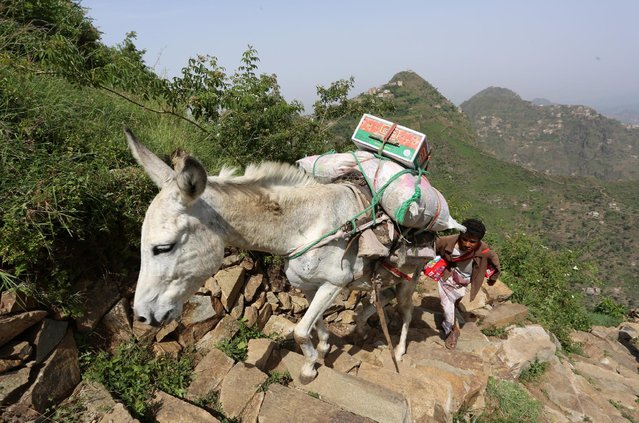
A man carries food supplies on a donkey to Dhalamlam Mountain in the Jafariya district of the western province of Raymah, Yemen June 2, 2016. (Photo by Abduljabbar Zeyad/Reuters)

A man carries food supplies on a donkey to Dhalamlam Mountain in the Jafariya district of the western province of Raymah, Yemen June 2, 2016. In villages perched high on a mountain in Western Yemen, residents are a safe distance from a conflict raging throughout most of the country but have had to turn the clock back on their lifestyles by centuries. (Photo by Abduljabbar Zeyad/Reuters)
Details
13 Sep 2016 09:23:00