Loading...
Done
Portal To Hell

If we were to burn NH4Cr2O7 with HgSCN in the Dark Ages in Europe and show it to anyone, it is us who would be burning next on a fiery cross of Inquisition. And it’s no wonder, since this experiment produces a truly marvelous result. At first, as you ignite the mixture of NH4Cr2O7 and HgSCN, all you can see is that it is slowly burning with a reddish flame. After a while, however, a crater is formed in the middle of the burning pile, and then, suddenly, tentacle-like appendages start sprouting from the burning mixture. And you can almost hear the scream of the mad occultist – “Come forth, Kraken! Come forth!” But of course, this is simply a chemical reaction that is called the "Pharoah's Serpent". It was also often sold in firework stores until people realized that it was toxic.
Details
01 Dec 2014 13:51:00


“The Rothschild Giraffe (Giraffa camelopardalis rothschildi) is among the most endangered giraffe subspecies with only a few hundred members in the wild. It is named after the famous family of the Tring Museum's founder, Lord Walter Rothschild, and is also known as the Baringo Giraffe, after the Lake Baringo area of Kenya, or as the Ugandan Giraffe. All of those that are living in the wild are in protected areas in Kenya and Uganda. (Recently it has been proposed that the Rothschild Giraffe is actually a separate species from other giraffes and not a giraffe subspecies).” – Wikipedia

Photo: Margaret, the 10-day-old Giraffestands beside Chester Zoo keeper Tim Rowlands on January 30, 2008, in Chester, England. Margaret is the first Rothschild giraffe born at the zoo. (Photo by Christopher Furlong/Getty Images)
Details
03 May 2011 11:41:00


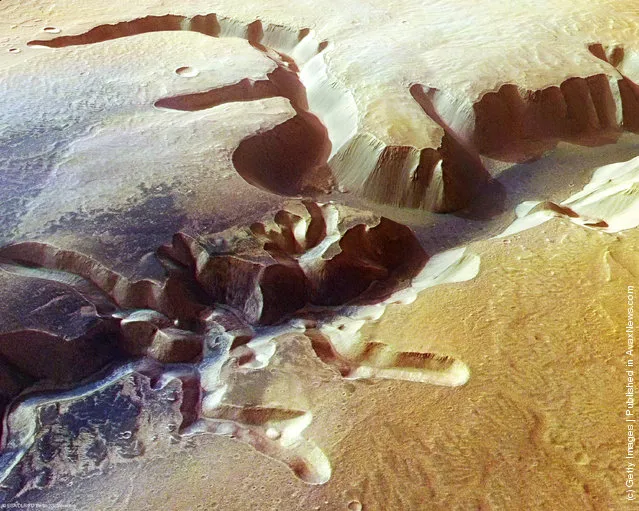
“Echus Chasma is a chasma in the Lunae Planum high plateau north of the Valles Marineris canyon system of Mars. Clay has been found in Echus Chasma that means that water once sat there for a time. Echus Chasma is approximately 100 km long and 10 km wide, with valleys ranging in depth from around 1 km to 4 km”. – Wikipedia

Photo: In this handout image supplied by the European Space Agency (ESA) on July 16, 2008, The Echus Chasma, one of the largest water source regions on Mars, is pictured from ESA's Mars Express. The data was acquired on September 25, 2005. The dark material shows a network of light-coloured, incised valleys that look similar to drainage networks known on Earth. It is still debated whether the valleys originate from precipitation, groundwater springs or liquid or magma flows on the surface. (Photo by ESA via Getty Images)
Details
18 Jul 2011 11:47:00
Tibetan Mastiff

“The Tibetan Mastiff also known as Do-khyi (variously translated as “home guard”, “door guard”, “dog which may be tied”, “dog which may be kept”), reflects its use as a guardian of herds, flocks, tents, villages, monasteries, and palaces, much as the old English ban-dog (also meaning tied dog) was a dog tied outside the home as a guardian. However, in nomad camps and in villages, the Do-khyi is traditionally allowed to run loose at night and woe be unto the stranger who walks abroad after dark”. – Wikipedia

Photo: A man displays a Tibetan Mastiff he raised during the Tibetan Mastiff exposition on April 7, 2007 in Langfang of Hebei Province, China. (Photo by China Photos/Getty Images)
Details
05 Oct 2011 14:27:00
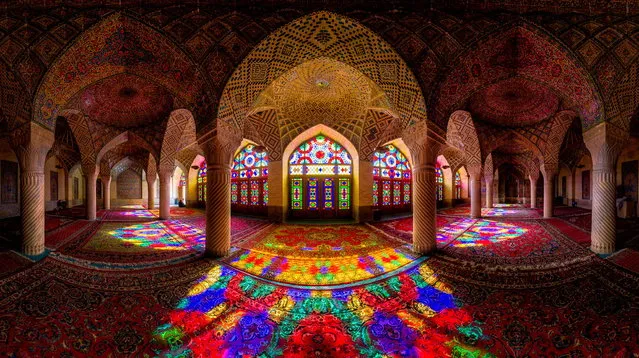
The Nasir Al-Mulk Mosque

The Nasīr al-Mulk Mosque or Pink Mosque is a traditional mosque in Shiraz, Iran, located in Goade-e-Araban place (near the famous Shah Cheragh mosque). The mosque was built during the Qājār era, and is still in use under protection by Nasir al Mulk's Endowment Foundation. It was built by the order of Mirza Hasan Ali Nasir al Molk, one of the lords of the Qajar Dynasty, in 1876 and was finished in 1888. The designers were Muhammad Hasan-e-Memar and Muhammad Reza Kashi Paz-e-Shirazi. The mosque extensively uses colored glass in its facade, and displays other traditional elements such as panj kāseh-i (five concaves) in its design, it is also named in popular culture as Pink Mosque due to the usage of beautiful pink color tiles for its interior design.
Details
26 Mar 2014 14:04:00
People fall down as they try to form a human pyramid to break the “Dahi handi”, an earthen pot filled with curd, an integral part of celebrations to mark Janmashtami in Mumbai, India, Monday, August 18, 2014. (Photo by Rafiq Maqbool/AP Photo)

People fall down as they try to form a human pyramid to break the “Dahi handi”, an earthen pot filled with curd, an integral part of celebrations to mark Janmashtami in Mumbai, India, Monday, August 18, 2014. Hindu devotees take part in the celebration in which an earthen pot is suspended high above the ground and groups of young men and children form a human pyramid to reach the pot and break it. The festival celebrates the birth of Hindu god Lord Krishna, one of the most popular gods in Hinduism. (Photo by Rafiq Maqbool/AP Photo)
Details
21 Aug 2014 09:38:00


“The Daleks are a fictional extraterrestrial race of genetically manipulated mutants from the British science fiction television series Doctor Who. Various storylines portray them as having had every emotion removed except hate, leaving them with a desire to purge the Universe of all non-Dalek life. Collectively they are the greatest enemies of the series' protagonist, the Time Lord known as the Doctor. Their famous catchphrase is “Exterminate!”, with each syllable individually synthesised in a frantic electronic voice” – Wikipedia

Photo: Max Hardy, aged 6, stands by a street sign from the Doctor Who Experience as Dalek, from the cult television show Doctor Who watches him on April 16, 2011 in London, England. The Doctor Who Experience Exhibition is currently running at Kensington Olympia Two, celebrating the science fiction programme that was originally screened in 1963. (Photo by Matthew Lloyd/Getty Images for BBC Worldwide)
Details
04 May 2011 10:47:00
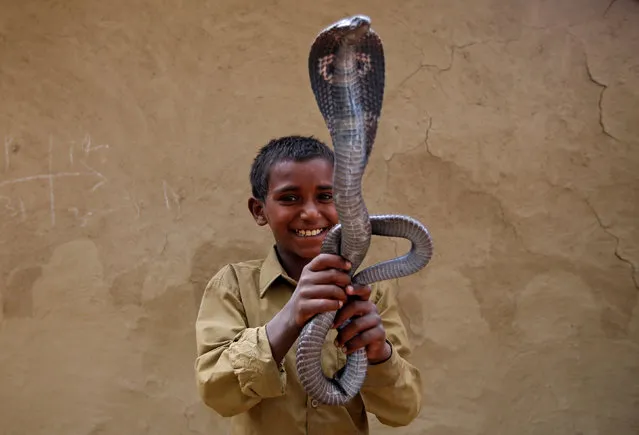
Ravi Nath poses for a photograph with a cobra snake in Jogi Dera (Snake charmers settlement), in the village of Baghpur, in the central state of Uttar Pradesh, India November 10, 2016. (Photo by Adnan Abidi/Reuters)

Ravi Nath poses for a photograph with a cobra snake in Jogi Dera (Snake charmers settlement), in the village of Baghpur, in the central state of Uttar Pradesh, India November 10, 2016. An ancient tribe of snake charmers, known as Saperas, have thrived over the generations by catching venomous snakes and making them dance to their music. Snakes are revered by Hindus in India and snake charmers are considered the followers of Lord Shiva, the blue-skinned Hindu god who is usually portrayed wearing a king cobra around his neck. (Photo by Adnan Abidi/Reuters)
Details
26 Jan 2017 13:06:00