Loading...
Done
Partially constructed notched burial plots are seen at the construction site of an underground tunnel designated for traditional Jewish burial at the Givat Shaul cemetery, on May 14, 2015, in Jerusalem, Israel. (Photo by David Vaaknin/The Washington Post)

Partially constructed notched burial plots are seen at the construction site of an underground tunnel designated for traditional Jewish burial at the Givat Shaul cemetery, on May 14, 2015, in Jerusalem, Israel. Underground cemetery being built by the Israeli Burial Society in Jerusalem due to a decrease in available land for traditional Jewish burials. (Photo by David Vaaknin/The Washington Post)
Details
21 May 2015 12:00:00
Afghan paraglider Leeda Ozori, 21, walks after practicing in Kabul, Afghanistan September 14, 2015. (Photo by Mohammad Ismail/Reuters)

Afghan paraglider Leeda Ozori, 21, walks after practicing in Kabul, Afghanistan September 14, 2015. She is one of a group of young Afghans taking to the skies of a capital where military helicopters and surveillance balloons are a far more familiar sight. Women in Afghanistan's conservative Muslim society are increasingly entering areas such as education, sports and the workplace, but most still wear the head-to-toe garment, the burqa. (Photo by Mohammad Ismail/Reuters)
Details
23 Sep 2015 08:02:00
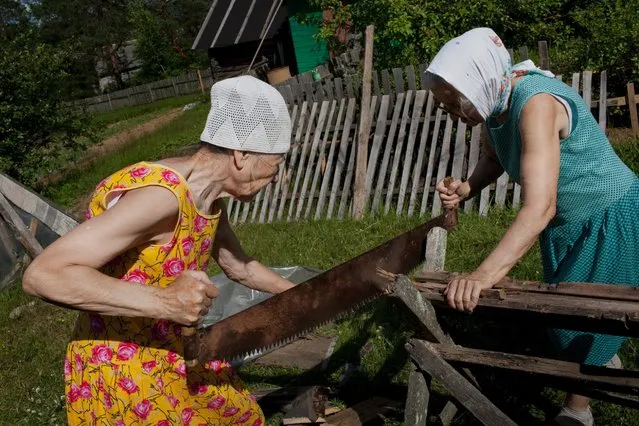
“Two-Handed Saw, 2014”. “Most of the neighbors have switched to power tools to run their households, the buzz of chain saws and weed-whackers overpowering the quieter sounds of country life, but my aunts hold on to the two-handed saw that's decades old, the sickle and scythe that need to be sharpened and polished after each use, the old axe that's becoming heavier each year. Each of these objects is familiar, holding memories of their brother, who succumbed to cancer a few years ago, of days before my grandfather lost his vision in the 50's, of busier days and longer futures”, Sablin told. (Photo by Nadia Sablin)

In northwest Russia, in a small village called Alekhovshchina, Nadia Sablin's aunts spend the warmer months together in the family home and live as the family has always lived, chopping wood to heat the house and making their own clothes. Sablin's book of photographs, “Aunties: The Seven Summers of Alevtina and Ludmila”, is published by Duke University Press. Here: “Two-Handed Saw, 2014”. (Photo by Nadia Sablin)
Details
25 Feb 2016 12:12:00
Lasha Pataraia pulls a truck, which weighs 8,250kg (8 tons), with his ear during an event to break the Guinness Book of World Records in Rustavi, outside Tbilisi November 29, 2012. The 32-year-old broke a Guinness record after he managed to pull the truck with his ear for 21,50 metres (70.5 feet), according to organisers. REUTERS/Irakli Gedenidze (GEORGIA - Tags: SOCIETY TPX IMAGES OF THE DAY)

Lasha Pataraia pulls a truck, which weighs 8,250kg (8 tons), with his ear during an event to break the Guinness Book of World Records in Rustavi, outside Tbilisi November 29, 2012. The 32-year-old broke a Guinness record after he managed to pull the truck with his ear for 21,50 metres (70.5 feet), according to organisers. (Photo by Irakli Gedenidze/Reuters)
Details
01 Dec 2012 08:27:00
The maned wolf is among the large mammals in the Brazilian Cerrado that are threatened by the increasing conversion of grasslands into farmland for grazing and growing crops. (Photo by Ben Cranke/Nature Picture Library/Alamy Stock Photo)

Global wildlife populations will decline by 67% by 2020 unless urgent action is taken to reduce human impact on species and ecosystems, warns the biennial Living Planet Index report from WWF (World Wide Fund for Nature) and ZSL (Zoological Society of London). From elephants to eels, here are some of the wildlife populations most affected by human activity. Here: The maned wolf is among the large mammals in the Brazilian Cerrado that are threatened by the increasing conversion of grasslands into farmland for grazing and growing crops. (Photo by Ben Cranke/Nature Picture Library/Alamy Stock Photo)
Details
28 Oct 2016 10:47:00
Gravel Workmen of Chittagong, Bangladesh, by Faisal Azim. Gravel workmen look through a glass window at a gravel-crushing yard in Chittagong. Full of dust and sand, it is an extremely unhealthy environment for working, but still hundreds of people work here for their livelihoods. (Photo by Faisal Azim/2016 Atkins CIWEM Environmental Photographer of the Year)

From Tibetan monks playing basket ball with ice thawing high up in the Himalayas, to the pollution that hides behind the Taj Mahal, here’s pick from 60 exceptional environmental photographs, by photographers and filmmakers from 70 countries, that will go on show at the Royal Geographical Society in London from 29 June to 21 August. The winners will be announced on 28 June. Here: Gravel Workmen of Chittagong, Bangladesh, by Faisal Azim. Gravel workmen look through a glass window at a gravel-crushing yard in Chittagong. Full of dust and sand, it is an extremely unhealthy environment for working, but still hundreds of people work here for their livelihoods. (Photo by Faisal Azim/2016 Atkins CIWEM Environmental Photographer of the Year)
Details
01 Jun 2016 12:25:00
Brtukan. “Being a girl of colour in a society where the majority of the people are white, I have had to get used to all the different ways people approach me. From being asked what kind of rap music you listen to and how you wash your hair, to getting told, “you don’t sound black”, “you’re pretty for a black girl” or “you’re not that black so it’s OK”, as if being black is such a bad thing”. (Photo by Lisa Minogue/The Guardian)

As part of FLAIR Melbourne – a Flinders Lane art festival – Melbourne’s Lisa Minogue presents stylised photographic portraits of Australian women of colour, their faces painted vibrantly to accentuate their individuality and encourage the viewer to study each face more closely. Minogue asked each woman the same question: “What do the words “coloured girl” mean to you?”. (Photo by Lisa Minogue/The Guardian)
Details
17 Aug 2016 11:16:00
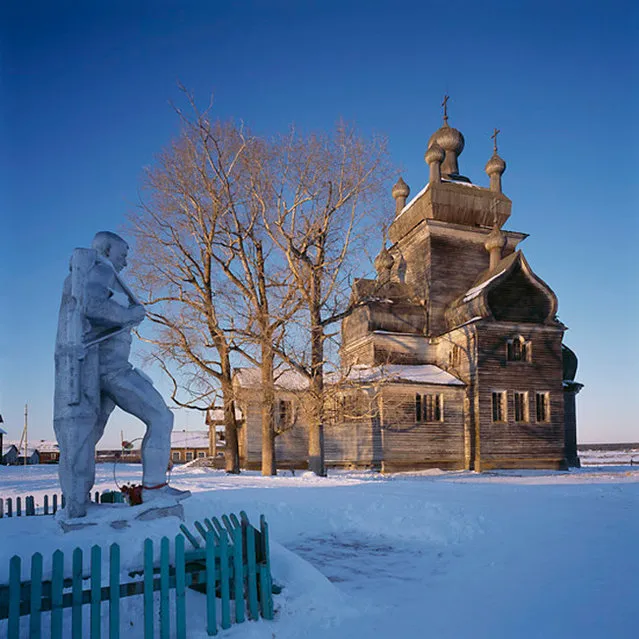
Wooden Churches - Travelling In The Russian North By Richard Davies Part 2

While communism, collectivism, worms, dry rot and casual looting failed to destroy the majestic wooden churches of Russia, it may be ordinary neglect that finally does them in. Dwindled now to several hundred remaining examples, these glories of vernacular architecture lie scattered amid the vastness of the world’s largest country. Just over a decade ago, Richard Davies, a British architectural photographer, struck out on a mission to record the fragile and poetic structures. Austerely beautiful and haunting, “Wooden Churches: Traveling in the Russian North” (White Sea Publishing; $132) is the result. Covering thousands of miles, Mr. Davies described how he and the writer Matilda Moreton tracked down the survivors from among the thousands of onion-domed structures built after Prince Vladimir converted to Christianity in 988.

See also: Wooden Churches Part1
Details
28 Nov 2013 12:13:00