Loading...
Done
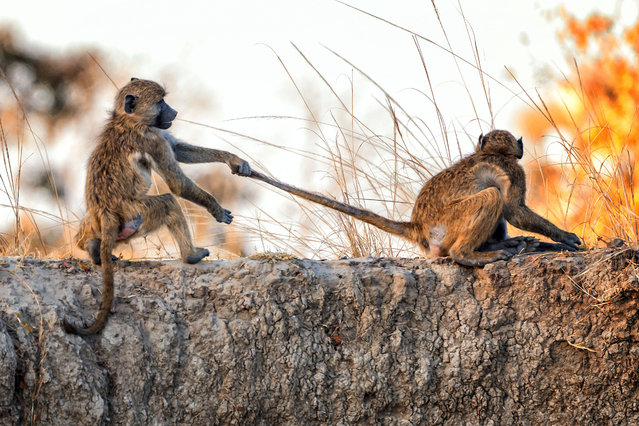
Going toe-to-toe, these fighting primates could give Floyd Mayweather a run for his money. The amazing images – captured by Australian tourist Julie Rathbone on the banks of the Zambezi river in Africa – show the pair engaging in a few fisticuffs. The Chacma baboons appeared to settle a disagreement by fighting - before a senior baboon plays referee and steps in to break it up. Nurse unit manager Julie Rathbone, 59, from New South Wales, was on a cruise down the river when she spotted the fracas unfolding. (Photo by Julie Rathbone/Caters News)

Going toe-to-toe, these fighting primates could give Floyd Mayweather a run for his money. The amazing images – captured by Australian tourist Julie Rathbone on the banks of the Zambezi river in Africa – show the pair engaging in a few fisticuffs. The Chacma baboons appeared to settle a disagreement by fighting – before a senior baboon plays referee and steps in to break it up. Nurse unit manager Julie Rathbone, 59, from New South Wales, was on a cruise down the river when she spotted the fracas unfolding. (Photo by Julie Rathbone/Caters News)
Details
28 Mar 2015 12:05:00
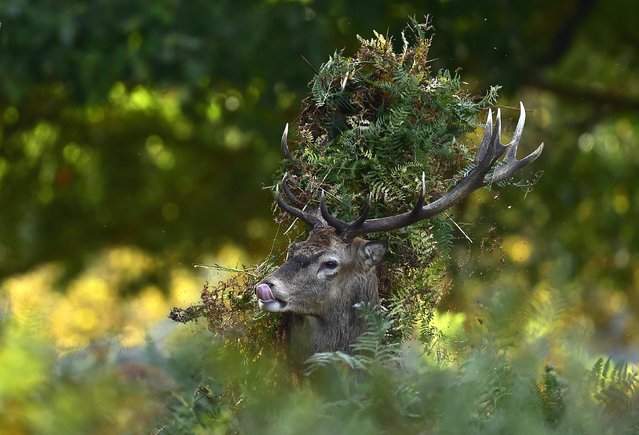
A male red deer with antlers covered in bracken, walks through undergrowth in Richmond Park in south west London, October 3, 2014. Over 600 red and fallow deer roam in the largest of London's Royal Parks, and have their numbers managed in an annual cull each November and February. (Photo by Toby Melville/Reuters)

A male red deer with antlers covered in bracken, walks through undergrowth in Richmond Park in south west London, October 3, 2014. Over 600 red and fallow deer roam in the largest of London's Royal Parks, and have their numbers managed in an annual cull each November and February. (Photo by Toby Melville/Reuters)
Details
04 Oct 2014 12:17:00
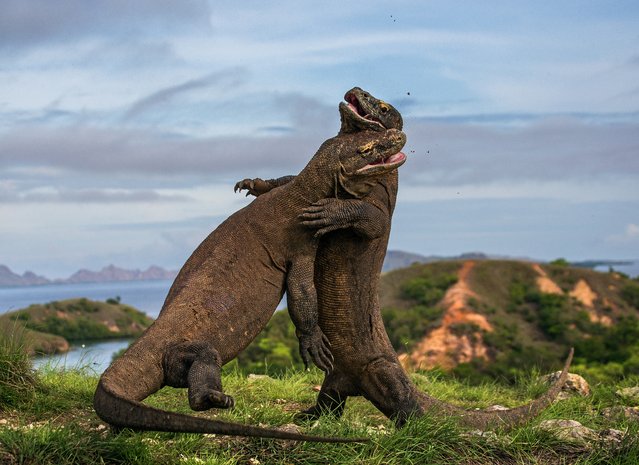
Komodo Judo by Andrey Gudkov. Finalist, Amphibians & Reptiles. Two large male Komodo dragons hissing angrily at each other in Indonesia’s Komodo national park. Komodo dragons can grow up to 8ft. (Photo by Andrey Gudkov/Wildlife Photographer of the Year 2015)

Komodo Judo by Andrey Gudkov. Finalist, Amphibians & Reptiles. Two large male Komodo dragons hissing angrily at each other in Indonesia’s Komodo national park. Komodo dragons can grow up to 8ft. (Photo by Andrey Gudkov/Wildlife Photographer of the Year 2015)
Details
16 Nov 2015 08:15:00
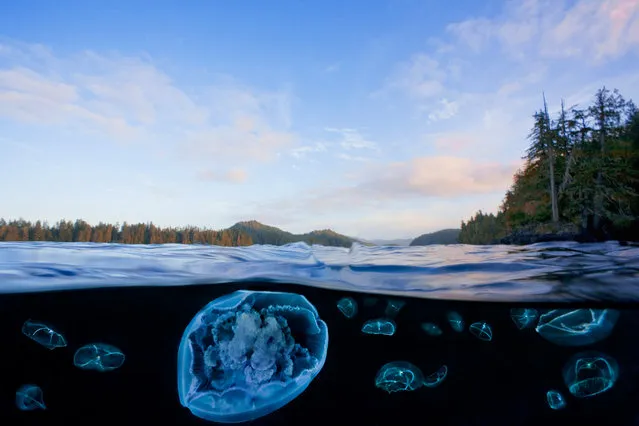
Moon jellyfish and cross jellies. (Photo by David Hall)

David Hall’s photographs of scenery and creatures off the coast of Canada in the Pacific Northwest portray serenity under the water, which belie the extreme challenges he faces to get his images. For each shoot, Hall wears a dry suit, a neoprene body suit that covers all of his body but his head and traps air inside to keep him warm. Water temperature in Canada’s British Columbia typically ranges between 45 and 50 degrees Fahrenheit. Photo: Moon jellyfish and cross jellies. (Photo by David Hall)
Details
16 Sep 2014 12:57:00
Lola is seen at left in everyday clothes – and then at right in her work clothes. She works as a clown in Paris. (Photo by Bruno Fert/Picturetank)

“The series of photos called Workwears, by French photographer Bruno Fert, visually juxtaposes people’s private lives with their lives at work. A firefighter, a fisherman, a nurse, a diver, a judge. One by one, Fert’s photos show people in their homes wearing everyday clothing – followed by another photo showing them dressed in the clothing of their chosen professions. Our reaction, Fert said, reminds us how tightly humans hold on to certain stereotypes about some professions. “I like to break those stereotypes”, he said”. – Thom Patterson via CNN. Here: Lola is seen at left in everyday clothes – and then at right in her work clothes. She works as a clown in Paris. (Photo by Bruno Fert/Picturetank)
Details
29 Oct 2014 12:40:00
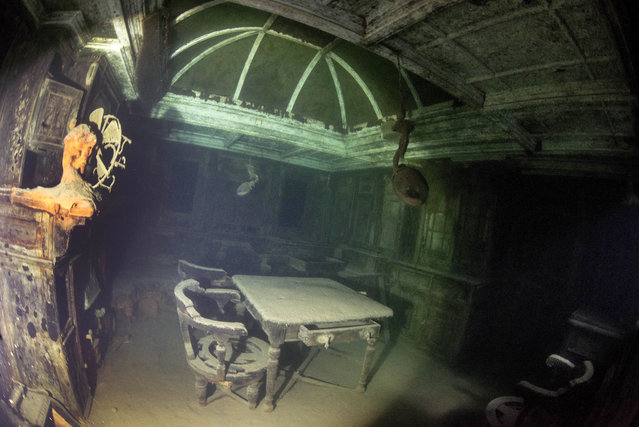
Not many divers visit the Gunilda, due to its remote location, depths of 270 feet, and chilly (38 degrees F/3 degrees C) temperatures. (Photo by Becky Kagan Schott/Caters News Agency)

These stunning images reveal the remains of a more than century-old sunken ship that has been preserved beneath freezing Lake Superior. The ship looks almost exactly the same as it did the day it sunk beneath waves all those years ago. At 60 meters long (approximately 198 feet), the «Gunilda» sunk after it struck some rocks and was not saved. Now, these stunning images have been captured 107 years after the sinking when a small group of divers revisited the vessel. (Photo by Becky Kagan Schott/Caters News Agency)
Details
25 Apr 2018 00:01:00
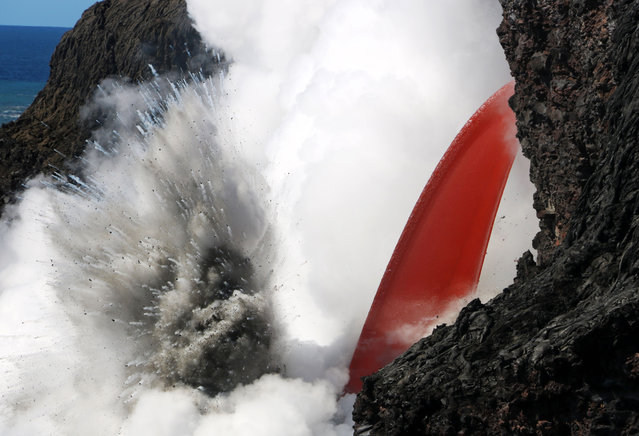
This image obtained January 31, 2017 from the US Geological Survey's Hawaiian Volcano Observatory showing a  lava stream, pouring out of the lava tube on the sea cliff at the Kamokuna ocean entry from the Kilauea Volcano on January 29. (Photo by AFP Photo/USGS)

This image obtained January 31, 2017 from the US Geological Survey's Hawaiian Volcano Observatory showing a lava stream, pouring out of the lava tube on the sea cliff at the Kamokuna ocean entry from the Kilauea Volcano on January 29. (Photo by AFP Photo/USGS)
Details
01 Feb 2017 10:21:00
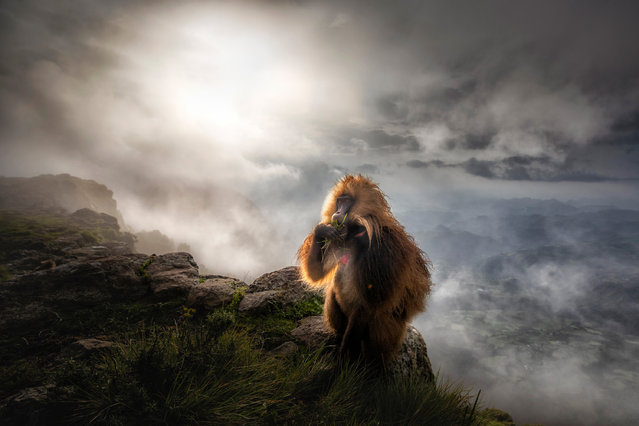
Highly commended, mammals: Gelada after the storm – Marco Gaiotti (Italy). “Gelada baboons are the only monkey species in the world that feed on grasses. They are native to the tableland of Ethiopia. Every morning large family groups wander from their sleeping places in the steep rock face, up to 1,000 metres high, to the feeding grounds at the tablelands. This image clearly depicts their feeding strategy: they pull out bunches of grass, sort the stalks and then lift them to their mouth. This shot was taken towards the end of the rainy season after a heavy storm”. (Photo by Marco Gaiotti/2019 GDT European Wildlife Photographer of the Year)

Highly commended, mammals: Gelada after the storm – Marco Gaiotti (Italy). “Gelada baboons are the only monkey species in the world that feed on grasses. They are native to the tableland of Ethiopia. Every morning large family groups wander from their sleeping places in the steep rock face, up to 1,000 metres high, to the feeding grounds at the tablelands. This image clearly depicts their feeding strategy: they pull out bunches of grass, sort the stalks and then lift them to their mouth. This shot was taken towards the end of the rainy season after a heavy storm”. (Photo by Marco Gaiotti/2019 GDT European Wildlife Photographer of the Year)
Details
31 Oct 2019 00:03:00