Loading...
Done
Maurice Heesen Photography  Death With Smile

We only fear death because we don’t know what is there. It’s better to keep laughing in life until we meet death.
Details
11 Oct 2012 09:47:00
The anthropometric record card of Sarah Giles, a servant who was convicted of stealing in 1897, on display making up part of a mosaic of cards on a table top during a press preview for the Crime Museum Uncovered exhibition at the Museum of London in the City of London, Wednesday, October 7, 2015. (Photo by Alastair Grant/AP Photo)

The anthropometric record card of Sarah Giles, a servant who was convicted of stealing in 1897, on display making up part of a mosaic of cards on a table top during a press preview for the Crime Museum Uncovered exhibition at the Museum of London in the City of London, Wednesday, October 7, 2015. Drawn from Scotland Yard's private collection, the show charts more than a century of violence and suffering, from the murders of Jack the Ripper to IRA and al-Qaida bombings. But it also celebrates the brains, bravery and scientific advances that helped catch perpetrators and solve crimes. (Photo by Alastair Grant/AP Photo)
Details
11 Oct 2015 08:00:00


A Funnel Web spider is pictured at the Australian Reptile Park January 23, 2006 in Sydney, Australia. The Funnel Web is one of Australia's deadliest animals, with a venom that is packed with at least 40 different toxic proteins. A bite from a Funnel Web causes massive electrical over-load in the body's nervous system. Finally, fatalities occur from either heart attack or a pulmonary oedema, where the capillaries around the lungs begin to leak fluid and the patient effectively drowns. Death can come as quickly as two hours after a bite if no medical treatment is sought. Due to advances in anti-venom, there has been no death from a Funnel Web bite in Australia since 1980. Australia is home to some of the most deadly and poisonous animals on earth. (Photo by Ian Waldie/Getty Images)
Details
25 Apr 2011 07:49:00
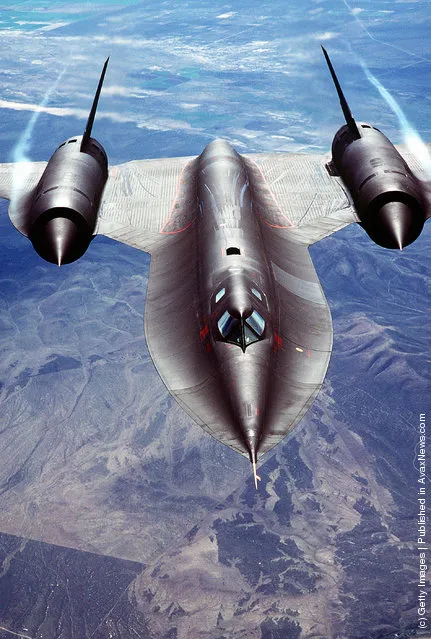
A U.S. Air Force SR-71A, also known as the Blackbird, is put through it's paces during a test flight

“The Lockheed SR-71 “Blackbird” was an advanced, long-range, Mach 3+ strategic reconnaissance aircraft. It was developed as a black project from the Lockheed A-12 reconnaissance aircraft in the 1960s by the Lockheed Skunk Works. Clarence “Kelly” Johnson was responsible for many of the design's innovative concepts. During reconnaissance missions the SR-71 operated at high speeds and altitudes to allow it to outrace threats. If a surface-to-air missile launch was detected, the standard evasive action was simply to accelerate and outrun the missile”. – Wikipedia

Photo: A U.S. Air Force SR-71A, also known as the “Blackbird”, is put through it's paces during a test flight over Beale Air Force Base in California. The aircraft is a strategic reconnaissance plane by Lockheed and is the world's fastest and highest flying operational aircraft. (Photo by Getty Images)
Details
07 Sep 2011 12:17:00
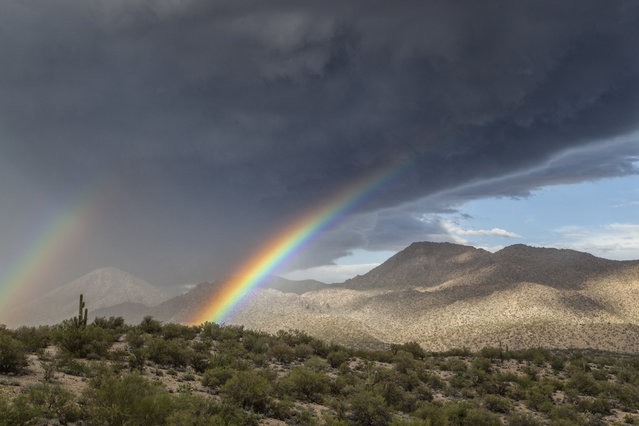
Two rainbows emerge from a black storm above the mountains, on August 19, 2014, in Kingman, Arizona.  Double tornadoes, lightning storms and rotating supercells – this is what it's like to chase storms for a year.(Photo by Roger Hill/Barcroft Media)

Two rainbows emerge from a black storm above the mountains, on August 19, 2014, in Kingman, Arizona. Double tornadoes, lightning storms and rotating supercells – this is what it's like to chase storms for a year. These dramatic images show apocalyptic weather throughout 2014 from a lightning storm to a pair of rainbows. Roger Hill, 57, has been chasing storms in the United States for thirty years and runs a tour operation with his wife Caryn. His favourite photograph of the year was also one of the most difficult to get – as two violent tornadoes tore through Pilger, Nebraska on June 16. The spiraling winds killed a five-year-old girl and injured at least 19 others, and as Roger tried to get the perfect shot debris began to rain down on his car. (Photo by Roger Hill/Barcroft Media)
Details
25 Feb 2015 09:27:00
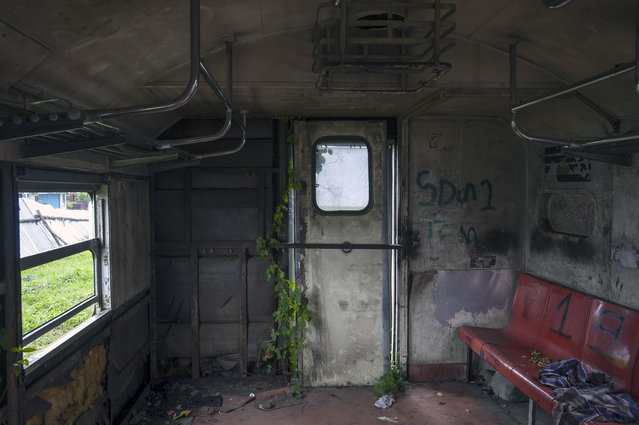
The carriages have decayed over time, on February 27, 2015, in Purwakarta, Indonesia. Dozens of trains are stacked on top of each other in what looks like a post-apocalyptic world. The old electric trains that travelled in and out of Jakarta, Indonesia, are weathered and decayed over time. The trains were used everyday since the 1980s and carried thousands of people to work. (Photo by HKV/Barcroft Media)

The carriages have decayed over time, on February 27, 2015, in Purwakarta, Indonesia. Dozens of trains are stacked on top of each other in what looks like a post-apocalyptic world. The old electric trains that travelled in and out of Jakarta, Indonesia, are weathered and decayed over time. The trains were used everyday since the 1980s and carried thousands of people to work. Now the carriages, which were once the lifeblood of public transport in the south-Asian city, have been left to rust among shrubbery. (Photo by HKV/Barcroft Media)
Details
21 Apr 2015 11:13:00
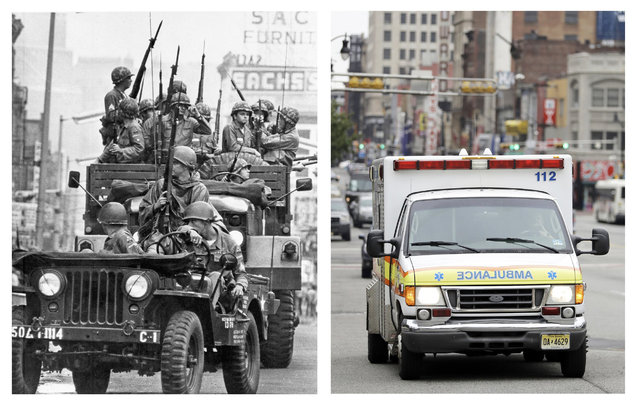
In a July 14, 1967 file photo, left, National Guardsmen make their way along Market Street in Newark, N.J, after an evening of deadly rioting and looting in what came to be known as the Newark riots. In a June 16, 2017 photo, right, an ambulance drives on the same block 50 years later. (Photo by AP Photo/File, left; Julio Cortez, right)


In a July 14, 1967 file photo, left, National Guardsmen make their way along Market Street in Newark, N.J, after an evening of deadly rioting and looting in what came to be known as the Newark riots. In a June 16, 2017 photo, right, an ambulance drives on the same block 50 years later. (Photo by AP Photo/File, left; Julio Cortez, right)

Details
14 Jul 2017 07:21:00
The following “Utopian Tours” drawings are conceptual images of what tourism in North Korea might one day look like, created by North Korean architects. The images, curated by Nick Bonner, are on view as part of the exhibition at the Venice Architecture Biennale in the Korean Pavilion. Bonner runs the Beijing-based Koryo Tours – a company that organizes tours of outsiders into North Korea. (Photo by Nick Bonner/Kyle Vanhemert/Venice Architecture Biennale)

At this year’s Venice Bienniale in Italy, the Korean pavilion has a curious exhibit called “Commissions for Utopia”. It includes renderings from North Korea’s top architects and artists (all anonymous), many of whom studied at the Paekho Institute of Architecture, North Korea’s state-run architectural college, and none of whom have ever left the country. They were asked to create a vision of North Korea’s future sustainable architecture for its expanding tourism industry. Their final products are a glimpse into what it would be like to envision the future after being entirely cut off from the present for almost 70 years. (Photo by Nick Bonner/Kyle Vanhemert/Venice Architecture Biennale)
Details
08 Aug 2014 11:03:00