Loading...
Done
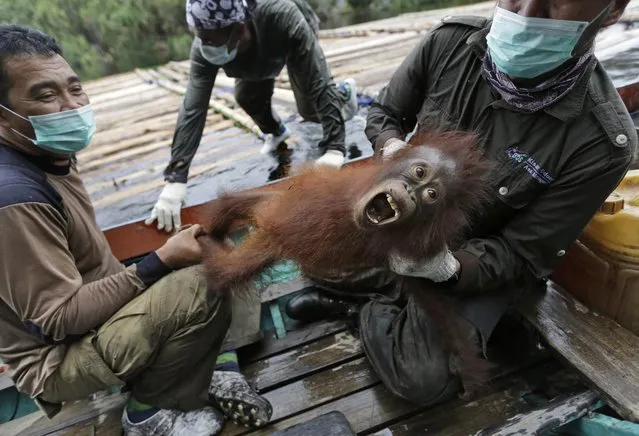
In this January 7, 2016, photo, conservationists of Borneo Orangutan Survival Foundation hold a baby orangutan rescued along with its mother during a rescue and release operation for orangutans trapped in a swath of jungle in Sungai Mangkutub, Central Kalimantan, Indonesia. Last year's forest fires drove orangutans closer to the river bank, where they had to live in an over-populated swath of forest as thin as 30 meters wide along the river. (Photo by Dita Alangkara/AP Photo)

In this January 7, 2016, photo, conservationists of Borneo Orangutan Survival Foundation hold a baby orangutan rescued along with its mother during a rescue and release operation for orangutans trapped in a swath of jungle in Sungai Mangkutub, Central Kalimantan, Indonesia. Last year's forest fires drove orangutans closer to the river bank, where they had to live in an over-populated swath of forest as thin as 30 meters wide along the river. (Photo by Dita Alangkara/AP Photo)
Details
25 Jan 2016 11:36:00
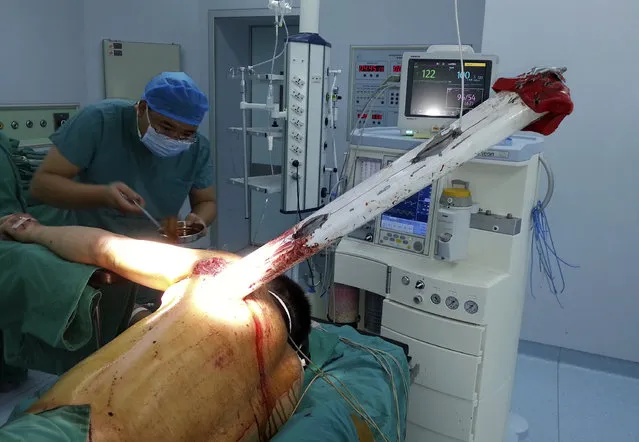
A doctor performs surgery on an injured man with a part of an aluminium alloy fence through his chest after a car accident in Zhumadian, Henan province, China, September 15, 2014. The doctor managed to surgically remove the piece. (Photo by Reuters/Stringer)

A doctor performs surgery on an injured man with a part of an aluminium alloy fence through his chest after a car accident in Zhumadian, Henan province, China, September 15, 2014. The doctor managed to surgically remove the piece. (Photo by Reuters/Stringer)
Details
20 Sep 2014 10:59:00
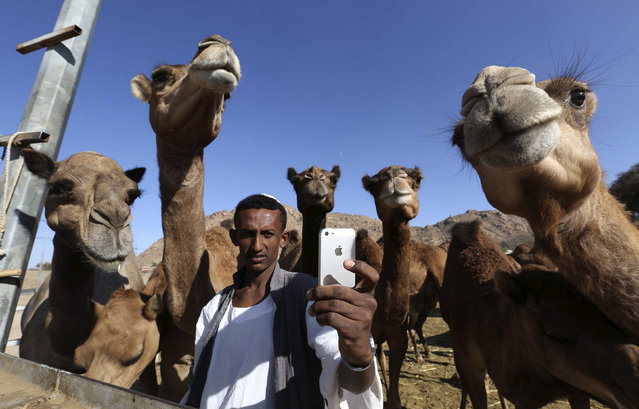
A man takes a “selfie” with camels at a farm in Taif November 1, 2014. Saudi Arabia said late on Wednesday it had detected six new cases of the deadly Middle East Respiratory Syndrome (MERS) in 24 hours, the biggest daily jump for months with officials blaming lax hospital procedures. (Photo by Mohamed Alhwaity/Reuters)

A man takes a “selfie” with camels at a farm in Taif November 1, 2014. Saudi Arabia said late on Wednesday it had detected six new cases of the deadly Middle East Respiratory Syndrome (MERS) in 24 hours, the biggest daily jump for months with officials blaming lax hospital procedures. Scientists are not sure of the origin of the virus, but several studies have linked it to camels and some experts think it is being passed to humans through close physical contact or through the consumption of camel meat or camel milk. (Photo by Mohamed Alhwaity/Reuters)
Details
08 Nov 2014 12:33:00
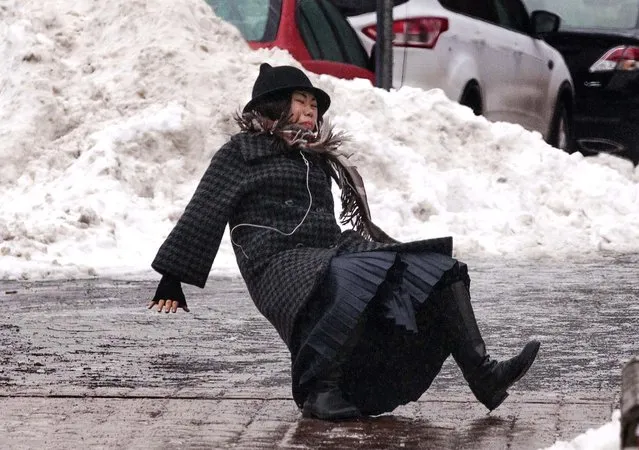
A woman falls while slipping on ice during freezing rain on Roosevelt Island, a borough of Manhattan, in New York January 5, 2014. New York City was hit on Friday by the first severe winter storm of 2014 and was still in the grip of sub-freezing weather on Sunday morning. The woman got up and walked away from the fall. (Photo by Zoran Milich/Reuters)

A woman falls while slipping on ice during freezing rain on Roosevelt Island, a borough of Manhattan, in New York January 5, 2014. New York City was hit on Friday by the first severe winter storm of 2014 and was still in the grip of sub-freezing weather on Sunday morning. The woman got up and walked away from the fall. (Photo by Zoran Milich/Reuters)
Details
07 Jan 2014 08:49:00
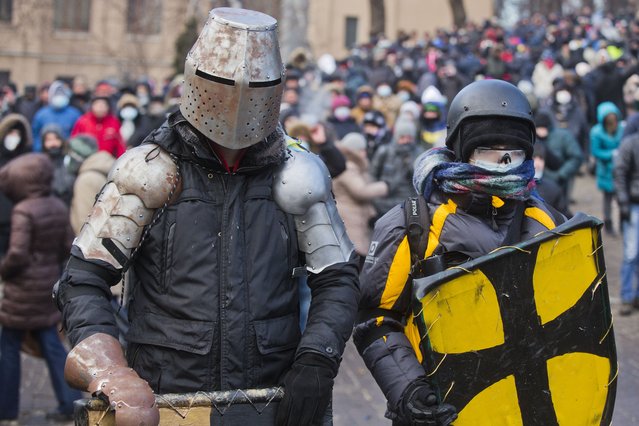
Protesters clad in improvised protective gear prepare for a clash with police in central Kiev, Ukraine, Monday, January 20, 2014. After a night of vicious streets battles, anti-government protesters and police clashed anew Monday in the Ukrainian capital Kiev. (Photo by Evgeny Feldman/AP Photo)

Protesters clad in improvised protective gear prepare for a clash with police in central Kiev, Ukraine, Monday, January 20, 2014. After a night of vicious streets battles, anti-government protesters and police clashed anew Monday in the Ukrainian capital Kiev. (Photo by Evgeny Feldman/AP Photo)
Details
21 Jan 2014 11:23:00
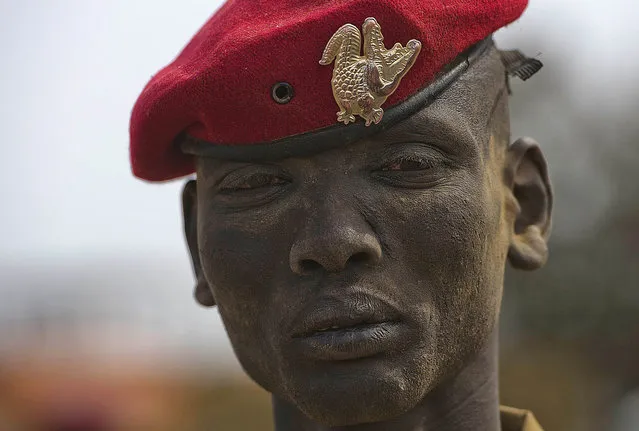
A South Sudanese People Liberation Army (SPLA) soldier patrols the streets in Malakal on January 21, 2014. (Photo by Harrison Ngethi/AFP Photo)

A South Sudanese People Liberation Army (SPLA) soldier patrols the streets in Malakal on January 21, 2014. (Photo by Harrison Ngethi/AFP Photo)
Details
26 Jan 2014 12:48:00
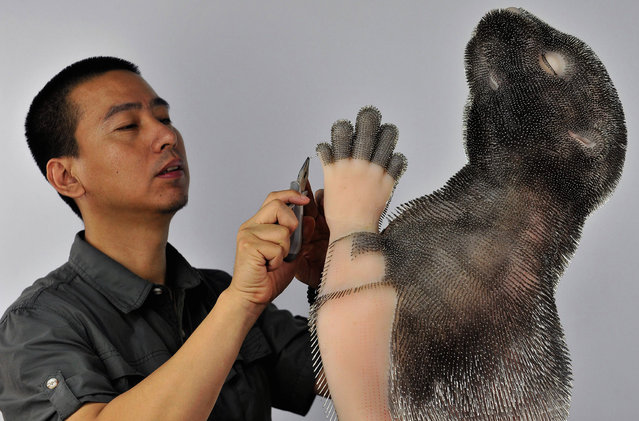
Professor Xie Yong works on an art installation of a beaver, which is made out of plastic and around 300,000 needles, in Shenyang, Liaoning province, July 23, 2013. The needles, according to Xie, represent the pain felt by animals when their fur is taken off to produce clothing. (Photo by Reuters/Stringer)

Professor Xie Yong works on an art installation of a beaver, which is made out of plastic and around 300,000 needles, in Shenyang, Liaoning province, July 23, 2013. The needles, according to Xie, represent the pain felt by animals when their fur is taken off to produce clothing. (Photo by Reuters/Stringer)
Details
27 Jul 2013 09:15:00
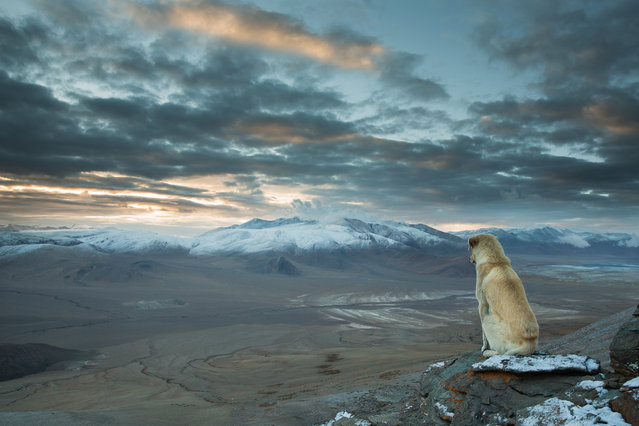
“Himalayan Dog”. This dog just appeared out of nowhere and followed us for an entire week during our trekking trip in the Himalayan outback. He always used to sleep in front of our tent and guarded us in the nights. When I decided to get up at 4 a.m. to climb the next 5000 m peak for sunrise he accompanied me as well. On the top he was sitting for the entire 30 minutes on this place looking straight into the countryside. Photo location: Ladakh, India. (Photo and caption by Sebastian Wahlhuetter/National Geographic Photo Contest)

“Himalayan Dog”. This dog just appeared out of nowhere and followed us for an entire week during our trekking trip in the Himalayan outback. He always used to sleep in front of our tent and guarded us in the nights. When I decided to get up at 4 a.m. to climb the next 5000 m peak for sunrise he accompanied me as well. On the top he was sitting for the entire 30 minutes on this place looking straight into the countryside. Photo location: Ladakh, India. (Photo and caption by Sebastian Wahlhuetter/National Geographic Photo Contest)
Details
01 Apr 2014 10:47:00