Loading...
Done
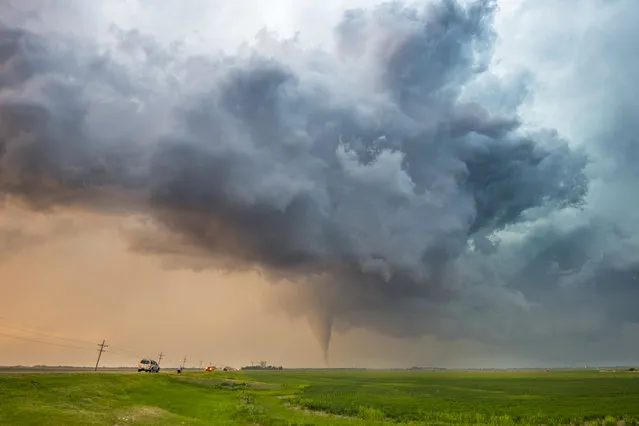
“The Sunsetter”. An EF-4 tornado rips through the open space of farmland near Rozel, Kansas. This tornado moves slowly but powerful towards the setting sun an gets its beautiful color right before sunset. Storm Chasers are spotting on the left side. Photo location: Rozel, Kansas. (Photo and caption by Dennis Oswald/National Geographic Photo Contest)

“The Sunsetter”. An EF-4 tornado rips through the open space of farmland near Rozel, Kansas. This tornado moves slowly but powerful towards the setting sun an gets its beautiful color right before sunset. Storm Chasers are spotting on the left side. Photo location: Rozel, Kansas. (Photo and caption by Dennis Oswald/National Geographic Photo Contest)

ATTENTION! All pictures are presented in high resolution. To see Hi-Res images – just TWICE click on any picture. In other words, click small picture – opens the BIG picture. Click BIG picture – opens VERY BIG picture.
Details
01 Dec 2013 11:03:00
On August 31, 2012, a long filament of solar material that had been hovering in the sun's atmosphere, the corona, erupted out into space at 4:36 p.m. EDT. The coronal mass ejection, or CME, traveled at over 900 miles per second. The CME did not travel directly toward Earth, but did connect with Earth's magnetic environment, or magnetosphere, causing aurora to appear on the night of Monday, September 3. (Photo by NASA/GSFC/SDO)

On August 31, 2012, a long filament of solar material that had been hovering in the sun's atmosphere, the corona, erupted out into space at 4:36 p.m. EDT. The coronal mass ejection, or CME, traveled at over 900 miles per second. The CME did not travel directly toward Earth, but did connect with Earth's magnetic environment, or magnetosphere, causing aurora to appear on the night of Monday, September 3. (Photo by NASA/GSFC/SDO via The Atlantic)
Details
14 Sep 2012 09:01:00
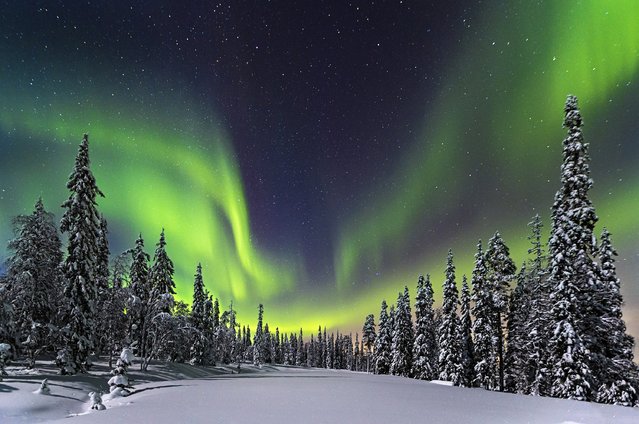
“Forest lights”. Aurora Borealis over the forest of the Pyhae Luosto National Park, Finland. (Photo and caption by Nicholas Roemmelt/National Geographic Traveler Photo Contest)

The 26th annual National Geographic Traveler Photo Contest is now accepting submissions. Official categories include: “Travel Portraits”, “Outdoor Scenes”, “Sense of Place” and “Spontaneous Moments”. The contest is accepting entries until June 30. Photo: “Forest lights”. Aurora Borealis over the forest of the Pyhae Luosto National Park, Finland. (Photo and caption by Nicholas Roemmelt/National Geographic Traveler Photo Contest)
Details
30 Mar 2014 08:02:00
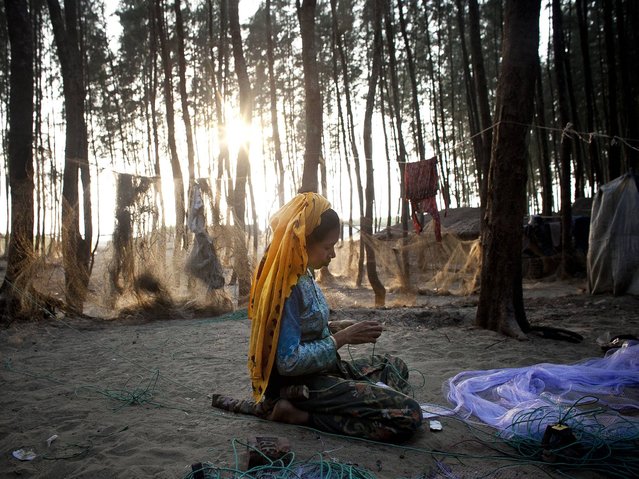
32 year old Mahada Khatum repairs a fishing net outside her home in the Shamalapur Rohingya refugee settlement in Chittagong district. Some years ago she escaped violence and discrimination from the Zomgara Baharchara village in the Meherulla district of Myanmar. (Photo by Getty Images/Stringer)

32 year old Mahada Khatum repairs a fishing net outside her home in the Shamalapur Rohingya refugee settlement on April 11, 2014 in Chittagong district, Bangladesh. Some years ago she escaped violence and discrimination from the Zomgara Baharchara village in the Meherulla district of Myanmar. (Photo by Getty Images/Stringer)
Details
20 Apr 2014 09:30:00
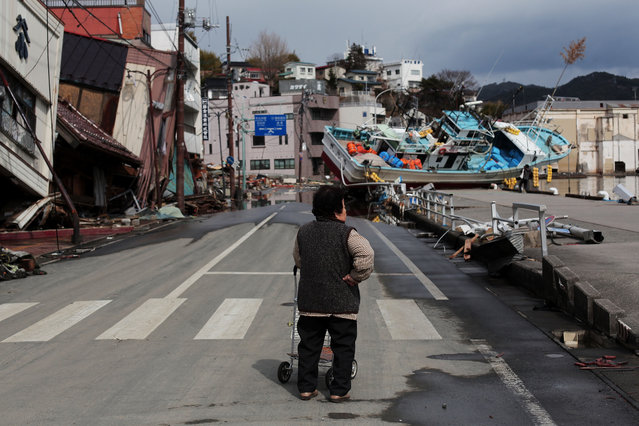
A woman surveys the damage after the earthquake on March 17, 2011 in Kensennuma, Japan. Residents were allowed back to their homes today and began the massive cleanup operation caused by a 9.0 magnitude strong earthquake that struck on March 11 off the coast of north-eastern Japan. The quake triggered a tsunami wave of up to 10 metres which engulfed large parts of north-eastern Japan. The death toll has risen past 5000 with at least 8600 people still missing. (Photo by Chris McGrath/Getty Images)

A woman surveys the damage after the earthquake on March 17, 2011 in Kensennuma, Japan. Residents were allowed back to their homes today and began the massive cleanup operation caused by a 9.0 magnitude strong earthquake that struck on March 11 off the coast of north-eastern Japan. The quake triggered a tsunami wave of up to 10 metres which engulfed large parts of north-eastern Japan. The death toll has risen past 5000 with at least 8600 people still missing. (Photo by Chris McGrath/Getty Images)
Details
13 Mar 2017 00:05:00
Revellers attend the Victorian Picnic during the Wave and Goth festival in Leipzig, Germany, May 22, 2015. The annual festival, known in Germany as Wave-Gotik Treffen (WGT), features over 100 bands and artists in venues all over the city playing Gothic rock and other styles of the dark wave music subculture. One of the biggest of its kind, the event attracts a regular audience of up to 20,000, the organisers said. (Photo by Hannibal Hanschke/Reuters)

Revellers attend the Victorian Picnic during the Wave and Goth festival in Leipzig, Germany, May 22, 2015. The annual festival, known in Germany as Wave-Gotik Treffen (WGT), features over 100 bands and artists in venues all over the city playing Gothic rock and other styles of the dark wave music subculture. One of the biggest of its kind, the event attracts a regular audience of up to 20,000, the organisers said. (Photo by Hannibal Hanschke/Reuters)
Details
23 May 2015 11:09:00
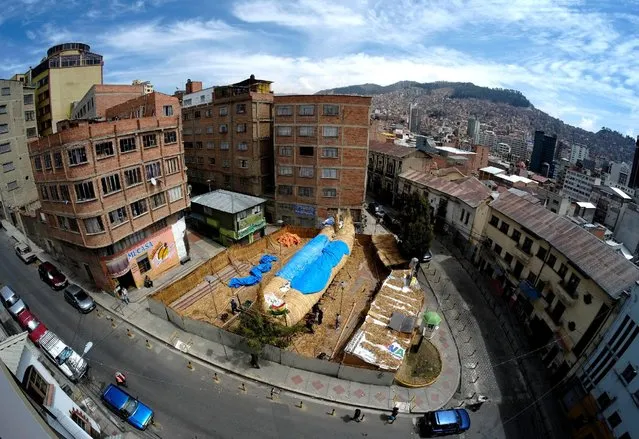
Aerial view of the “Viracocha III”, a boat made only from the totora reed, as it is being prepared to cross the Pacific from Chile to Australia on an expected six-month journey, La Paz, Bolivia, October 19, 2016. An expedition in a boat made only of reeds crafted by indigenous Bolivians is getting ready to cross the Pacific from South America to Australia, in a fresh attempt to prove that ancient mariners were capable of making the journey. Phil Buck, a 51-year-old explorer from the United States, already has led two similar expeditions and will captain the “Viracocha III” set to depart from northern Chile in February on an expected six-month journey. (Photo by David Mercado/Reuters)

Aerial view of the “Viracocha III”, a boat made only from the totora reed, as it is being prepared to cross the Pacific from Chile to Australia on an expected six-month journey, La Paz, Bolivia, October 19, 2016. An expedition in a boat made only of reeds crafted by indigenous Bolivians is getting ready to cross the Pacific from South America to Australia, in a fresh attempt to prove that ancient mariners were capable of making the journey. (Photo by David Mercado/Reuters)
Details
20 Oct 2016 10:53:00
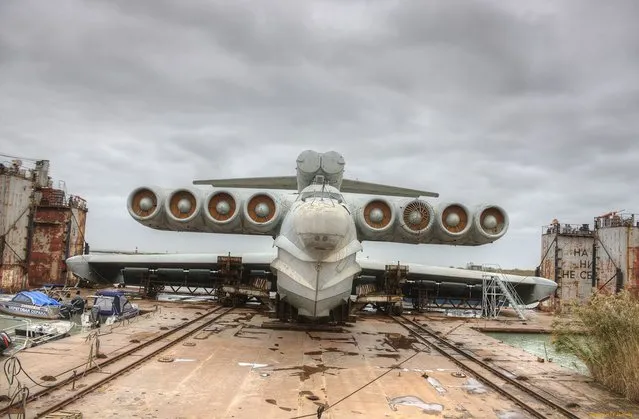
The Lun-class Ekranoplane was used by the Soviet Navy starting in 1987, and wasn't retired until the late 1990s, after the Soviet Union's fall. (Igor113)

“The Lun-class ekranoplan (NATO reporting name Duck) was a ground effect vehicle (GEV) designed by Rostislav Evgenievich Alexeev and used by the Soviet and Russian navies from 1987 until sometime in the late 1990s. It “flew” using the lift generated by the ground effect of its large wings when close to the surface of the water – about four metres or less. Although they might look similar and/or have related technical characteristics, ekranoplans like the Lun are not aircraft, seaplanes, hovercraft, or hydrofoils – ground effect is a separate technology altogether. The International Maritime Organization classifies these vehicles as maritime ships. The name Lun comes from the Russian for harrier”. – Wikipedia (Photo by Igor113)
Details
08 Aug 2014 10:51:00