Loading...
Done
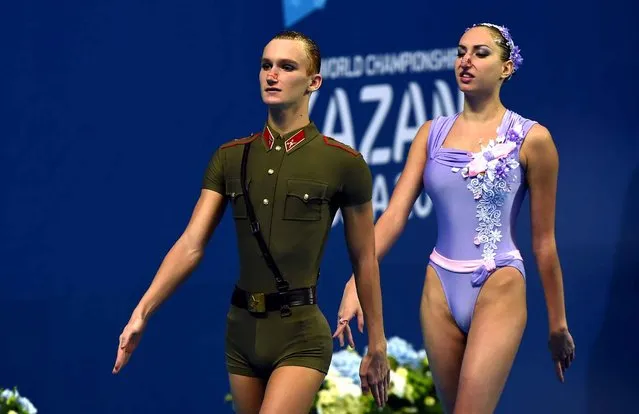
Russia's synchronised swimming duet Aleksandr Maltsev (L) and Darina Valitova compete in the Mixed Duet Technical preliminary during the synchronised swimming competition at the 2015 FINA World Championships in Kazan on July 25, 2015. (Photo by Christophe Simon/AFP Photo)

Russia's synchronised swimming duet Aleksandr Maltsev (L) and Darina Valitova compete in the Mixed Duet Technical preliminary during the synchronised swimming competition at the 2015 FINA World Championships in Kazan on July 25, 2015. (Photo by Christophe Simon/AFP Photo)
Details
25 Jul 2015 13:06:00
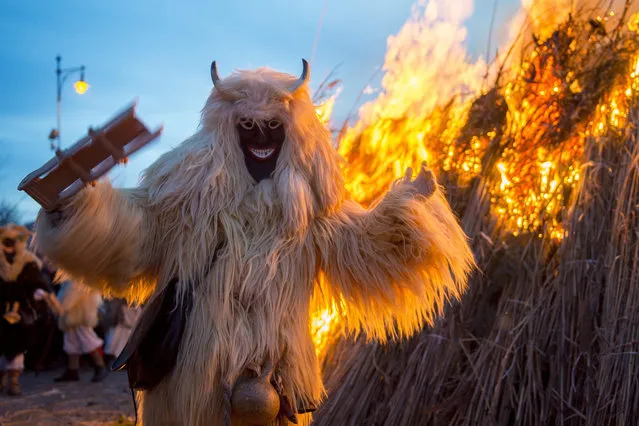
A reveler wearing sheepfur costume is seen in front of a bonfire on which they burn a coffin symbolizing winter during the closing ceremony of the traditional carnival parade in Mohacs, 189 kms south of Budapest, Hungary, 07 February 2016. (Photo by Tamas Soki/EPA)

A reveler wearing sheepfur costume is seen in front of a bonfire on which they burn a coffin symbolizing winter during the closing ceremony of the traditional carnival parade in Mohacs, 189 kms south of Budapest, Hungary, 07 February 2016. The carnival parade of people, the so-called busos, dressed in such costumes and frightening wooden masks, using various noisy wooden rattlers is traditionally held on the seventh weekend before Easter to drive away winter, and is a revival of a legend, which says that ethnic Croats ambushed the Osmanli Turkish troops, who escaped in panic seeing the terrifying figures during the Turkish occupation of Hungary. (Photo by Tamas Soki/EPA)

Details
09 Feb 2016 14:02:00
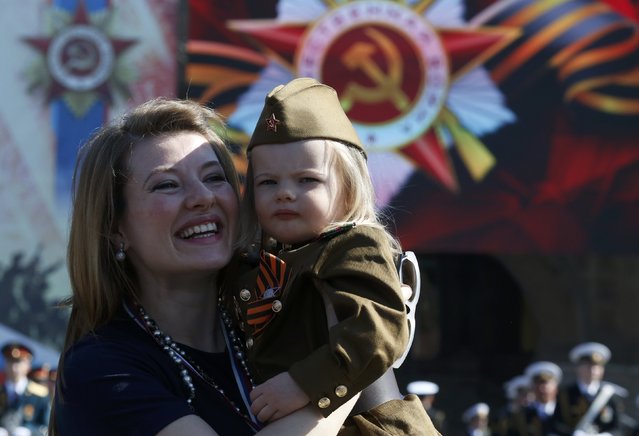
A woman and a girl dressed in historical Red Army uniform, wait before watching the Victory Day parade, marking the 71st anniversary of the victory over Nazi Germany in World War Two, at Red Square in Moscow, Russia, May 9, 2016. (Photo by Grigory Dukor/Reuters)

A woman and a girl dressed in historical Red Army uniform, wait before watching the Victory Day parade, marking the 71st anniversary of the victory over Nazi Germany in World War Two, at Red Square in Moscow, Russia, May 9, 2016. (Photo by Grigory Dukor/Reuters)
Details
10 May 2016 13:19:00
Kirby Chambliss of the United States flies in formation with Matt Hall of Australia, Yoshihide Muroya of Japan and Nigel Lamb of Britain prior to the third stage of the Red Bull Air Race World Championship in front of the Petronas Towers in Kuala Lumpur, Malaysia, on May 15, 2014. (Photo by Joerg Mitter/Red Bull via Reuters)

Kirby Chambliss of the United States flies in formation with Matt Hall of Australia, Yoshihide Muroya of Japan and Nigel Lamb of Britain prior to the third stage of the Red Bull Air Race World Championship in front of the Petronas Towers in Kuala Lumpur, Malaysia, on May 15, 2014. (Photo by Joerg Mitter/Red Bull via Reuters)
Details
17 May 2014 12:56:00
Galapagos – Rocking the Cradle: Four major ocean currents converge along the Galapagos archipelago, creating the conditions for an extraordinary diversity of animal life, April 25, 2016. The islands are home to at least 7,000 flora and fauna species, of which 97 percent of the reptiles, 80 percent of the land birds, 50 percent of the insects and 30 percent of the plants are endemic. The local ecosystem is highly sensitive to the changes in temperature, rainfall and ocean currents that characterize the climatic events known as El Niño and La Niña. These changes cause marked fluctuations in weather and food availability. Many scientists expect the frequency of El Niño and La Niña to increase as a result of climate change, making the Galapagos a possible early-warning location for its effects. (Photo by Thomas P. Peschak for National Geographic/World Press Photo)

Galapagos – Rocking the Cradle: Four major ocean currents converge along the Galapagos archipelago, creating the conditions for an extraordinary diversity of animal life, April 25, 2016. The islands are home to at least 7,000 flora and fauna species, of which 97 percent of the reptiles, 80 percent of the land birds, 50 percent of the insects and 30 percent of the plants are endemic. (Photo by Thomas P. Peschak for National Geographic/World Press Photo)
Details
16 Apr 2018 00:01:00
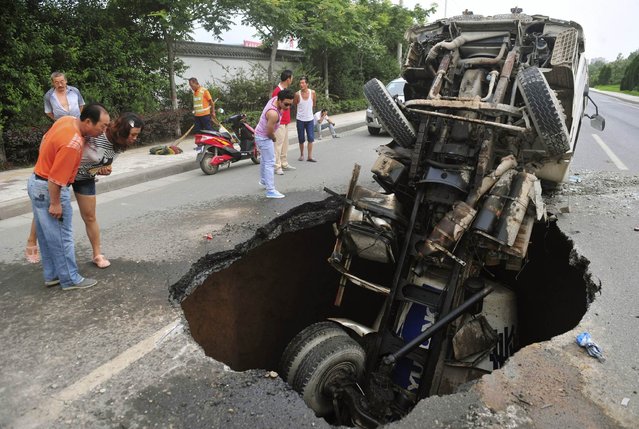
People look at a tanker after it fell into a caved-in area on a road in Xi'an, Shaanxi province, July 27, 2013. No casualty was reported in the accident, according to local media. (Photo by Reuters/Stringer)

People look at a tanker after it fell into a caved-in area on a road in Xi'an, Shaanxi province, July 27, 2013. No casualty was reported in the accident, according to local media. (Photo by Reuters/Stringer)
Details
03 Aug 2013 11:22:00
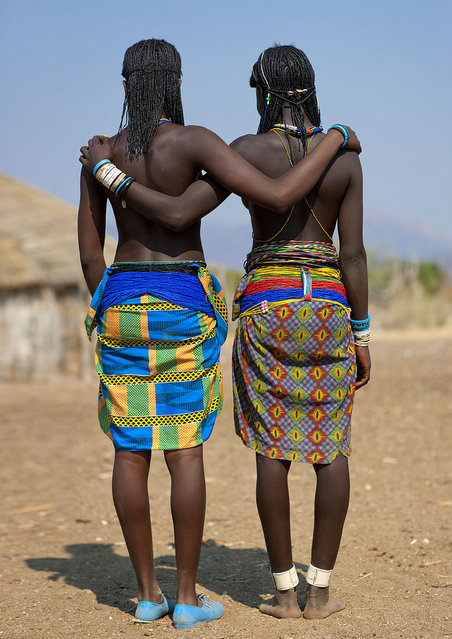
“Show us our butts! Mucawana tribe – Angola. In Soba village, the Muhacaona (Mucawana) tribe, perhaps the best place i have visited. They use cow dung and fat to make this so nice haircut, and love the beads. They asked me to make pictures of their backs... and butts to see on the camera screen if everything was perfect!”. (Eric Lafforgue)

“Show us our butts! Mucawana tribe – Angola. In Soba village, the Muhacaona (Mucawana) tribe, perhaps the best place i have visited. They use cow dung and fat to make this so nice haircut, and love the beads. They asked me to make pictures of their backs... and butts to see on the camera screen if everything was perfect!”. (Photo and comments by Eric Lafforgue)
Details
09 Nov 2012 15:04:00
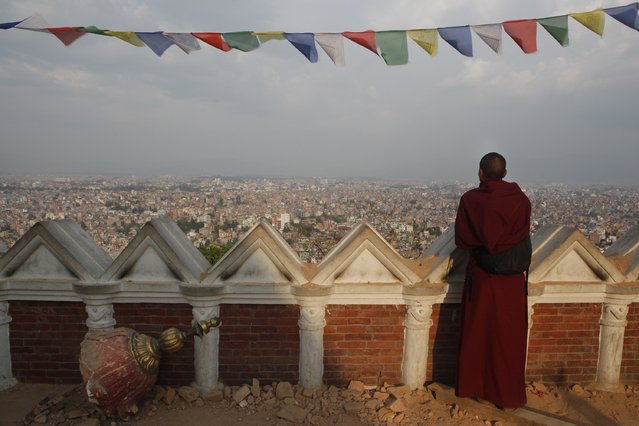
A Buddhist monk catches an aerial view of Kathmandu from the damaged Swayambhunath Stupa premises in Kathmandu, Nepal, Wednesday, May 6, 2015. The April 25 earthquake killed thousands and injured many more as it flattened mountain villages and destroyed buildings and archaeological sites in Kathmandu. (Photo by Niranjan Shrestha/AP Photo)

A Buddhist monk catches an aerial view of Kathmandu from the damaged Swayambhunath Stupa premises in Kathmandu, Nepal, Wednesday, May 6, 2015. The April 25 earthquake killed thousands and injured many more as it flattened mountain villages and destroyed buildings and archaeological sites in Kathmandu. (Photo by Niranjan Shrestha/AP Photo)
Details
08 May 2015 13:20:00