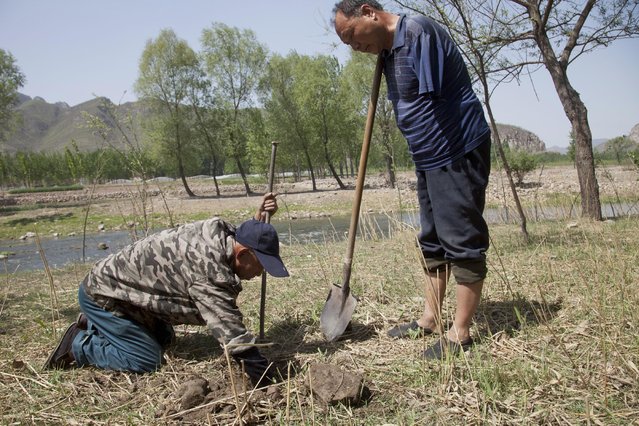
In this April 23, 2015 photo, friends Jia Haixia, left, and Jia Wenqi work to plant a tree in a field in Yeli village near Shijiazhuang city in northern China's Hebei province. For the past 13 years, Jia Wenqi, who has no arms, and Jia Haixia, who is blind, have worked together to plant and water more than 12,000 trees near their village. (Photo by Helene Franchineau/AP Photo)
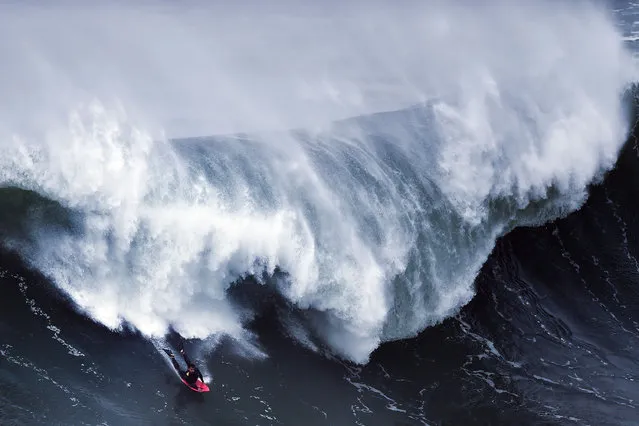
A bodyboarder rides a wave during a big- wave surfing session at Praia do Norte in Nazare on November 19, 2016. (Photo by Patricia de Melo Moreira/AFP Photo)
A model waits backstage to present creations from the Fall-Winter 2021/2022 collection of the Georgiela Studio fashion brand during a young talents “EGO” fashion show on the last day of the 73rd Mercedes-Benz Fashion Week Madrid, in Madrid, Spain, 11 April 2021. The fashion event runs from 08 to 11 April. (Photo by Mariscal/EPA/EFE)
A member of the “Castellers Minyons de Terrassa” adjusts her belt before forming a human tower or ÒcastellÓ during the festival of the patron saint of Barcelona “The Virgin of Mercy” at Sant Jaume square in Barcelona, Spain, September 20, 2015. The formation of human towers is a tradition in Catalonia dating back to the 18th century. (Photo by Susana Vera/Reuters)
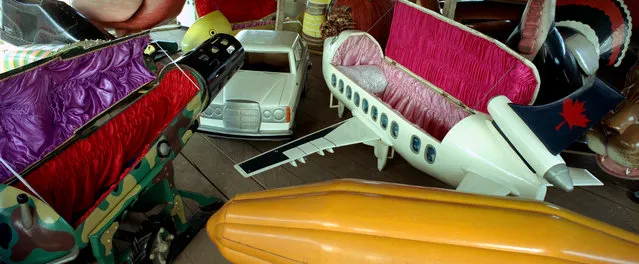
Some people joke about having clowns at their funeral, but how about having a coffin that looks like a gigantic cellphone? It is impossible to tell at the first glance that these colorful sculptures are actually coffins. The coffins were made by Kane Kwei and his assistant Paa Joe more than twenty years ago and have been a somewhat grim tourist attraction ever since. These coffins were probably made as an advertisement for the actual business, since it would hard to imagine someone actually ordering a coffin such as this.
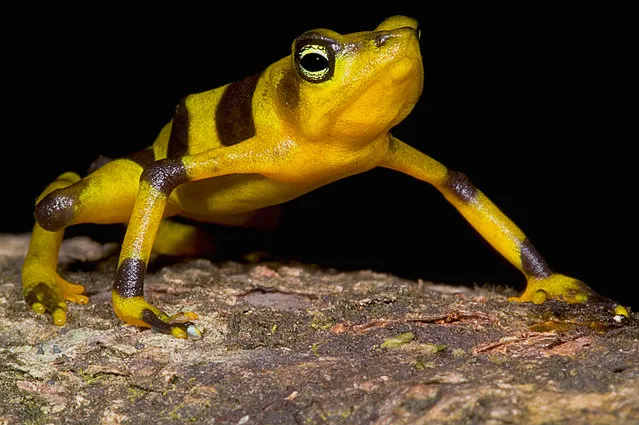
Wildlife photographer Danté Fenolio has headed into areas untouched by sunlight – deep seas, caves and underground – and found creatures that are exploding with colour. Here: The golden harlequin toad has vanished from the wild, and only a small number live on in captivity. A fungus caused them, and many other amphibians, to die out in their home in Central America. (Photo by Danté Fenolio/The Guardian/Johns Hopkins University Press)