Loading...
Done
Revellers participate in a parade on the street during a carnival in the village of Vevcani, south of Skopje, Macedonia January 13, 2016. Vevcani village marks the annual Orthodox St. Vasilij Day with a carnival that features a 1,400-year-old celebration with pagan roots. The highlights of the carnival include a political satire where masked villagers act out current events. (Photo by Ognen Teofilovski/Reuters)

Revellers participate in a parade on the street during a carnival in the village of Vevcani, south of Skopje, Macedonia January 13, 2016. Vevcani village marks the annual Orthodox St. Vasilij Day with a carnival that features a 1,400-year-old celebration with pagan roots. The highlights of the carnival include a political satire where masked villagers act out current events. (Photo by Ognen Teofilovski/Reuters)
Details
15 Jan 2016 08:05:00
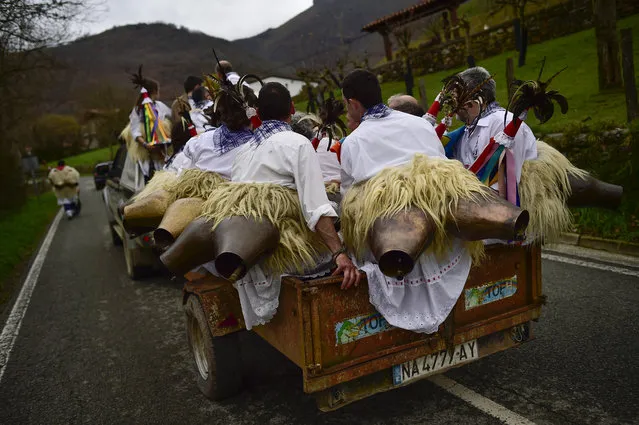
Joaldunaks return in a trailer to their town at the end of Carnival between of the Pyrenees villages of Ituren and Zubieta, northern Spain, Monday, February 1, 2016. In one of the most ancient carnivals in Europe, dating from before the Roman empire, companies of Joaldunak (cowbells) made up of residents of two towns, Ituren and Zubieta, parade the streets costumed in sandals, lace petticoats, sheepskins around the waist and shoulders, coloured neckerchiefs, conical caps with ribbons and a hyssop of horsehair in their right hands and cowbells hung across their lower back. (Photo by Alvaro Barrientos/AP Photo)

Joaldunaks return in a trailer to their town at the end of Carnival between of the Pyrenees villages of Ituren and Zubieta, northern Spain, Monday, February 1, 2016. In one of the most ancient carnivals in Europe, dating from before the Roman empire, companies of Joaldunak (cowbells) made up of residents of two towns, Ituren and Zubieta, parade the streets costumed in sandals, lace petticoats, sheepskins around the waist and shoulders, coloured neckerchiefs, conical caps with ribbons and a hyssop of horsehair in their right hands and cowbells hung across their lower back. (Photo by Alvaro Barrientos/AP Photo)
Details
02 Feb 2016 13:07:00
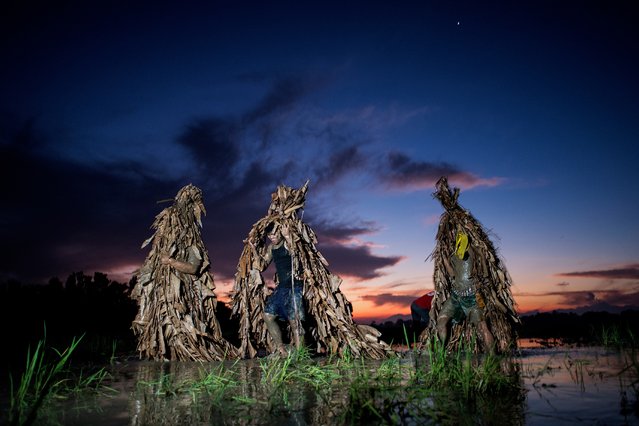
Devotees wear costumes made of banana leaves as they head to church to attend mass as part of a religious festival, in honor of St. John the Baptist, also known locally as the “mud people” festival, in Aliaga town, Nueva Ecija province, north of Manila, on June 24, 2017. Farmers coated in mud paraded in Philippine villages on June 24 to mark one of the Catholic nation's most colourful religious festivals. (Photo by Noel Celis/AFP Photo)

Devotees wear costumes made of banana leaves as they head to church to attend mass as part of a religious festival, in honor of St. John the Baptist, also known locally as the “mud people” festival, in Aliaga town, Nueva Ecija province, north of Manila, on June 24, 2017. Farmers coated in mud paraded in Philippine villages on June 24 to mark one of the Catholic nation's most colourful religious festivals. (Photo by Noel Celis/AFP Photo)
Details
27 Jun 2017 08:30:00
Young revelers take part in a parade called "La Calabiuza" on November 1, 2015, on the eve of the Day of the Dead in Tonacatepeque, 20 kms (13 miles) north of San Salvador. During the celebration, the residents of Tonacatepeque, originally an indigenous community, recall the characters from the mythology of Cuscatlan – pre-Columbian west and central regions of El Salvador – and their dead relatives. (Photo by Marvin Recinos/AFP Photo)

Young revelers take part in a parade called "La Calabiuza" on November 1, 2015, on the eve of the Day of the Dead in Tonacatepeque, 20 kms (13 miles) north of San Salvador. During the celebration, the residents of Tonacatepeque, originally an indigenous community, recall the characters from the mythology of Cuscatlan – pre-Columbian west and central regions of El Salvador – and their dead relatives. (Photo by Marvin Recinos/AFP Photo)
Details
04 Nov 2015 11:50:00
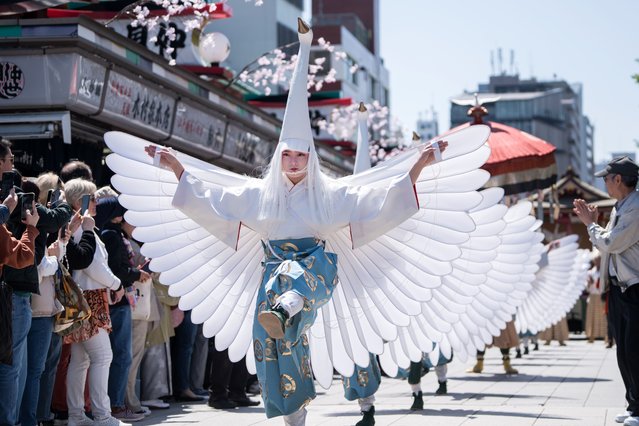
Dancers perform during the Shirasagi-no Mai, or White Heron Dance, at the Sensoji Temple on April 09, 2023 in Tokyo, Japan. The parade, which originated in the 8th-12th century in Kyoto, was revived in 1968 to celebrate Tokyo's 100th Anniversary and to wish for peace. The dance is now held twice a year, in April and November, at the Sensoji Temple in Asakusa, one of Tokyo's most popular tourist destinations for foreign visitors. (Photo by Tomohiro Ohsumi/Getty Images)

Dancers perform during the Shirasagi-no Mai, or White Heron Dance, at the Sensoji Temple on April 09, 2023 in Tokyo, Japan. The parade, which originated in the 8th-12th century in Kyoto, was revived in 1968 to celebrate Tokyo's 100th Anniversary and to wish for peace. The dance is now held twice a year, in April and November, at the Sensoji Temple in Asakusa, one of Tokyo's most popular tourist destinations for foreign visitors. (Photo by Tomohiro Ohsumi/Getty Images)
Details
25 Apr 2023 03:32:00
A participant takes part in the High-Heels Race as part of the Pride celebrations, in the Chueca neighbourhood in Madrid on July 7, 2022. MADO (Madrid Pride) is a series of street celebrations that take place during the city's LGBTIQ (lesbian, gay, bisexual, transgender, intersеx and queer) Pride week. The Pride parade on July 9 will be the highlight of the week. (Photo by Javier Soriano/AFP Photo)

A participant takes part in the High-Heels Race as part of the Pride celebrations, in the Chueca neighbourhood in Madrid on July 7, 2022. MADO (Madrid Pride) is a series of street celebrations that take place during the city's LGBTIQ (lesbian, gay, bisexual, transgender, intersеx and queer) Pride week. The Pride parade on July 9 will be the highlight of the week. (Photo by Javier Soriano/AFP Photo)
Details
31 Oct 2023 06:39:00
Bear Vs Tiger

It's not often that two ferocious tigers have to beat a hasty retreat from a confrontation. But it seems that the wrath of a mother bear protecting two cubs on her back was more than enough to scare this pair off. Wildlife photographer Aditya Singh captured the encounter during a visit to Ranthambore Tiger Reserve in Rajasthan, India.
Details
24 Jan 2014 09:11:00


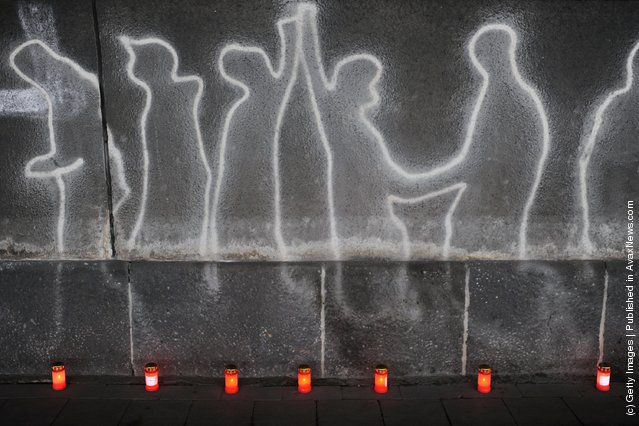
“On 24 July 2010, a stampede at the 2010 Love Parade electronic dance music festival in Duisburg, North Rhine-Westphalia, Germany, caused the death of 21 people. At least 510 more were injured”. – Wikipedia

Photo: Wall art and candles are pictured in the tunnel of the 2010 Loveparade disaster near to where many of the deaths occurred on the first anniversary of the tragedy on July 24, 2011 in Duisburg, Germany. (Photo by Thomas Starke/Getty Images)
Details
25 Jul 2011 11:49:00