Loading...
Done
Invasion (laser girls) 2017. “I’m always thinking about my art practice, so any experience I have may spike a visual when I have an idea in mind. An example is that, when I was thinking about the Invasion series, I was inspired by Alfred Hitchcock’s movie The Birds (1963). I love Hitchcock’s other movies and have been contemplating a series based on Rear Window (1954). I also find inspiration outside the cinema in music clips and magazines”. (Photo by Michael Cook/Perimeter Books)

Invasion (laser girls) 2017. “I’m always thinking about my art practice, so any experience I have may spike a visual when I have an idea in mind. An example is that, when I was thinking about the Invasion series, I was inspired by Alfred Hitchcock’s movie The Birds (1963). I love Hitchcock’s other movies and have been contemplating a series based on Rear Window (1954). I also find inspiration outside the cinema in music clips and magazines”. (Photo by Michael Cook/Perimeter Books)
Details
09 Nov 2025 05:06:00
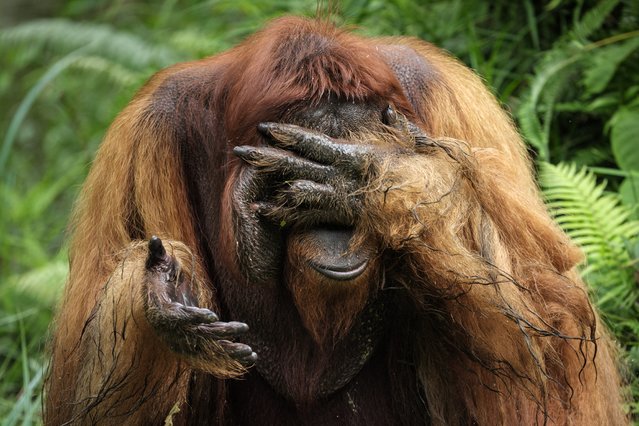
Bujang, a 35-year-old male orangutan rescued from a circus in Sumatra, washes his face on a sanctuary island surrounded by a river where non-releasable orangutans are protected for life at the Samboja Lestari Orangutan Rehabilitation Center run by the non-profit Borneo Orangutan Survival (BOS) Foundation in Samboja, East Kalimantan, on July 12, 2024. (Photo by Yasuyoshi Chiba/AFP Photo)

Bujang, a 35-year-old male orangutan rescued from a circus in Sumatra, washes his face on a sanctuary island surrounded by a river where non-releasable orangutans are protected for life at the Samboja Lestari Orangutan Rehabilitation Center run by the non-profit Borneo Orangutan Survival (BOS) Foundation in Samboja, East Kalimantan, on July 12, 2024. (Photo by Yasuyoshi Chiba/AFP Photo)

Details
14 Nov 2025 03:17:00
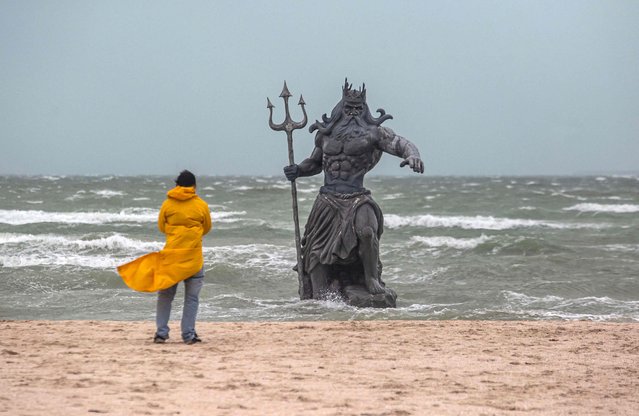
A man looks at a statue of the Greek god Poseidon on a beach during the passage of tropical storm Beryl in Progreso, on the Yucatan Peninsula, Mexico, on July 5, 2024. Beryl weakened to a tropical storm Friday after hitting Mexico as a Category 2 hurricane, with fierce winds causing material damage but no injuries along the tourist-rich Yucatan Peninsula. (Photo by Hugo Borges/AFP Photo)

A man looks at a statue of the Greek god Poseidon on a beach during the passage of tropical storm Beryl in Progreso, on the Yucatan Peninsula, Mexico, on July 5, 2024. Beryl weakened to a tropical storm Friday after hitting Mexico as a Category 2 hurricane, with fierce winds causing material damage but no injuries along the tourist-rich Yucatan Peninsula. (Photo by Hugo Borges/AFP Photo)
Details
14 Nov 2025 03:34:00
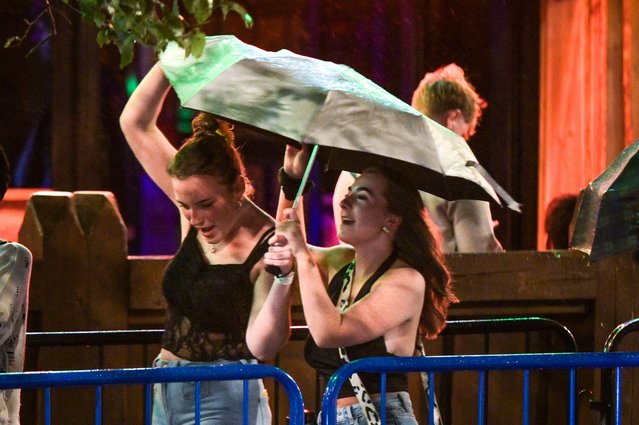
Revellers battled against 40mph winds and driving rain to get to nightclubs in Birmingham city centre on September 21, 2025. The Met Office released a yellow weather warning for strong wind and heavy rain overnight across much of England and Wales. The partygoers used their coats and umbrellas to shelter from the barmy conditions. (Photo by British News and Media/Alamy Live News)

Revellers battled against 40mph winds and driving rain to get to nightclubs in Birmingham city centre on September 21, 2025. The Met Office released a yellow weather warning for strong wind and heavy rain overnight across much of England and Wales. The partygoers used their coats and umbrellas to shelter from the barmy conditions. (Photo by British News and Media/Alamy Live News)
Details
22 Nov 2025 06:03:00
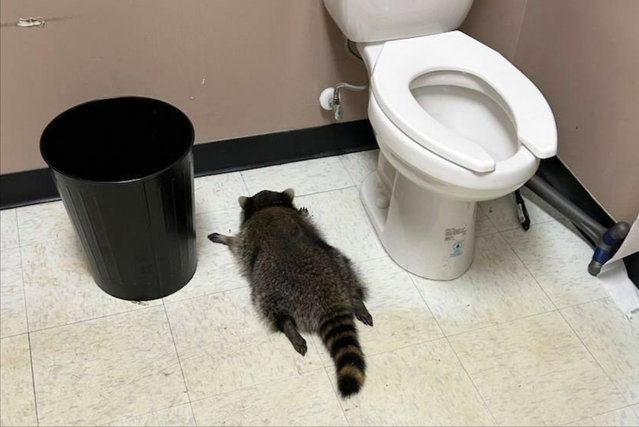
In more “raccoons are getting more like us” news, a drunk raccoon was found in a liquor store in Virginia, US in the first decade of December 2025. The animal had got into the shop via some loose ceiling tiles, knocked bottles of spirits off the shelves, lapped up the contents and passed out in the toilets. Once it had sobered up, it was released back into the wild – no doubt with a crashing hangover. (Photo by AP Photo)

In more “raccoons are getting more like us” news, a drunk raccoon was found in a liquor store in Virginia, US in the first decade of December 2025. The animal had got into the shop via some loose ceiling tiles, knocked bottles of spirits off the shelves, lapped up the contents and passed out in the toilets. Once it had sobered up, it was released back into the wild – no doubt with a crashing hangover. (Photo by AP Photo)
Details
11 Dec 2025 06:38:00


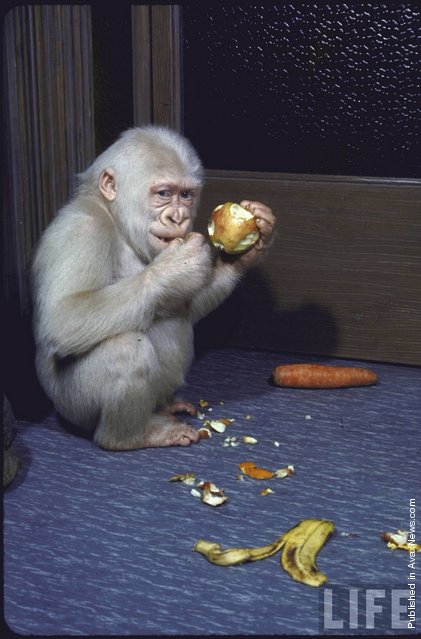
“Snowflake (c. 1964 – November 24, 2003) was an albino gorilla. He was the only known albino gorilla so far, and the most popular resident of the Barcelona Zoo in Catalonia, Spain. Originally named Nfumu Ngui in Fang language ("white gorilla") by his captor, he was then nicknamed Floquet de Neu (Catalan for little snowflake) by his keeper Jordi Sabater Pi. On his arrival to Barcelona where he was given an official reception by the then Mayor of Barcelona, Josep Maria de Porcioles, in November 1966, he was called Blancanieves (“Snow White”) in the newspaper Tele/Exprés. But he became famous with the name given to him by Sabater when National Geographic Magazine featured him on the main page in March 1967, with the English name Snowflake. This name spread among the press (Stern, Life, Paris-Match) and was later translated to Spanish as Copito de Nieve. Sabater himself called the gorilla Floquet or Copi, and in the later years Nfumu. The asteroid 95962 Copito, discovered by Catalan astronomer J. Manteca, is named in his honour”.
Details
07 Mar 2011 15:50:00


“Harisu (하리수 or 河莉秀) is the stage name of Lee Kyung-eun originally Lee Kyung-yeop (born February 17, 1975), a transsexual pop singer, model and actress from South Korea. Born biologically male, Harisu identified as female from early childhood, and underwent s*x reassignment surgery in the 1990s. She is noted for being South Korea's first transgender entertainer, and in 2002 became only the second person in Korea to legally change their gender. Her stage name is an adaptation of the English phrase «hot issue»”.

Photo: South Korean transsexual singer and actress Harisu (R) poses for pictures with a fan who played the role of groom during a simulated Chinese wedding at a fan club activity on August 5, 2006 in Changchun of Jilin Province, China. (Photo by China Photos/Getty Images)
Details
17 Mar 2011 11:31:00


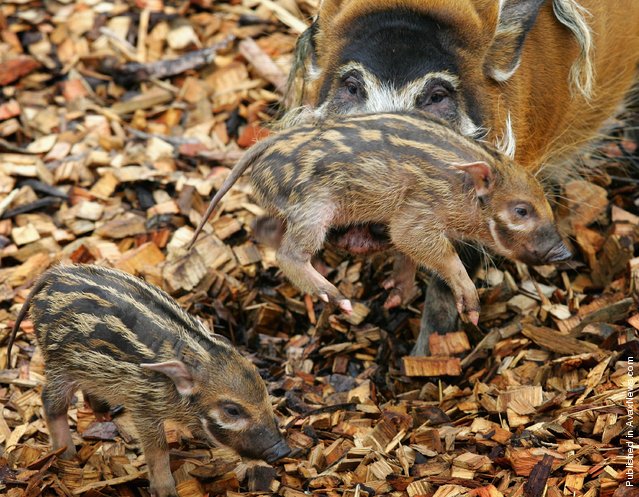
“The Red River Hog (Potamochoerus porcus), also known as the Bush Pig (but not to be confused with P. larvatus, common name “Bushpig”), is a wild member of the pig family living in Africa, with most of its distribution in the Guinean and Congolian forests. It is rarely seen away from rainforests, and generally prefers areas near rivers or swamps.

Red River Hogs eat grass, berries, roots, insects, molluscs, small vertebrates and carrion. They are capable of causing damage to plantations. Red River Hogs typically live in herds of 6-20 members led by a dominant boar. Sows rear 3-6 piglets at a time.”

Photo: Two 17 day old red river hoglet twins forage for food next to their mother Bahiti at London Zoo on August 23, 2007 in London, England. Red River hoglets inhabit the forests and swamps of West and Central Africa. The recent additions to the London Zoo pig pen have been eagerly awaited by zoo keepers. (Photo by Chris Jackson/Getty Images)
Details
18 Mar 2011 15:15:00