Loading...
Done
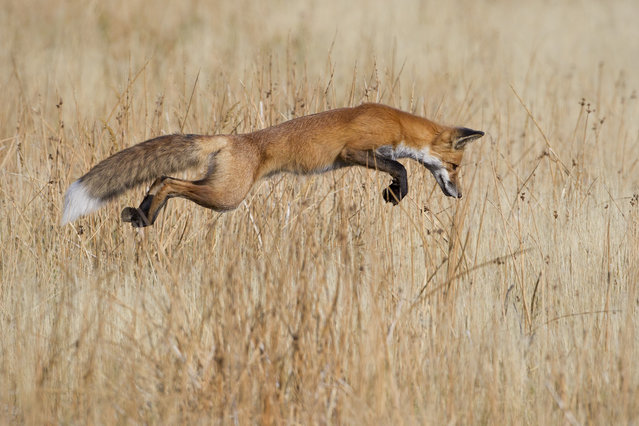
Canada: “Lucky pounce”. (Photo by Connor Stefanison/Wildlife Photographer of the Year 2013)

The winners of The London’s Natural History Museum's prestigious Wildlife Photographer of the Year for 2013 have finally been unveiled. Selected from almost 43,000 entries from 96 countries, the winners offer a glimpse of the stunning array of natural beauty on our planet. Photo: Canada: “Lucky pounce”. “Anticipating the pounce – that was the hardest part”, says Connor, who had come to Yellowstone National Park, Wyoming, USA, in search of wildlife as much as the spectacular landscape. He had found this fox, his first ever, on his last day in the park. It was so absorbed in hunting that Connor had plenty of time to get out of the car and settle behind a rock. It quartered the grassland, back and forth, and then started staring intently at a patch of ground, giving Connor just enough warning of the action to come. When it sprung up, Connor got his shot. And when it landed, the fox got his mouse. (Photo by Connor Stefanison/Wildlife Photographer of the Year 2013)
Details
17 Oct 2013 08:12:00
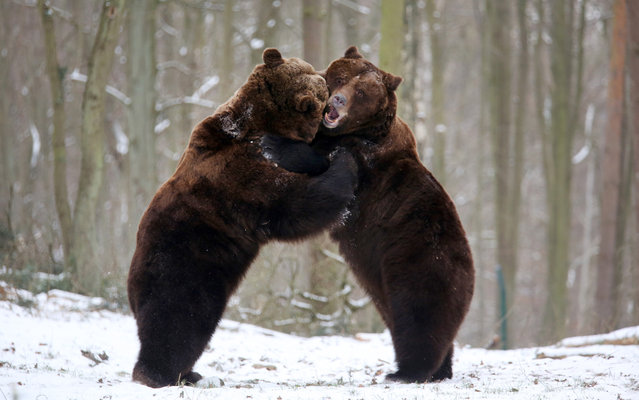
Swedish brown bears “Fred” and “Frode” play in the snow on January 30, 2014 at the Natur- und Umweltpark (NUP) animal park in Guestrow, northeastern Germany. Despite of icy temperatures, the bear brothers took a break from their winter rest. (Photo by Bernd Wuestneck/AFP Photo/DPA)

Swedish brown bears “Fred” and “Frode” play in the snow on January 30, 2014 at the Natur- und Umweltpark (NUP) animal park in Guestrow, northeastern Germany. Despite of icy temperatures, the bear brothers took a break from their winter rest. (Photo by Bernd Wuestneck/AFP Photo/DPA)
Details
01 Feb 2014 13:50:00
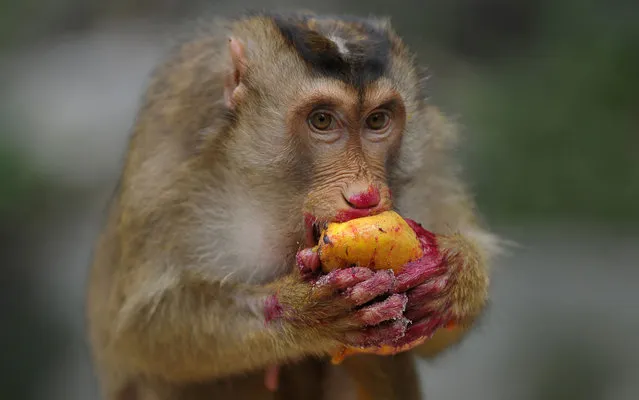
A wild macaque monkey eats fruit dropped by pedestrians in a suburb of Kuala Lumpur, Malaysia, on June 11, 2013. (Photo by Mohd Rasfan/AFP Photo)

A wild macaque monkey eats fruit dropped by pedestrians in a suburb of Kuala Lumpur, Malaysia, on June 11, 2013. (Photo by Mohd Rasfan/AFP Photo)
Details
15 Jun 2013 11:38:00
Ocean voyage

Do you think that history is a science? Well, not exactly. First, and foremost, history is the state's “legend of wars”, it’s official regalia. Of course, public historians are not interested in scientific truth – quite the opposite. In this respect, any attempt to present a state’s history as altruistic and benevolent as possible is welcomed and encouraged – as opposed to any revisionism attempts that may be more accurate. In this matter, Chinese have surpassed us all – they revised in highly creative manner (but rather shamelessly) the technology already invented by Europeans, a process that resulted in oldest state on the planet. Here is an interesting paradox: ask any sinologist about the Middle Kingdom during second century B.C., and he will describe it to you in such a vivid manner as if he has been living there all his life – but as soon as you will ask him to describe Chinese history in the 19-20th centuries… let's say, his eagerness will be greatly diminished. However, we will discuss China in a different article, and in the meantime we will try to understand how exactly historic “legend of wars” is formed and functions – based on a specific and well-known example. A great example is Ferdinand Magellan's first voyage around the world.
Details
14 Nov 2011 09:11:00
A French Bulldog named Nord Boss stands an the back of his owner Natasha while they skateboard in the Sokolniki Park in Moscow, Russia on October 14, 2020. (Photo by Evgenia Novozhenina/Reuters)

A French Bulldog named Nord Boss stands an the back of his owner Natasha while they skateboard in the Sokolniki Park in Moscow, Russia on October 14, 2020. (Photo by Evgenia Novozhenina/Reuters)
Details
30 Oct 2020 00:01:00
Two women enjoy drinks outside a pub in the soho area of central London on November 4, 2020, on the eve of a second novel coronavirus COVID-19 lockdown in an effort to combat soaring infections. English pubs call last orders at the bar for a month on Wednesday evening, as the country effectively shuts down from November 5, for the second time this year to try to cut coronavirus cases. Prime Minister Boris Johnson insisted that the lockdown for England would end “automatically” in four weeks, as he tried to placate party critics over the spiralling economic fallout. (Photo by Stephen Lock/i-Images)

Two women enjoy drinks outside a pub in the soho area of central London on November 4, 2020, on the eve of a second novel coronavirus COVID-19 lockdown in an effort to combat soaring infections. English pubs call last orders at the bar for a month on Wednesday evening, as the country effectively shuts down from November 5, for the second time this year to try to cut coronavirus cases. Prime Minister Boris Johnson insisted that the lockdown for England would end “automatically” in four weeks, as he tried to placate party critics over the spiralling economic fallout. (Photo by Stephen Lock/i-Images)
Details
06 Nov 2020 00:07:00
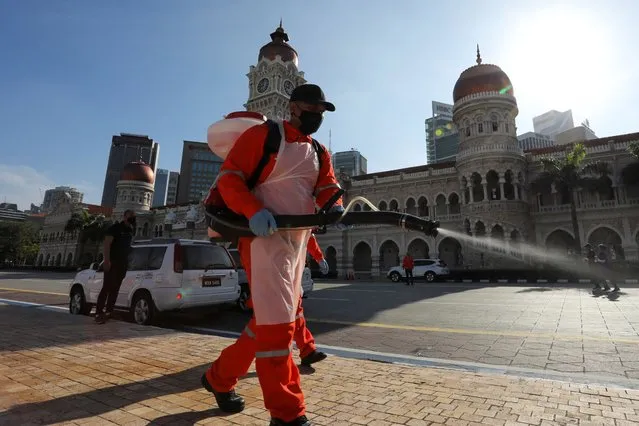
A worker sprays disinfectant at Independence Square during a disinfection operation, amid the coronavirus disease (COVID-19) outbreak in Kuala Lumpur on October 17, 2020. (Photo by Lim Huey Teng/Reuters)

A worker sprays disinfectant at Independence Square during a disinfection operation, amid the coronavirus disease (COVID-19) outbreak in Kuala Lumpur on October 17, 2020. (Photo by Lim Huey Teng/Reuters)
Details
13 Nov 2020 00:05:00
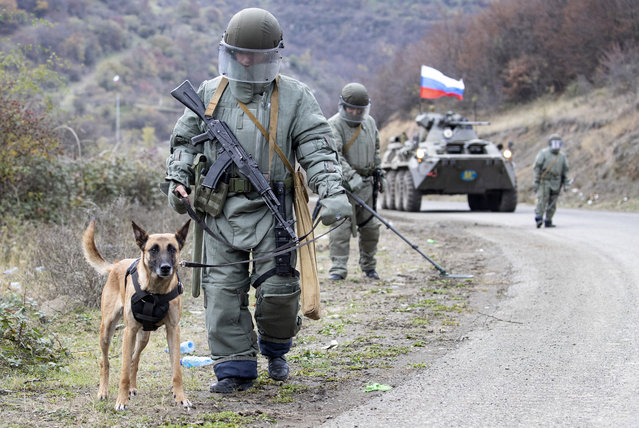
Experts of the Anti-Mine Center of the Russian Defense Ministry clear mines at a motorway linking the cities of Stepanakert and Goris in Nagorno-Karabakh on November 23, 2020. (Photo by Stanislav Krasilnikov/TASS)

Experts of the Anti-Mine Center of the Russian Defense Ministry clear mines at a motorway linking the cities of Stepanakert and Goris in Nagorno-Karabakh on November 23, 2020. (Photo by Stanislav Krasilnikov/TASS)
Details
25 Nov 2020 00:07:00