Loading...
Done
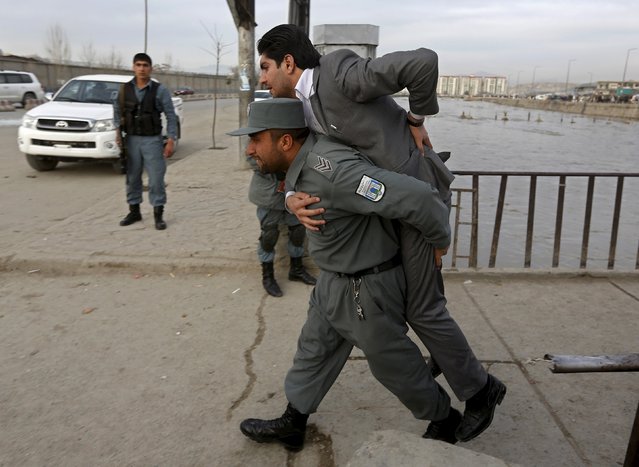
An Afghan policeman carries a wounded man at the site of a suicide attack in Kabul March 25, 2015. Six people were killed and more than 30 injured in the suicide bombing in the Afghan capital on Wednesday that struck close to the presidential palace in the heart of the city, the Interior Ministry said. The suicide bomber had been travelling in a vehicle packed with explosives and it was not immediately clear what the target of the attack had been. (Photo by Omar Sobhani/Reuters)

An Afghan policeman carries a wounded man at the site of a suicide attack in Kabul March 25, 2015. Six people were killed and more than 30 injured in the suicide bombing in the Afghan capital on Wednesday that struck close to the presidential palace in the heart of the city, the Interior Ministry said. The suicide bomber had been travelling in a vehicle packed with explosives and it was not immediately clear what the target of the attack had been. (Photo by Omar Sobhani/Reuters)
Details
26 Mar 2015 12:33:00
Tokyo Rainbow Pride 2015, at Yoyogi park-Shibuya,  on April 26, 2015. Some 3,000 lesbian, gay, bisexual and transgender people paraded through Tokyo’s Shibuya district Sunday afternoon to demonstrate their hope that Japanese society will continue to forge ahead with recent moves to embrace equality and diversity. (Photo by Yoshiaki Miura)

Tokyo Rainbow Pride 2015, at Yoyogi park-Shibuya, on April 26, 2015. Some 3,000 lesbian, gay, bisexual and transgender people paraded through Tokyo’s Shibuya district Sunday afternoon to demonstrate their hope that Japanese society will continue to forge ahead with recent moves to embrace equality and diversity. In a nation where prejudice against sexual minorities persists, the annual Tokyo Rainbow Pride parade has sought to counter the trend by openly spotlighting LGBT residents and spreading their voices. But this year, LGBT participants and proponents seemed particularly joyous, emboldened by what they see as a blossoming of LGBT-friendly moves by municipalities and companies. (Photo by Yoshiaki Miura)
Details
27 Apr 2015 10:40:00
An employee of Daikin Industries Ltd works the production line of outdoor air conditioning units at the company's Kusatsu factory in Shiga prefecture, western Japan March 20, 2015. As Japan heads into the season of peak demand for room air-conditioners, Daikin managers have been tasked with figuring out how to boost output by some 20 percent at the 45-year-old Kusatsu plant that six years ago the company had almost given up on as unprofitable. (Photo by Yuya Shino/Reuters)

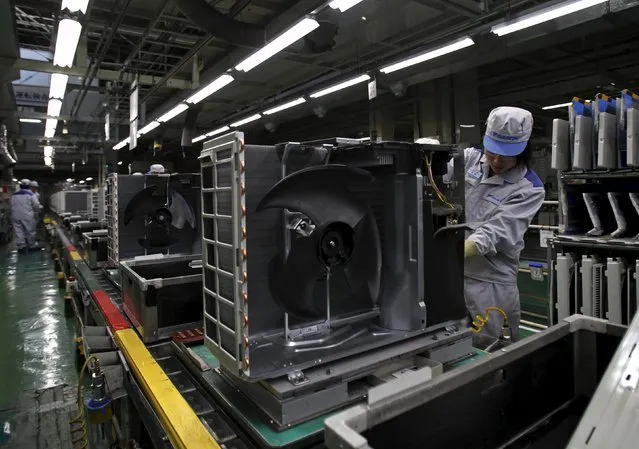
An employee of Daikin Industries Ltd works the production line of outdoor air conditioning units at the company's Kusatsu factory in Shiga prefecture, western Japan March 20, 2015. As Japan heads into the season of peak demand for room air-conditioners, Daikin managers have been tasked with figuring out how to boost output by some 20 percent at the 45-year-old Kusatsu plant that six years ago the company had almost given up on as unprofitable. (Photo by Yuya Shino/Reuters)
Details
06 Apr 2015 09:10:00
Workers carry a rope line to fasten a decommissioned ship at the Alang shipyard in the western Indian state of Gujarat, March 27, 2015. The European Union plans to impose strict new rules on how companies scrap old tankers and cruise liners, run aground and dismantled on beaches in South Asia. (Photo by Amit Dave/Reuters)

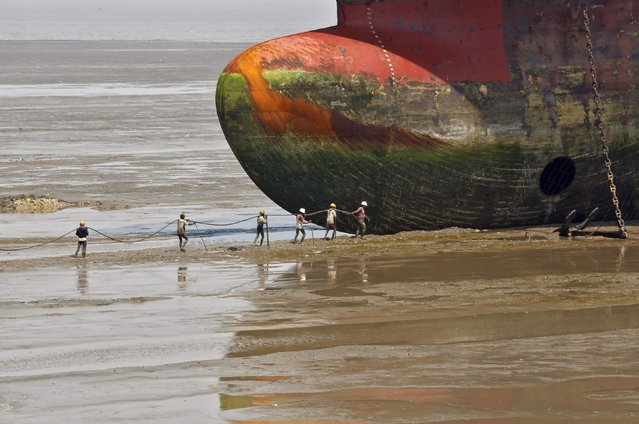
Workers carry a rope line to fasten a decommissioned ship at the Alang shipyard in the western Indian state of Gujarat, March 27, 2015. The European Union plans to impose strict new rules on how companies scrap old tankers and cruise liners, run aground and dismantled on beaches in South Asia. However the practice in India, Bangladesh and Pakistan, hazardous for humans and the environment, will still be hard to stop. European, Turkish and Chinese recyclers are set to benefit from the revamped standards. Depending on raw material prices, ship owners can make up to $500 per tonne of steel from an Indian yard, compared with $300 in China and just $150 in Europe. (Photo by Amit Dave/Reuters)
Details
01 Apr 2015 11:40:00
These may look like alien creatures from another planet, but the odd organisms are, in fact, colorful, microscopic life forms found in our forests. The bizarre slime molds, known as mycetozoa or fungus animals, were captured by geologist Valeriya Zvereva. (Photo by Valeriya Zvereva/Caters News)

These may look like alien creatures from another planet, but the odd organisms are, in fact, colorful, microscopic life forms found in our forests. The bizarre slime molds, known as mycetozoa or fungus animals, were captured by geologist Valeriya Zvereva. She spent months documenting the common life forms that are found beneath our feet – but are rarely seen. Incredibly, the organisms can move and hunt for other microscopic life forms on which to feed. Zvereva, who is from Moscow, used a special macro lens to capture the vibrant and up-close shots, which show off the organisms’ unlikely beauty. (Photo by Valeriya Zvereva/Caters News)
Details
20 Apr 2015 13:27:00
Windows and doors of an old residential building are pictured in central Mumbai October 10, 2014. The cost for buying a residential apartment in Mumbai close to the city centre ranges from 12,000 Indian rupees ($ 200) per square feet to 112,552 Indian rupees ($ 1800) per square feet. (Photo by Danish Siddiqui/Reuters)

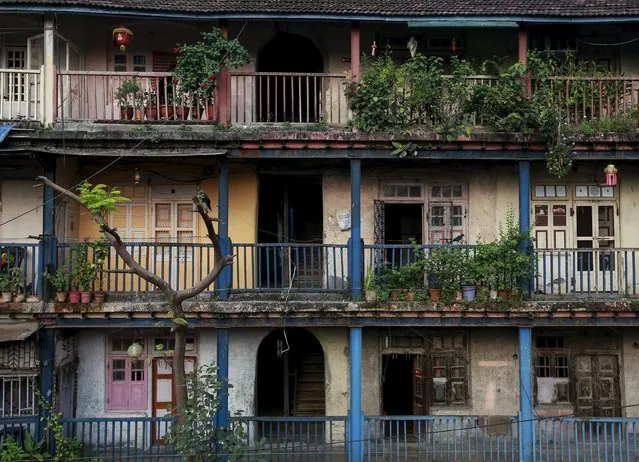
In Mumbai, the windows of new high-rise apartment blocks, old low-rise residential buildings and shantytown shacks portray the disparity in living conditions and incomes in the Indian city. Rents for a place to live range from more than $2,000 to less than $5 a month. Here: Windows and doors of an old residential building are pictured in central Mumbai October 10, 2014. The cost for buying a residential apartment in Mumbai close to the city centre ranges from 12,000 Indian rupees ($ 200) per square feet to 112,552 Indian rupees ($ 1800) per square feet. (Photo by Danish Siddiqui/Reuters)
Details
23 Apr 2015 12:29:00
8. NEW ZEALAND: A woman dives from a platform into a giant air bed at a park in Palmerston North September 29, 2011. (Photo by Marcos Brindicci/Reuters)

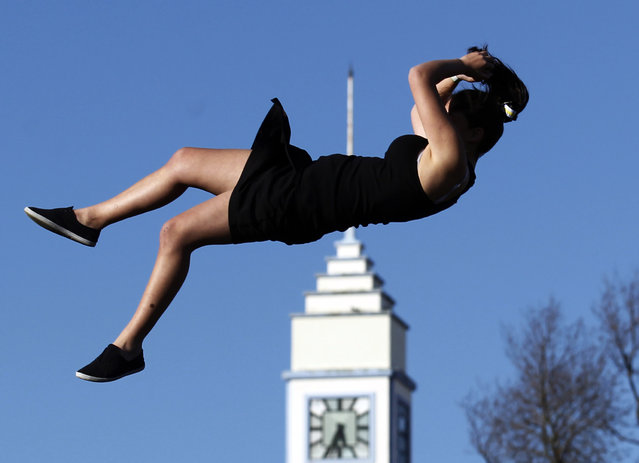
The report, prepared by the Sustainable Development Solutions Network (SDSN) and the Earth Institute at Columbia University, showed Syria, Afghanistan and eight sub-Saharan countries as the 10 least happy places on earth to live. The top 10 this year were Denmark, Switzerland, Iceland, Norway, Finland, Canada, Netherlands, New Zealand, Australia, and Sweden. Denmark was in third place last year, behind Switzerland and Iceland. The bottom 10 were Madagascar, Tanzania, Liberia, Guinea, Rwanda, Benin, Afghanistan, Togo, Syria and Burundi. The United States came in at 13, the United Kingdom at 23, France at 32, and Italy at 50. Here: #8. NEW ZEALAND: A woman dives from a platform into a giant air bed at a park in Palmerston North September 29, 2011. (Photo by Marcos Brindicci/Reuters)
Details
26 Mar 2016 13:19:00
A participant is hit by an orange during an annual carnival battle in the northern Italian town of Ivrea February 7, 2016. Dressed up as Middle Age kings' guards, a group of men ride in a horse-drawn carriage and pelt “foot soldiers” with oranges as thousands of people gather to re-enact a Middle Age battle when the townsfolk of Ivrea overthrew an evil king. In a strange twist, instead of swords and cross bows, these days the weapons of choice are oranges. (Photo by Stefano Rellandini/Reuters)

A participant is hit by an orange during an annual carnival battle in the northern Italian town of Ivrea February 7, 2016. Dressed up as Middle Age kings' guards, a group of men ride in a horse-drawn carriage and pelt “foot soldiers” with oranges as thousands of people gather to re-enact a Middle Age battle when the townsfolk of Ivrea overthrew an evil king. In a strange twist, instead of swords and cross bows, these days the weapons of choice are oranges. (Photo by Stefano Rellandini/Reuters)
Details
08 Feb 2016 12:03:00