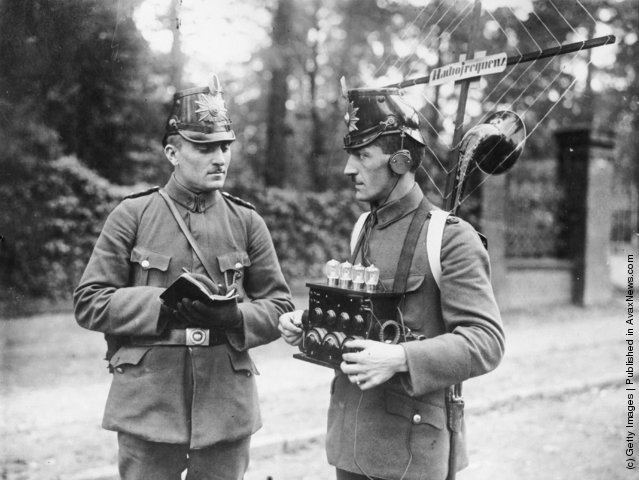
A member of the German wireless police picks up signals on the radio equipment he carries on his back, while his colleague takes notes. (Photo by General Photographic Agency/Getty Images). Circa 1925
Reuters Photographer Carlos Barria photographed a person born in each year China's one child policy has been in existence; from a man born in 1979, to a baby born in 2014, and asked them if they would have like to have siblings. Here: Lv Mengmeng, who was born in 1995, poses for a photograph in Shanghai August 22, 2014. When asked if she would like siblings, Mengmeng said: “Maybe brothers, because I think they could protect me”. (Photo by Carlos Barria/Reuters)
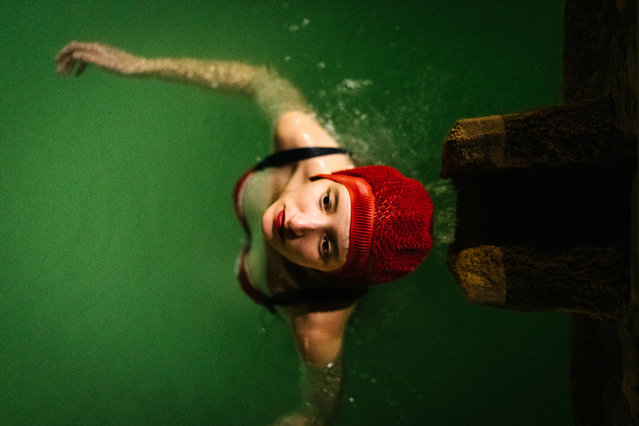
Shortlist, open competition, lifestyle. Healing Vibes – the hot springs of Bagno Vignoni in Italy flow out at a temperature of about 49°C. They were appreciated by the Romans for their healing powers, and have been used as therapeutic treatments since the 12th century, under Emperor Federico II. (Photo by Stefano Butturini/Sony World Photography Awards)
A police officer points his gun while confronting a gang during a protest against Prime Minister Ariel Henry's government and insecurity, in Port-au-Prince, Haiti on March 1, 2024. (Photo by Ralph Tedy Erol/Reuters)
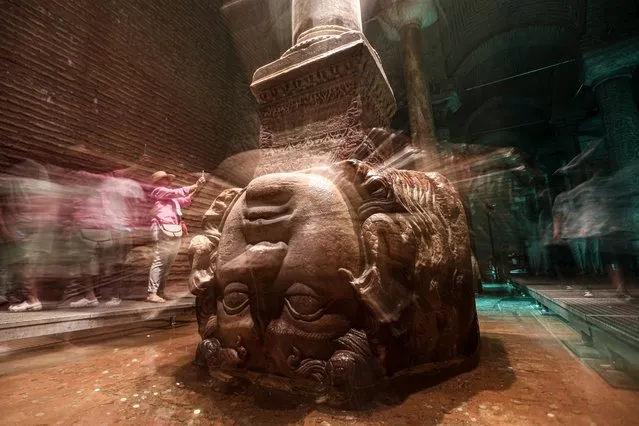
People walk behind the Medusa head in the Basilica Cistern in Istanbul, Turkey, 24 July 2022. The site has been restored by the Istanbul Metropolitan Municipality and is now open for visitors again. The Byzantine structure was commissioned by Emperor Justinian and built in 532. The underground Basilica, also called Underground Cistern, is the largest well preserved cistern in Istanbul, which rests on a total of 336 columns. According to historical texts, more than 7,000 slaves were involved in the construction of the cistern. (Photo by Sedat Suna/EPA/EFE)
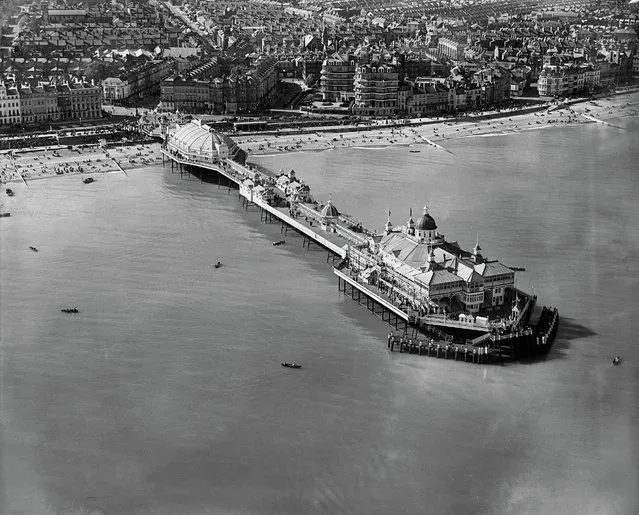
While the lido was described as bringing “modernism to the masses” on the British coast it was just the latest example of a trend that had been developing since Victorian times – transforming seaside towns into resorts for leisure and entertainment. In the latter half of the nineteenth century, the fashion was for local authorities to build great piers stretching from the promenade out into the sea. The Eastbourne Pier, pictured here in May 1931, was erected between 1866 and 1870 to an ingenious design by Eugenius Birch, which saw the structure sitting on special cups allowing the supporting struts to “move” in bad weather. Arranged on the pier's 1,000-foot length were kiosks, a theatre, a ballroom and a camera obscura. 1931. (Photo by Aerofilms Collection via “A History of Britain From Above”)
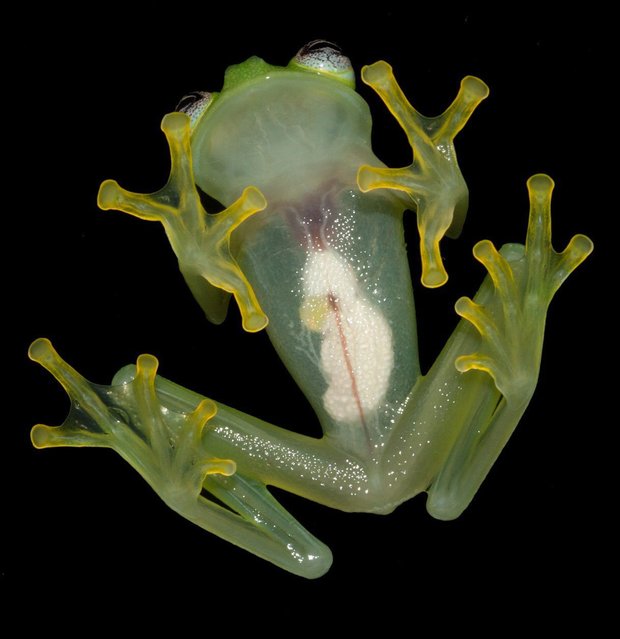
A handout photograph provided by Brian Kubicki of Costa Rican Amphibian Research Center on 26 April 2016 shows a “Crystal frog”, Hyalinobatrachium dianae (H. diane). This frog was discovered by US biologist Brian Kubicki and Costa Ricans Stanley Salazar and Robert Puschendorf in a rainy forest of Costa Rican caribbean after 40 years without notice of any new example of this kind. (Photo by Brian Kubicki/EPA/Costa Rican Amphibian Research Center)
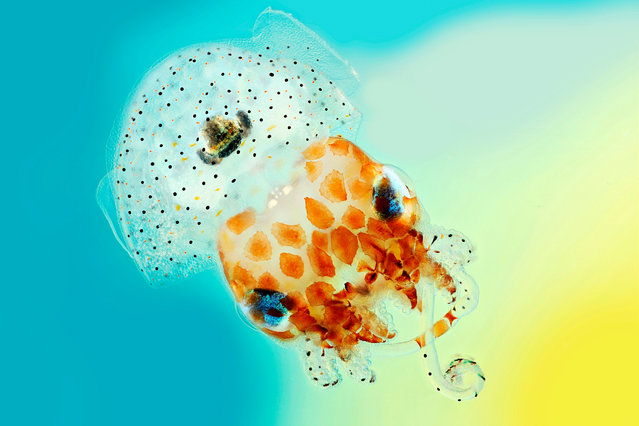
With its huge eyes, comical name and diminutive size, Mark R. Smith’s image of a baby Hawaiian bobtail squid can’t help but raise a smile. A curiously endearing creature, the cephalopod is just 1.5cm across, its mantle cavity bearing more than a passing resemblance to a rather natty shower cap. But it is also a beautiful example of symbiosis – nature’s version of “I’ll scratch your back if you scratch mine” – for on the underside of the squid is a light organ which houses bioluminescent bacteria. The squid offers the bacteria protection and food, while the bacteria emit a glow – a handy trait that the squid uses to offset its silhouette, helping it to evade predators in the depths below. Mark R. Smith’s entry combines several images of a Hawaiian bobtail squid with different focus lengths to create a final picture with greater depth of field than normal. (Photo by Mark R. Smith/Wellcome Images/Macroscopic Solutions)