Loading...
Done
“Locusts & Men”. Oppression, interaction, collaboration. In the life cycle of nature nothing is lost, but the coexistence of different species is sometimes difficult. In Madagascar periodically returns the archaic antagonism between man and the migratory locust, in a circle of life where the two species are looking for space and food for their survival. Photo location: Madagascar, 2013. (Photo and caption by Michele Martinelli/National Geographic Photo Contest)

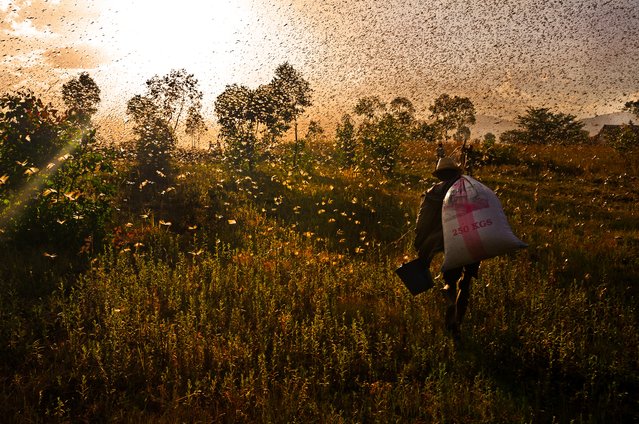
“Locusts & Men”. Oppression, interaction, collaboration. In the life cycle of nature nothing is lost, but the coexistence of different species is sometimes difficult. In Madagascar periodically returns the archaic antagonism between man and the migratory locust, in a circle of life where the two species are looking for space and food for their survival. At the end of the day a man walks home carrying on his shoulders the heavy bag which contains the locusts captured during the day. The insects provide nutritious meals for the man and his family. Photo location: Madagascar, 2013. (Photo and caption by Michele Martinelli/National Geographic Photo Contest)

ATTENTION! All pictures are presented in high resolution. To see Hi-Res images – just TWICE click on any picture. In other words, click small picture – opens the BIG picture. Click BIG picture – opens VERY BIG picture.
Details
03 Dec 2013 10:59:00
Participants ride horses, hold spears and wear historic armoured suits of the Middle Ages as they compete during the Saint George international knight tournament in Moscow, Russia, May 3, 2015. (Photo by Maxim Zmeyev/Reuters)

Participants ride horses, hold spears and wear historic armoured suits of the Middle Ages as they compete during the Saint George international knight tournament in Moscow, Russia, May 3, 2015. (Photo by Maxim Zmeyev/Reuters)
Details
09 May 2015 11:50:00
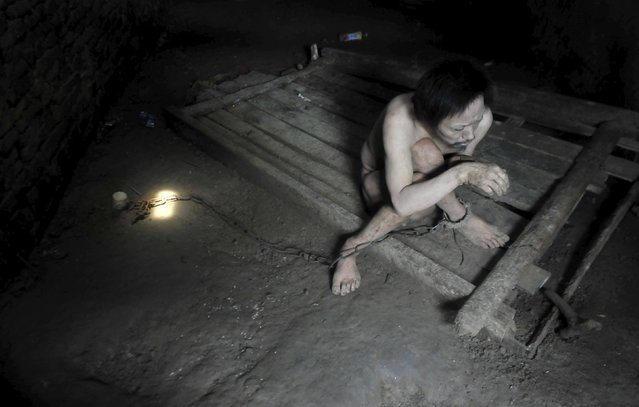
Tong Jieping, 44-year-old mentally disabled patient, is chained by his foot inside his room, in Qunxing village of Wangjiang county, Anhui province, China, July 14, 2015. Tong was diagnosed mentally ill when he was in his 20s. His parents, both in their 70s, could not afford the medical treatments so they had to lock him up in chains to prevent him from running away, according to Tong's family. (Photo by Reuters/Stringer)

Tong Jieping, 44-year-old mentally disabled patient, is chained by his foot inside his room, in Qunxing village of Wangjiang county, Anhui province, China, July 14, 2015. Tong was diagnosed mentally ill when he was in his 20s. His parents, both in their 70s, could not afford the medical treatments so they had to lock him up in chains to prevent him from running away, according to Tong's family. (Photo by Reuters/Stringer)
Details
15 Jul 2015 11:33:00
Pakistani female police commandos attend a training session in Nowshera, near Peshawar Pakistan, Wednesday, February 11, 2015. Authorities formed a Special Combat Unit after Taliban militants stormed a Peshawar school on Dec. 16, 2014 and massacred 150 children and teachers. (Photo by Mohammad Sajjad/AP Photo)

Pakistani female police commandos attend a training session in Nowshera, near Peshawar Pakistan, Wednesday, February 11, 2015. Authorities formed a Special Combat Unit after Taliban militants stormed a Peshawar school on Dec. 16, 2014 and massacred 150 children and teachers. (Photo by Mohammad Sajjad/AP Photo)
Details
14 Feb 2015 12:09:00
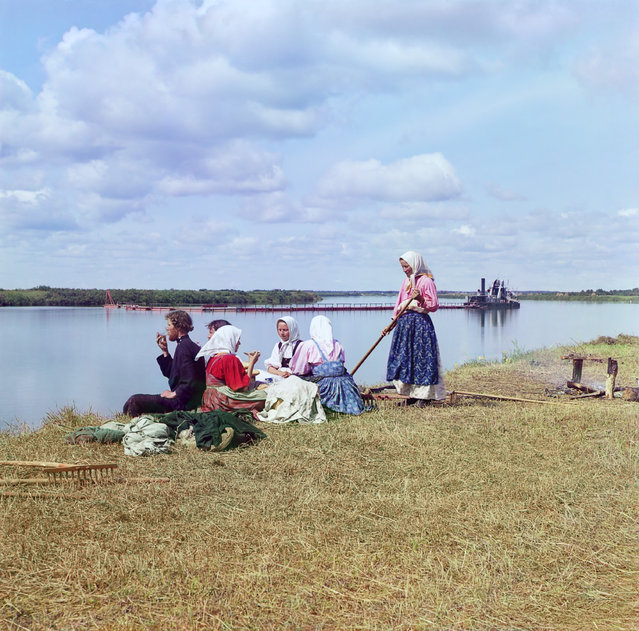
Photos by Sergey Prokudin-Gorsky. Dinner during haying. Russian Empire, Novgorod province, county Cherepovets, 1909

“Sergey Mikhaylovich Prokudin-Gorsky (August 30 1863 Russian Empire – September 27, 1944 Paris, France) was a Russian chemist and photographer. He is best known for his pioneering work in color photography of early 20th-century Russia”. – Wikipedia

Photo: Dinner during haying. Russian Empire, Novgorod province, county Cherepovets, 1909. (Photos by Sergey Prokudin-Gorsky via US Library of Congress and Prokudin-Gorsky.org)

P.S. All pictures are presented in high resolution. To see Hi-Res images – just TWICE click on any picture. In other words, click small picture – opens the BIG picture. Click BIG picture – opens VERY BIG picture (if available; this principle works anywhere on the site AvaxNews). Enjoy.
Details
24 Jul 2012 12:03:00
Masked women shout slogans during a demonstration marking the Latin American Day for Decriminalization of Therapeutic Abortion in Managua, Nicaragua, where abortions are illegal, on September 28, 2012. (Photo by Esteban Felix/Associated Press)

Masked women shout slogans during a demonstration marking the Latin American Day for Decriminalization of Therapeutic Abortion in Managua, Nicaragua, where abortions are illegal, on September 28, 2012. (Photo by Esteban Felix/Associated Press)
Details
03 Oct 2012 09:01:00
Models  backstage ahead of the St George New Generation show at Mercedes-Benz Fashion Week Australia 2015 at Carriageworks on April 16, 2015 in Sydney, Australia. (Photo by Brendon Thorne/Getty Images)

Models backstage ahead of the St George New Generation show at Mercedes-Benz Fashion Week Australia 2015 at Carriageworks on April 16, 2015 in Sydney, Australia. (Photo by Brendon Thorne/Getty Images)
Details
19 Apr 2015 09:20:00
Galapagos – Rocking the Cradle: Four major ocean currents converge along the Galapagos archipelago, creating the conditions for an extraordinary diversity of animal life, April 25, 2016. The islands are home to at least 7,000 flora and fauna species, of which 97 percent of the reptiles, 80 percent of the land birds, 50 percent of the insects and 30 percent of the plants are endemic. The local ecosystem is highly sensitive to the changes in temperature, rainfall and ocean currents that characterize the climatic events known as El Niño and La Niña. These changes cause marked fluctuations in weather and food availability. Many scientists expect the frequency of El Niño and La Niña to increase as a result of climate change, making the Galapagos a possible early-warning location for its effects. (Photo by Thomas P. Peschak for National Geographic/World Press Photo)

Galapagos – Rocking the Cradle: Four major ocean currents converge along the Galapagos archipelago, creating the conditions for an extraordinary diversity of animal life, April 25, 2016. The islands are home to at least 7,000 flora and fauna species, of which 97 percent of the reptiles, 80 percent of the land birds, 50 percent of the insects and 30 percent of the plants are endemic. (Photo by Thomas P. Peschak for National Geographic/World Press Photo)
Details
16 Apr 2018 00:01:00