Loading...
Done
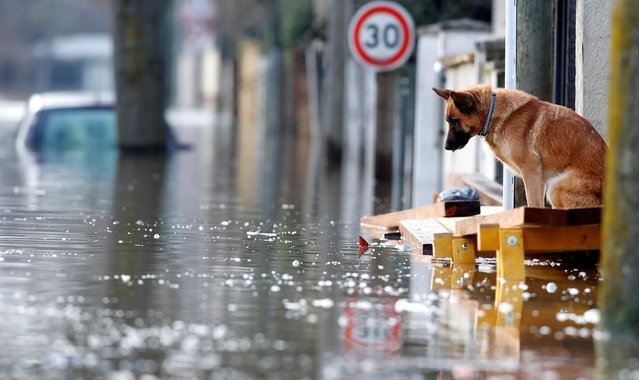
A dog is seen at the entrance of a house in the flooded residential area of Villeneuve-Saint-Georges, near Paris, France January 26, 2018. (Photo by Christian Hartmann/Reuters)

A dog is seen at the entrance of a house in the flooded residential area of Villeneuve-Saint-Georges, near Paris, France January 26, 2018. The Paris region has been deeply affected by the floods that hit the country over the past week, but in Paris, it was business as usual. (Photo by Christian Hartmann/Reuters)
Details
27 Jan 2018 07:16:00
A woman looks at head of bluefin tuna on display in front of a store at Tsukiji fish market in Tokyo, Monday, February 19, 2018.  The large bluefin are particularly valuable in Japan, where they are considered a premium sushi and sashimi fish. A single fish sold for more than $1.75 million at an auction in Japan in 2013. (Photo by Koji Sasahara/AP Photo)

A woman looks at head of bluefin tuna on display in front of a store at Tsukiji fish market in Tokyo, Monday, February 19, 2018. The large bluefin are particularly valuable in Japan, where they are considered a premium sushi and sashimi fish. A single fish sold for more than $1.75 million at an auction in Japan in 2013. (Photo by Koji Sasahara/AP Photo)
Details
06 Mar 2018 00:05:00
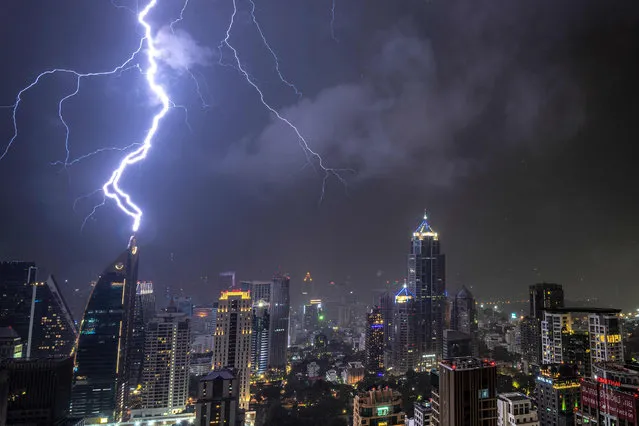
In this picture taken on October 27, 2019 lightening strikes on a building during a thunderstorm in Bangkok. (Photo by Mladen Antonov/AFP Photo)

In this picture taken on October 27, 2019 lightening strikes on a building during a thunderstorm in Bangkok. (Photo by Mladen Antonov/AFP Photo)
Details
31 Jan 2020 00:01:00
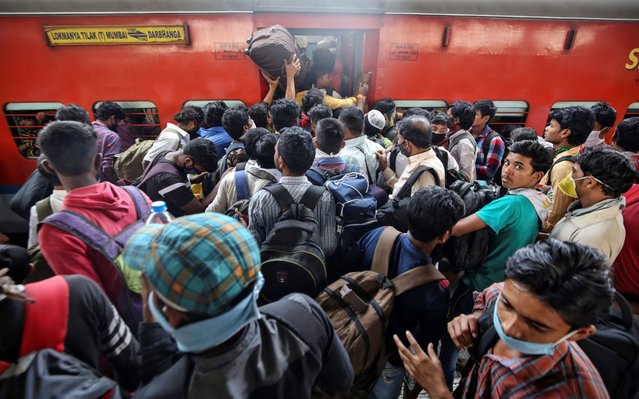
Migrant workers and their families board an overcrowded passenger train, after government imposed restrictions on public gatherings in attempts to prevent spread of coronavirus disease (COVID-19), in Mumbai, India, March 21, 2020. (Photo by Prashant Waydande/Reuters)

Migrant workers and their families board an overcrowded passenger train, after government imposed restrictions on public gatherings in attempts to prevent spread of coronavirus disease (COVID-19), in Mumbai, India, March 21, 2020. (Photo by Prashant Waydande/Reuters)
Details
29 Mar 2020 00:01:00
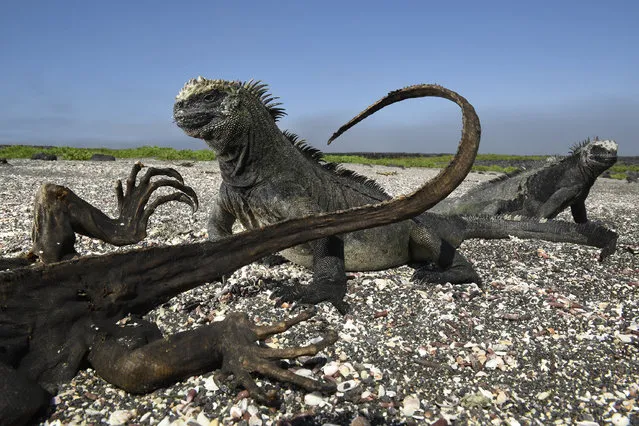
Galapagos – Rocking the Cradle: Four major ocean currents converge along the Galapagos archipelago, creating the conditions for an extraordinary diversity of animal life, April 25, 2016. The islands are home to at least 7,000 flora and fauna species, of which 97 percent of the reptiles, 80 percent of the land birds, 50 percent of the insects and 30 percent of the plants are endemic. The local ecosystem is highly sensitive to the changes in temperature, rainfall and ocean currents that characterize the climatic events known as El Niño and La Niña. These changes cause marked fluctuations in weather and food availability. Many scientists expect the frequency of El Niño and La Niña to increase as a result of climate change, making the Galapagos a possible early-warning location for its effects. (Photo by Thomas P. Peschak for National Geographic/World Press Photo)

Galapagos – Rocking the Cradle: Four major ocean currents converge along the Galapagos archipelago, creating the conditions for an extraordinary diversity of animal life, April 25, 2016. The islands are home to at least 7,000 flora and fauna species, of which 97 percent of the reptiles, 80 percent of the land birds, 50 percent of the insects and 30 percent of the plants are endemic. (Photo by Thomas P. Peschak for National Geographic/World Press Photo)
Details
16 Apr 2018 00:01:00
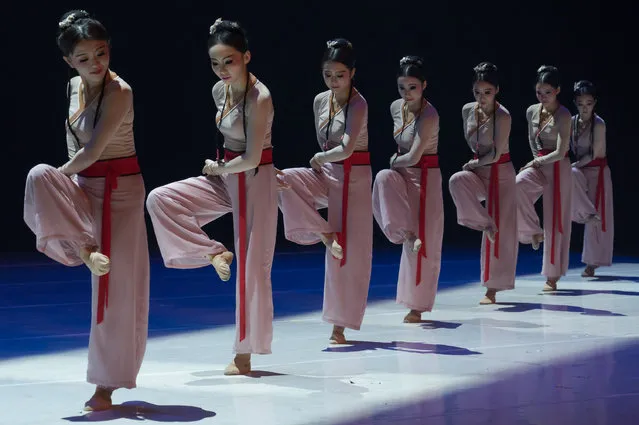
Artists from the Beijing Dance Academy perform to celebrate the Chinese Lunar New Year in Budapest, capital of Hungary, February 6, 2019. (Photo by Attila Volgyi/Xinhua News Agency/Barcroft Media)

Artists from the Beijing Dance Academy perform to celebrate the Chinese Lunar New Year in Budapest, capital of Hungary, February 6, 2019. (Photo by Attila Volgyi/Xinhua News Agency/Barcroft Media)
Details
08 Feb 2019 06:23:00
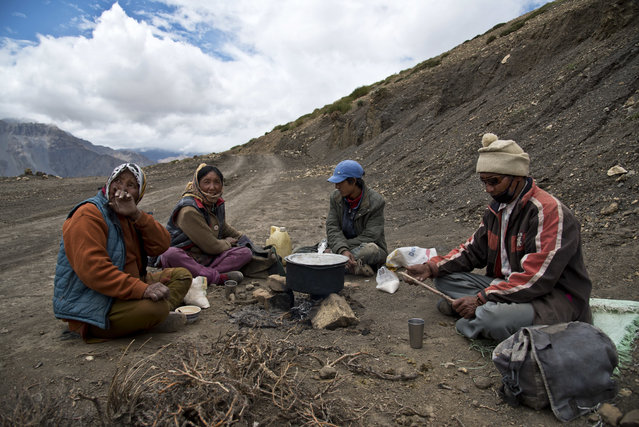
In this August 17, 2016, photo, from left to right, Chhering Chodom, 60, Tashi Yangzom, 50, Lobsang Chhering, 27, and Dorje Tandup, 58, drink milk tea on the side of the road. For centuries, the sleepy valley nestled in the Indian Himalayas remained a hidden Buddhist enclave forbidden to outsiders. Enduring the harsh year-round conditions of the high mountain desert, the people of Spiti Valley lived by a simple communal code – share the Earth's bounty, be hospitable to neighbors, and eschew greed and temptation at all turns. That's all starting to change, for better or worse. Since India began allowing its own citizens as well as outsiders to visit the valley in the early 1990s, tourism and trade have boomed. And the marks of modernization, such as solar panels, asphalt roads and concrete buildings, have begun to appear around some of the villages that dot the remote landscape at altitudes above 4,000 meters (13,000 feet). (Photo by Thomas Cytrynowicz/AP Photo)

In this August 17, 2016, photo, from left to right, Chhering Chodom, 60, Tashi Yangzom, 50, Lobsang Chhering, 27, and Dorje Tandup, 58, drink milk tea on the side of the road. For centuries, the sleepy valley nestled in the Indian Himalayas remained a hidden Buddhist enclave forbidden to outsiders. Enduring the harsh year-round conditions of the high mountain desert, the people of Spiti Valley lived by a simple communal code – share the Earth's bounty, be hospitable to neighbors, and eschew greed and temptation at all turns. That's all starting to change, for better or worse. (Photo by Thomas Cytrynowicz/AP Photo)
Details
15 Sep 2016 09:22:00
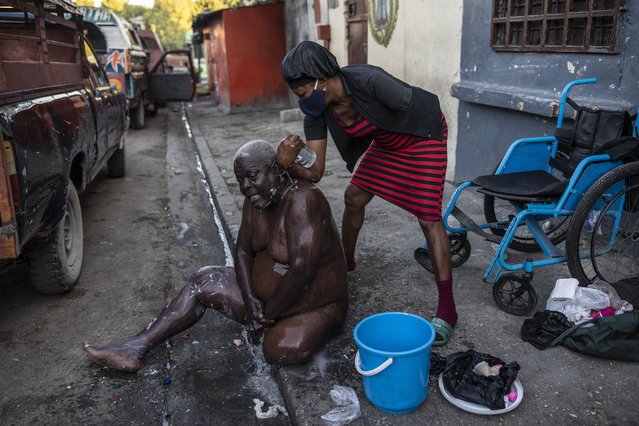
Marie Joseph bathes her friend Jean Robert outside a shelter for the internally displaced where they live due to police violence in Port-au-Prince, Haiti, Thursday, September 16, 2021. Most of the population of Port-au-Prince has no access to basic public services, no drinking water, electricity or garbage collection. (Photo by Rodrigo Abd/AP Photo)

Marie Joseph bathes her friend Jean Robert outside a shelter for the internally displaced where they live due to police violence in Port-au-Prince, Haiti, Thursday, September 16, 2021. Most of the population of Port-au-Prince has no access to basic public services, no drinking water, electricity or garbage collection. (Photo by Rodrigo Abd/AP Photo)
Details
26 Oct 2021 08:34:00