Loading...
Done
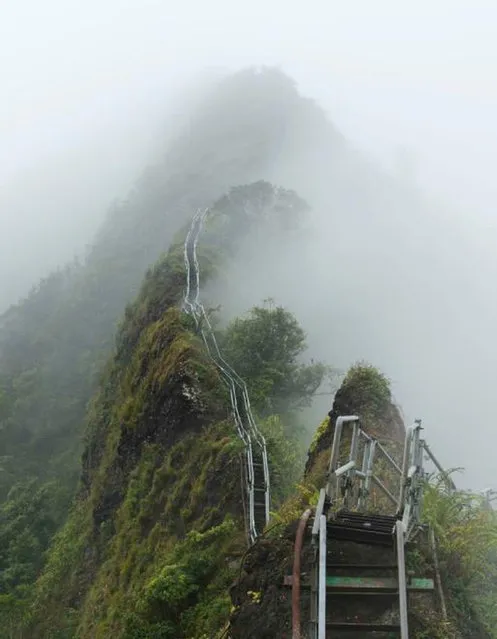
Stairway To Heaven In Hawaii

The Haʻikū Stairs, also known as the Stairway to Heaven or Haʻikū Ladder, is a steep hiking trail on the island of Oʻahu. The trail began as a wooden ladder spiked to the cliff on the south side of the Haʻikū Valley. It was installed in 1942 to enable antenna cables to be strung from one side of the cliffs above Haʻikū Valley to the other. A building to provide a continuous communication link between Wahiawā and Haʻikū Valley Naval Radio Station was constructed at the peak of Puʻukeahiakahoe, elevation about 2,800 feet (850 m). The antennae transmitted very low frequency radio signals from a 200,000-watt Alexanderson alternator in the center of Haʻikū valley. The signals could reach US Navy submarines as far away as Tokyo Bay while the submarines were submerged.
Details
30 Nov 2013 12:47:00


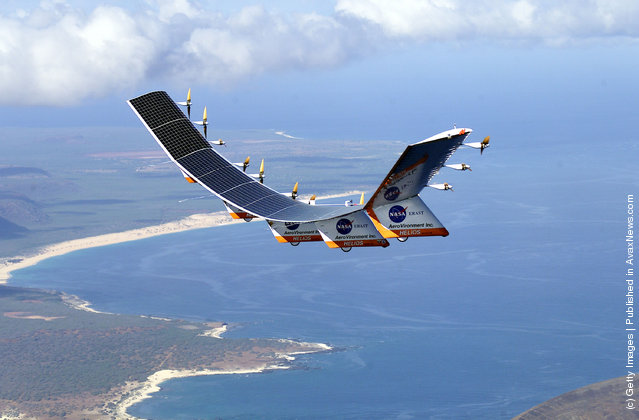
“NASA's Pathfinder, Pathfinder Plus, Centurion and Helios Prototype were an evolutionary series of solar- and fuel-cell-system-powered unmanned aerial vehicles. AeroVironment, Inc. developed the vehicles under NASA's Environmental Research Aircraft and Sensor Technology (ERAST) program. They were built to develop the technologies that would allow long-term, high-altitude aircraft to serve as “atmospheric satellites”, to perform atmospheric research tasks as well as serve as communications platforms”. – Wikipedia

Photo: The solar-electric Helios Prototype flying wing is flies over the Hawaiian islands of Niihau and Lehua during the first solar-powered test flight July 14, 2001 from the U.S. Navy's Pacific Missile Range Facility on Kauai, HI. The 18-hour flight was a functional checkout of the aircraft's systems and performance in preparation for an attempt to reach sustained flight at 100,000 feet altitude later in the summer. (Photo Courtesy of NASA/Getty Images)
Details
14 Jul 2011 09:24:00
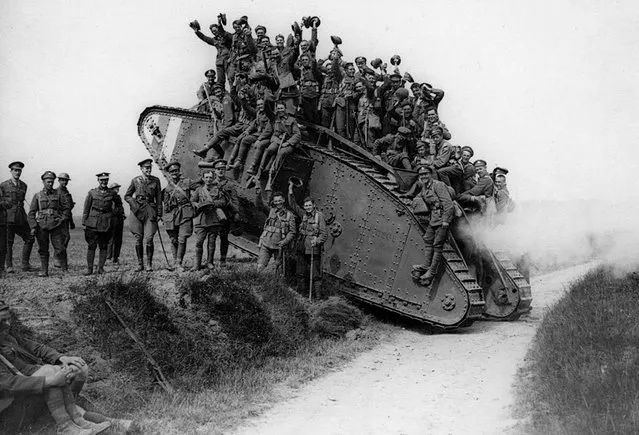
These black-and-white photos are taken from the new book “Armoured Warfare in the First World War 1916 – 1918” by Anthony Tucker-Jones and published by Pen & Sword Military. “Interestingly the British, French and Germans took completely different approaches with varying results”. The British military produced “Little Willie” in Autumn 1915 weighing 18 tonnes, which had a crew of two plus four gunners. “Inspired by a tracked artillery tractor “Little Willie” was referred to as a water tank – hence the name tank – to ensure secrecy”, said Anthony. “This led to the strange looking Mark I with its peculiar rhomboid shape, designed to cross trenches with guns in sponsons on either side. The Germans saw the tank as unchivalrous and were slow to grasp its utility. They favoured the Stormtrooper (specialist soldiers used to infiltrate enemy trenches) and artillery, not the tank”, said Anthony. “However, they didn’t hesitate to make use of captured British tanks. Although the tank helped secure victory and German soldiers dubbed it “Germany’s Downfall” the country was ultimately brought to its knees by the Allies blockade”. Here: British troops hitch a ride on a Mark IV after the massed tank fleet spearheading attack at Cambrai on November 20, 1917. (Photo by Anthony Tucker-Jones/Mediadrumworld.com)

These black-and-white photos are taken from the new book “Armoured Warfare in the First World War 1916 – 1918” by Anthony Tucker-Jones and published by Pen & Sword Military. Here: British troops hitch a ride on a Mark IV after the massed tank fleet spearheading attack at Cambrai on November 20, 1917. (Photo by Anthony Tucker-Jones/Mediadrumworld.com)
Details
23 Feb 2017 00:02:00
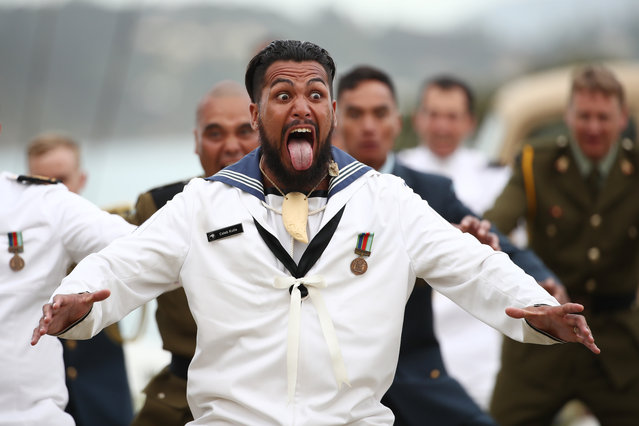
New Zealand Defence Force personal perform a haka during Te Rau Aroha, an evening to commemorate Maori service in the New Zealand Armed Forces on February 05, 2020 in Waitangi, New Zealand. The Waitangi Day national holiday celebrates the signing of the treaty of Waitangi on February 6, 1840 by Maori chiefs and the British Crown, that granted the Maori people the rights of British Citizens and ownership of their lands and other properties. (Photo by Fiona Goodall/Getty Images)

New Zealand Defence Force personal perform a haka during Te Rau Aroha, an evening to commemorate Maori service in the New Zealand Armed Forces on February 05, 2020 in Waitangi, New Zealand. The Waitangi Day national holiday celebrates the signing of the treaty of Waitangi on February 6, 1840 by Maori chiefs and the British Crown, that granted the Maori people the rights of British Citizens and ownership of their lands and other properties. (Photo by Fiona Goodall/Getty Images)
Details
07 Feb 2020 00:07:00
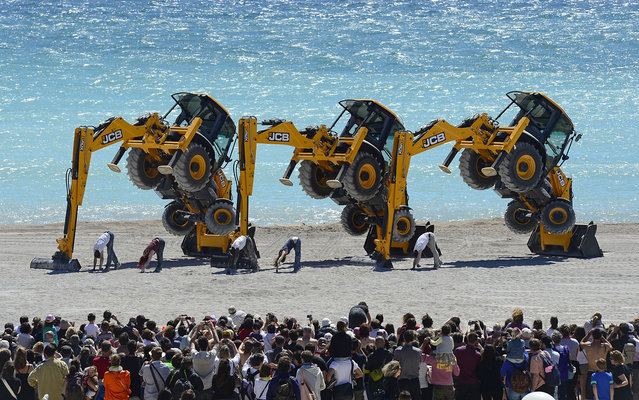
Dancers from the British theater company Motionhouse perform a show with excavators entitled “Traction” on the Prado beach in Marseille, France, on May 10, 2013. (Photo by Boris Horvat/AFP Photo)

Dancers from the British theater company Motionhouse perform a show with excavators entitled “Traction” on the Prado beach in Marseille, France, on May 10, 2013. (Photo by Boris Horvat/AFP Photo)
Details
11 May 2013 12:36:00
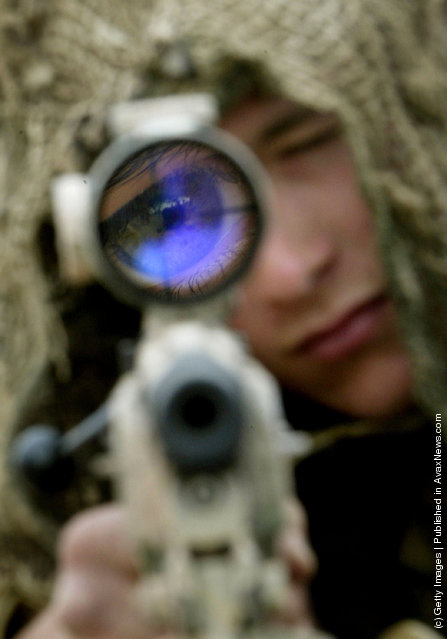
A British soldier from 3 Commando Brigade looks through the sight of his sniper rifle at Camp Gibraltar

A British soldier from 3 Commando Brigade looks through the sight of his sniper rifle at Camp Gibraltar February 24, 2003 near Kuwait City, Kuwait. (Photo by Ian Waldie/Getty Images)
Details
21 Dec 2011 13:45:00
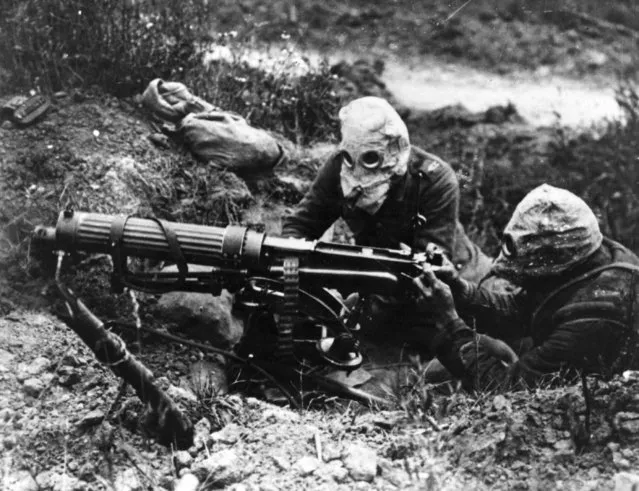
Gas-masked men of the British Machine Gun Corps with a Vickers machine gun during the first battle of the Somme, 1916. (Photo by General Photographic Agency/Getty Images)

Gas-masked men of the British Machine Gun Corps with a Vickers machine gun during the first battle of the Somme, 1916. (Photo by General Photographic Agency/Getty Images)
Details
14 Sep 2016 10:21:00
Rita Ora strips down to promote the new Tezenis lingerie range on December 7, 2016. The British singer, 26, shows off her curves in the latest campaign for the Italian brand. (Photo by Splash News/Tezenis)

Rita Ora strips down to promote the new Tezenis lingerie range on December 7, 2016. The British singer, 26, shows off her curves in the latest campaign for the Italian brand. (Photo by Splash News/Tezenis)
Details
11 Dec 2016 12:46:00