Loading...
Done


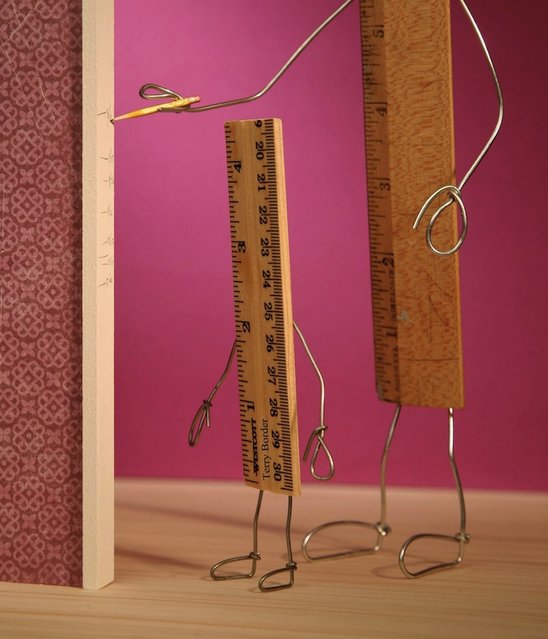
If you're not familiar with Terry's work, he takes boring, everyday objects and makes them come alive! The best thing about it is that it can be enjoyed by everyone. Young or old, we can all get a good chuckle out of his hilarious Bent Objects.
Details
29 May 2012 02:59:00
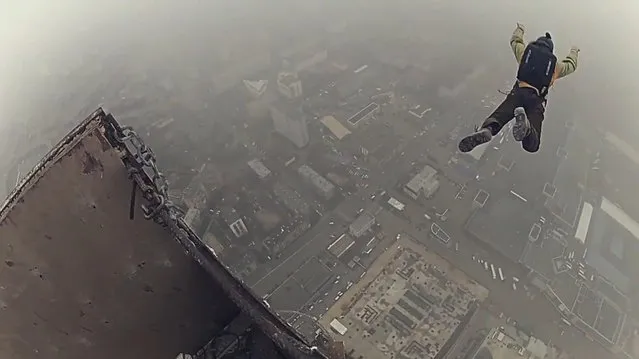
How to Illegally Climb up on the Highest Construction Crane in Europe

This is a story about how get to the top of the crane that mounted on the roof of the tallest building in Europe. So... its illegal and unsafe =)
Details
21 Dec 2012 09:34:00


The Last Bell (we mean the bell that informs the pupils about the beginning or the ending of the lessons) is the traditional feast of the Russian pupils who leave the school. The Last School Bell feast occurs in the end of May, when the school year has already finished, but the final examinations have not begun yet. (Read more...)
Details
02 Jun 2011 13:39:00
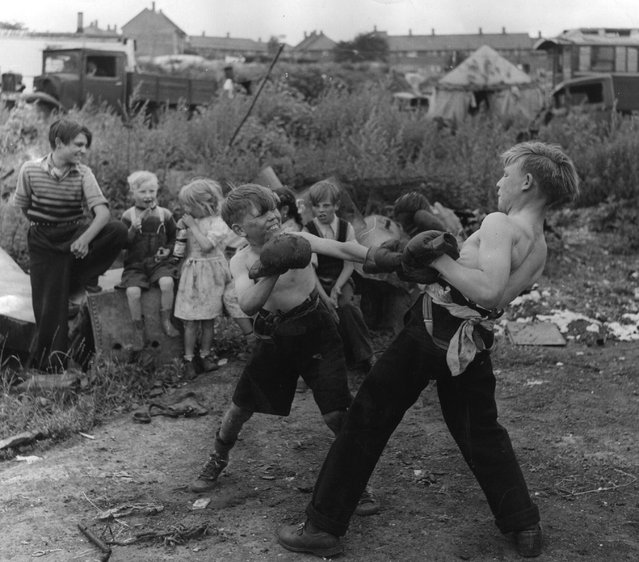
The unromantic gypsies. Children boxing in a gypsy camp in Kent, England on July 1, 1951. Like all boys these gypsy lads like to try their hand at boxing. Encouraged by their friends they fight it out on Corke's Meadow. Few Romanies now live a life of wandering romance. Most are like the three hundred squatters of Corke's Meadow, Kent, which is part of a “gypsy problem” that involves about 100,000 today. Of those about 25,000 can be rightly called gypsies, the rest are Mumpers and Posh-rats and Hobos. Corke's Meadow has both kinds. “Picture Post” cameraman Bert Hardy photographs the Corke's Meadow gypsies in their encampment. (Photo by Hulton-Deutsch Collection/Corbis via Getty Images)

The unromantic gypsies. Children boxing in a gypsy camp in Kent, England on July 1, 1951. Like all boys these gypsy lads like to try their hand at boxing. Encouraged by their friends they fight it out on Corke's Meadow. Few Romanies now live a life of wandering romance. Most are like the three hundred squatters of Corke's Meadow, Kent, which is part of a “gypsy problem” that involves about 100,000 today. Of those about 25,000 can be rightly called gypsies, the rest are Mumpers and Posh-rats and Hobos. Corke's Meadow has both kinds. “Picture Post” cameraman Bert Hardy photographs the Corke's Meadow gypsies in their encampment. (Photo by Hulton-Deutsch Collection/Corbis via Getty Images)
Details
12 Mar 2017 00:01:00
A woman browses through kimonos for sale at Boroichi flea market in Tokyo December 15, 2014. In the 16th century, Boroichi was a place for farmers to buy and sell rags, known as boro, for mending clothes and weaving sandals. Now in its 436th year, the original spirit lingers, with about 700 stands hawking fabric, used clothes and piles of rags. Others sell kitchen tools, pottery, seaweed and spices. (Photo by Thomas Peter/Reuters)

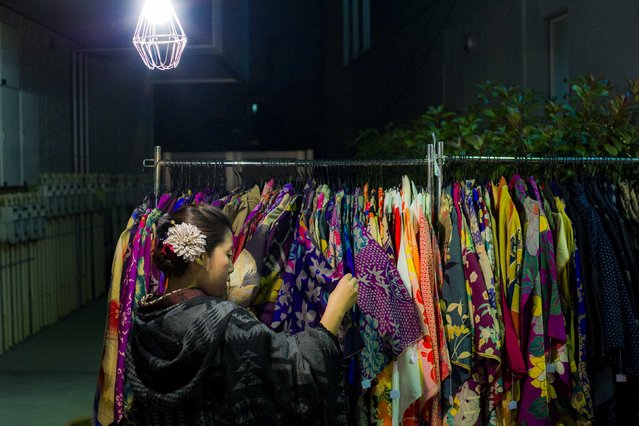
A woman browses through kimonos for sale at Boroichi flea market in Tokyo December 15, 2014. In the 16th century, Boroichi was a place for farmers to buy and sell rags, known as boro, for mending clothes and weaving sandals. Now in its 436th year, the original spirit lingers, with about 700 stands hawking fabric, used clothes and piles of rags. Others sell kitchen tools, pottery, seaweed and spices. About 200,000 people flock to the market, which is only open for four mid-winter days a year – two in December and two in January. (Photo by Thomas Peter/Reuters)
Details
19 Dec 2014 12:50:00
Photographer Sandro Giordoan has created a photo series of people who look like they’ve just taken terrible falls, spilling all their things around them. “Each shot ‘tells’ about worn out characters who, as if a sudden black-out of mind and body took over, let themselves crash with no attempt to save themselves, unable, because of the fatigue of the everyday ‘representation’ of living, oppressed by ‘appearance’ instead of simply ‘existing’,” said Giordano. (Photo by Sandro Giordoan)

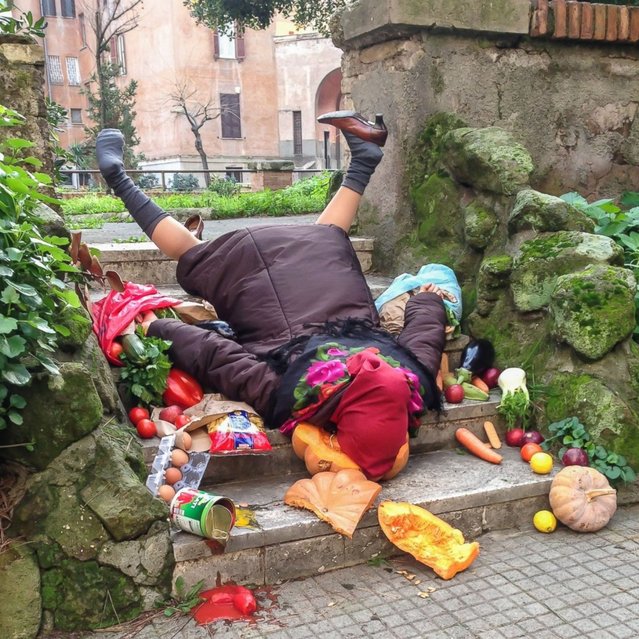
Photographer Sandro Giordoan has created a photo series of people who look like they’ve just taken terrible falls, spilling all their things around them. “Each shot ‘tells’ about worn out characters who, as if a sudden black-out of mind and body took over, let themselves crash with no attempt to save themselves, unable, because of the fatigue of the everyday ‘representation’ of living, oppressed by ‘appearance’ instead of simply ‘existing’,” said Giordano. (Photo by Sandro Giordoan)
Details
26 Jun 2014 11:46:00
Villagers from the Porto Novo community load into their canoes arapaima or pirarucu, the largest freshwater fish species in South America and one of the largest in the world, while fishing in Poco Fundo lake along a branch of the Solimoes river, one of the main tributaries of the Amazon, in the Mamiraua nature reserve near Fonte Boa about 600 km (373 miles) west of Manaus, November 26, 2013. (Photo by Bruno Kelly/Reuters)

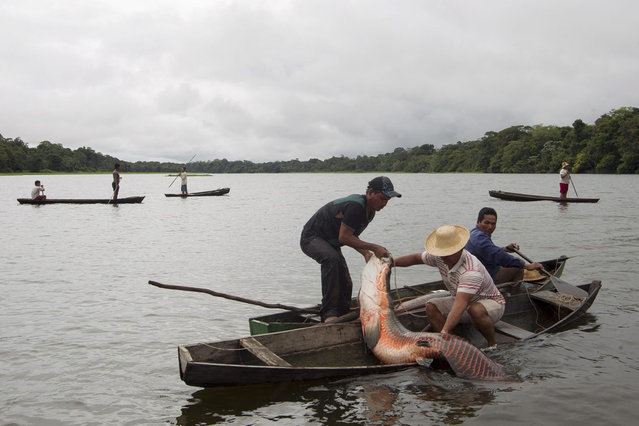
Villagers from the Porto Novo community load into their canoes arapaima or pirarucu, the largest freshwater fish species in South America and one of the largest in the world, while fishing in Poco Fundo lake along a branch of the Solimoes river, one of the main tributaries of the Amazon, in the Mamiraua nature reserve near Fonte Boa about 600 km (373 miles) west of Manaus, November 26, 2013. Catching the arapaima, a fish that is sought after for its meat and is considered by biologists to be a living fossil, is only allowed once a year by Brazil's environmental protection agency. The minimum size allowed for a fisherman to keep an arapaima is 1.5 meters (4.9 feet). (Photo by Bruno Kelly/Reuters)
Details
17 Dec 2013 08:03:00
Mikhail Kalashnikov, the father of the world's most popular assault rifle, is handed  an AK-74 November 23, 2002 in Izhevsk,1000 East km. from Moscow. November 23 marked the 55th anniversary of the release of the first Kalashnikov gun. According to the Moscow-based Center for Analysis of Strategic and Technologies some 70 million to 100 million Kalashnikovs have been built worldwide since 1947, compared about 7 million to Kalashnikov's Western rival the M-16 assault rifles. (Photo by Oleg Nikishin/Getty Images)

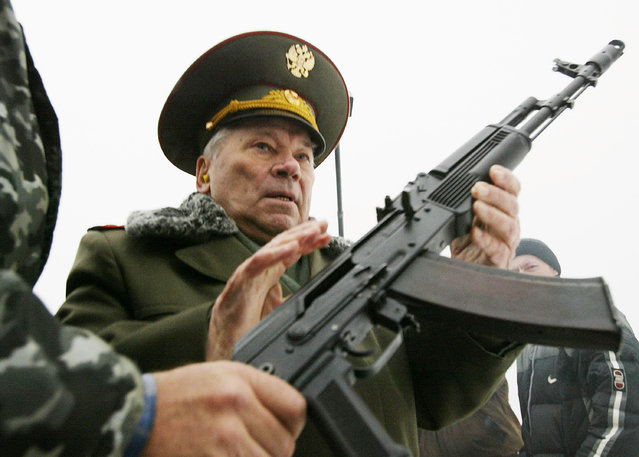
Mikhail Kalashnikov, the father of the world's most popular assault rifle, is handed an AK-74 November 23, 2002 in Izhevsk,1000 East km. from Moscow. November 23 marked the 55th anniversary of the release of the first Kalashnikov gun. According to the Moscow-based Center for Analysis of Strategic and Technologies some 70 million to 100 million Kalashnikovs have been built worldwide since 1947, compared about 7 million to Kalashnikov's Western rival the M-16 assault rifles. (Photo by Oleg Nikishin/Getty Images)
Details
24 Dec 2013 09:12:00