Loading...
Done
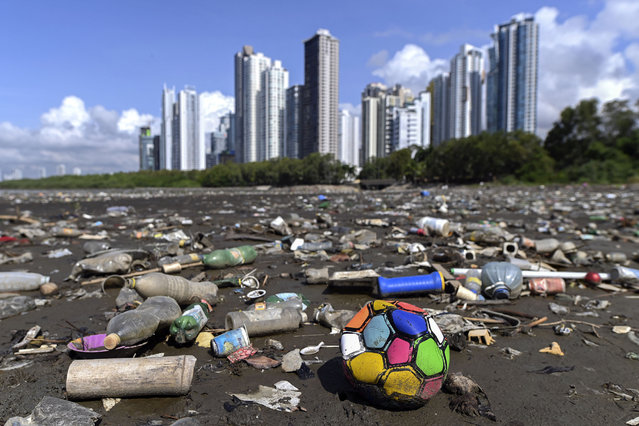
Garbage, including plastic waste, is seen at the beach of Costa del Este, in Panama City, on April 19, 2021. Every two weeks, Marine Biology students descend about five meters in the sea to take care of a coral nursery of the staghorn species (Acropora cervicornis) in Portobelo, Panama, with which they aim to restore reefs damaged by climate change and pollution, as part of the Reef2Reef project. (Photo by Luis Acosta/AFP Photo)

Garbage, including plastic waste, is seen at the beach of Costa del Este, in Panama City, on April 19, 2021. Every two weeks, Marine Biology students descend about five meters in the sea to take care of a coral nursery of the staghorn species (Acropora cervicornis) in Portobelo, Panama, with which they aim to restore reefs damaged by climate change and pollution, as part of the Reef2Reef project. (Photo by Luis Acosta/AFP Photo)
Details
21 Jun 2021 07:30:00
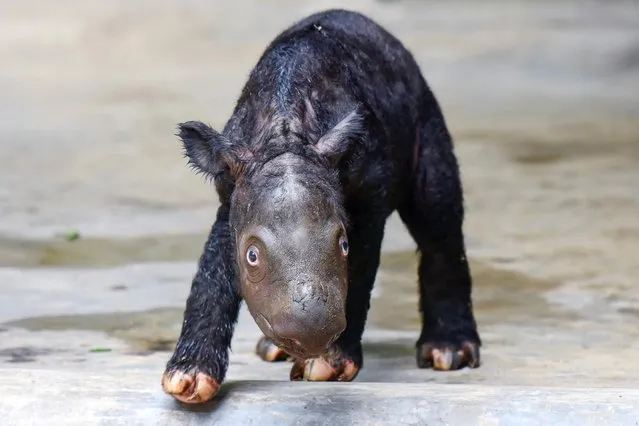
In this undated photo released by Indonesian Ministry of Environment and Forestry, a newly born Sumatran rhino calf walks in its enclosure at Sumatran Rhino Sanctuary at Way Kambas National Park, Indonesia. The critically endangered Sumatran rhino was born on Sumatra Island Saturday, November 25, 2023, the second Sumatran rhino born in the country this year and a welcome addition to a species that currently numbers fewer than 50 animals. (Photo by Indonesian Ministry of Environment and Forestry via AP Photo)

In this undated photo released by Indonesian Ministry of Environment and Forestry, a newly born Sumatran rhino calf walks in its enclosure at Sumatran Rhino Sanctuary at Way Kambas National Park, Indonesia. The critically endangered Sumatran rhino was born on Sumatra Island Saturday, November 25, 2023, the second Sumatran rhino born in the country this year and a welcome addition to a species that currently numbers fewer than 50 animals. (Photo by Indonesian Ministry of Environment and Forestry via AP Photo)
Details
17 Dec 2023 05:52:00
Impossible Animals By Jan Oliehoek. Part2

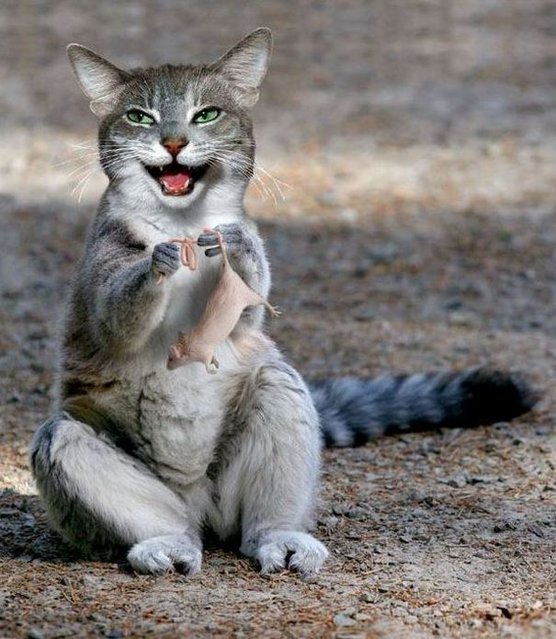
We’re showcasing photo-manipulation by Jan Oliehoek, a Dutch artist with a love for animals, photography and Photoshop. Oliehoek loves creating animal species that somehow never made it into our biology books, such as felines with rodent heads, lambs with the body of a squirrel, zebra rhinos and hippo-frogs! He’s currently having two of his pictures featured in Crazy Photography, an upcoming title from Vivays Publishing
Details
25 May 2013 11:56:00
Ocean Ramsey freediving with a shark. (Photo by Juan Oliphant/Caters News)

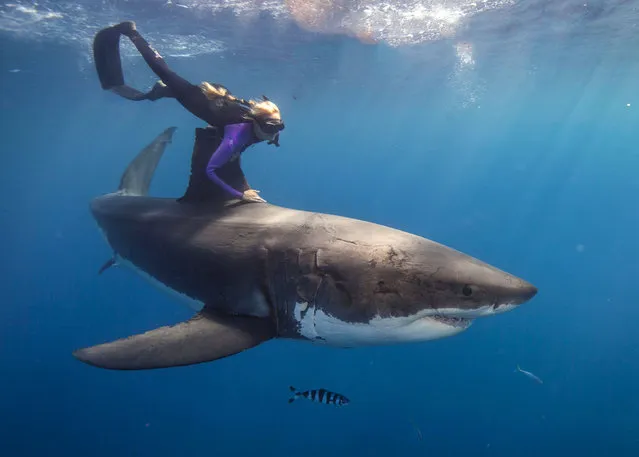
“Meet the woman dispelling the myths about one of the worlds most feared ocean predators by swimming without protection with great white sharks. Petite beauty Ocean Ramsey travels the globe swimming with many species of sharks hoping to prove they are nothing like their Jaws film reputation”. – Caters News. Photo: Ocean Ramsey freediving with a shark. (Photo by Juan Oliphant/Caters News)
Details
26 Feb 2014 11:09:00
Waitomo Glowworm Caves New Zealand

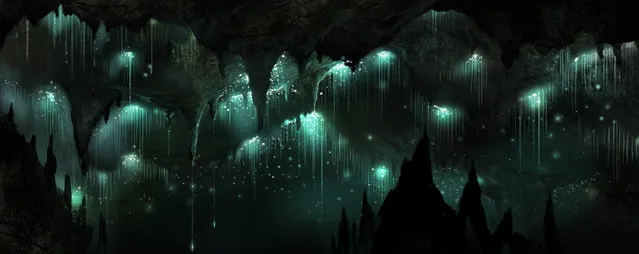
The Waitomo Glowworm Caves attraction is a cave at Waitomo on the North Island of New Zealand, known for its population of glowworms, Arachnocampa luminosa. This species is found exclusively in New Zealand. They are around the size of an average mosquito. This cave is part of the Waitomo Caves system that includes the Ruakuri Cave and the Aranui Cave.
Details
12 May 2014 09:55:00
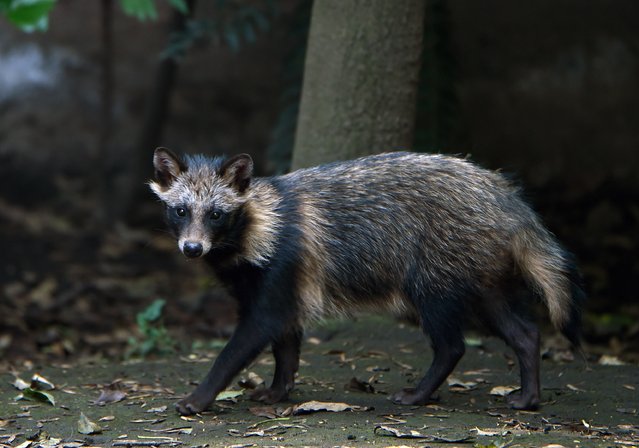
View of a raccoon dog or Tanuki (Nyctereutes procyonoides) at the Chapultpec Zoo in Mexico City on August 06, 2015. (Photo by Alfredo Estrella/AFP Photo)

View of a raccoon dog or Tanuki (Nyctereutes procyonoides) at the Chapultpec Zoo in Mexico City on August 06, 2015. This species is native from Japan and China. (Photo by Alfredo Estrella/AFP Photo)
Details
05 Mar 2016 11:37:00
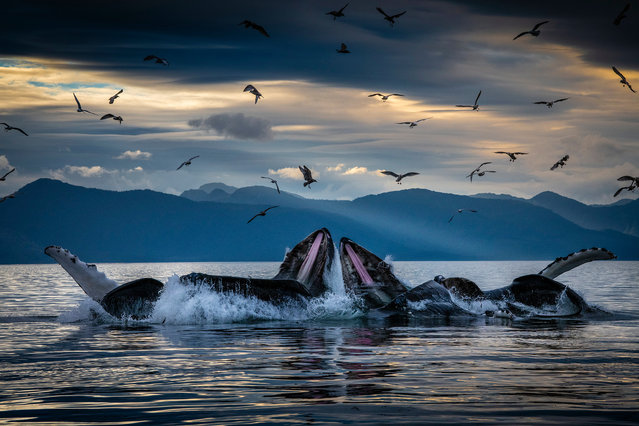
“Secrets of the Whales”. Skerry’s photographs celebrate the lives and culture of whales, illuminating recent research and their diverse behaviours. His latest work focuses on four key species: sperm whales, humpbacks, orca and beluga whales. Humpback whales bubble-net feeding off the coast of Alaska. They work cooperatively to feed on herring by blowing a perfect ring of bubbles underwater to form a net encircling the fish. The whales then swim up through the centre of the bubble net with their mouths open. (Photo by Brian Skerry/National Geographic Photo/Visa pour l'Image)

“Secrets of the Whales”. Skerry’s photographs celebrate the lives and culture of whales, illuminating recent research and their diverse behaviours. His latest work focuses on four key species: sperm whales, humpbacks, orca and beluga whales. Humpback whales bubble-net feeding off the coast of Alaska. They work cooperatively to feed on herring by blowing a perfect ring of bubbles underwater to form a net encircling the fish. The whales then swim up through the centre of the bubble net with their mouths open. (Photo by Brian Skerry/National Geographic Photo/Visa pour l'Image)
Details
04 Sep 2021 09:02:00
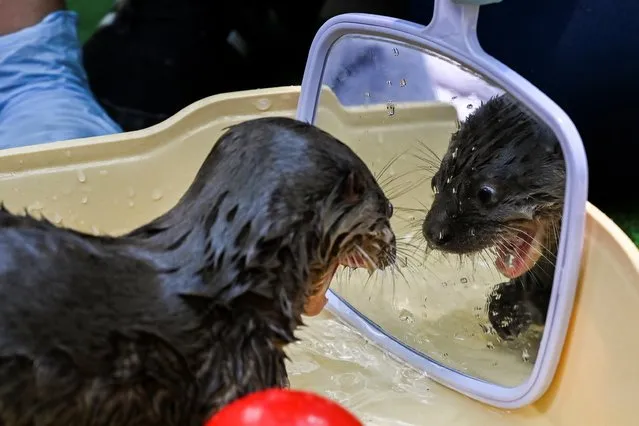
A river otter (lontra longicaudis) of 6-weeks-old looks in the mirror during a bath in the Animal Welfare Unit of the Zoo in Cali, Colombia, on October 22, 2019. The baby otter was found abandoned brought to the Cali Zoo for breeding, for its extensive experience in raising these species. According to the International Union for Conservation of Nature the river otter (lontra longicaudis) are in danger of extinction, because of mining, agriculture, pollution of rivers and housing construction in their habitat. (Photo by Luis Robayo/AFP Photo)

A river otter (lontra longicaudis) of 6-weeks-old looks in the mirror during a bath in the Animal Welfare Unit of the Zoo in Cali, Colombia, on October 22, 2019. The baby otter was found abandoned brought to the Cali Zoo for breeding, for its extensive experience in raising these species. According to the International Union for Conservation of Nature the river otter (lontra longicaudis) are in danger of extinction, because of mining, agriculture, pollution of rivers and housing construction in their habitat. (Photo by Luis Robayo/AFP Photo)
Details
27 Oct 2019 00:03:00