Loading...
Done
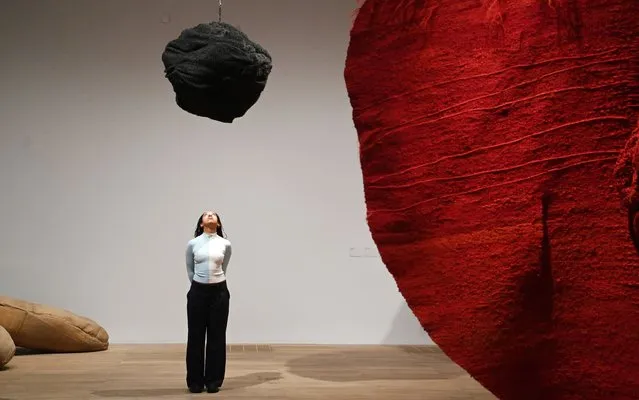
An exhibition staff member looks over artworks by Polish artist Magdalena Abakanowicz on display during a preview of the exhibition “Magdalena Abakanowicz: Every Tangle of Thread and Rope” at the Tate Modern in London, Britain, 15 November 2022. The large-scale Abakan sculptures have been brought together for the first time in the UK. The exhibit opens on 17 November 2022 and runs until 21 May 2023. (Photo by Andy Rain/EPA/EFE/Rex Features/Shutterstock)

An exhibition staff member looks over artworks by Polish artist Magdalena Abakanowicz on display during a preview of the exhibition “Magdalena Abakanowicz: Every Tangle of Thread and Rope” at the Tate Modern in London, Britain, 15 November 2022. The large-scale Abakan sculptures have been brought together for the first time in the UK. The exhibit opens on 17 November 2022 and runs until 21 May 2023. (Photo by Andy Rain/EPA/EFE/Rex Features/Shutterstock)
Details
25 Jan 2023 03:47:00
Police cars are seen overturned in the street in the framework of a demonstration against Cuban President Miguel Diaz-Canel in Havana, on July 11, 2021. Thousands of Cubans took part in rare protests Sunday against the communist government, marching through a town chanting “Down with the dictatorship” and “We want liberty”. (Photo by Yamil Lage/AFP Photo)

Police cars are seen overturned in the street in the framework of a demonstration against Cuban President Miguel Diaz-Canel in Havana, on July 11, 2021. Thousands of Cubans took part in rare protests Sunday against the communist government, marching through a town chanting “Down with the dictatorship” and “We want liberty”. (Photo by Yamil Lage/AFP Photo)
Details
24 Jul 2021 08:18:00
Bees are sensitive to light, which makes them follow the glowing embers down to the ground. (Photo by Hasnoor Hussain/The Guardian)

During the spring harvest season, a group of traditional Malaysian honey hunters travel to the rainforest near the Thai border to collect honeycombs from giant bees – and risk their lives climbing 200ft trees. Here: Bees are sensitive to light, which makes them follow the glowing embers down to the ground. (Photo by Hasnoor Hussain/The Guardian)
Details
22 Oct 2016 10:26:00
Kaw-Claa, a Tlingit native woman in full potlatch dancing costume, 1906. (Photo by Case & Draper/Buyenlarge/Getty Images)

Kaw-Claa, a Tlingit native woman in full potlatch dancing costume, 1906. (Photo by Case & Draper/Buyenlarge/Getty Images)
Details
11 Jan 2017 14:42:00
In this October 6, 2018, photo, a craftsman makes daggers or “Jambiyya” in Yemeni Arabic, made out of remains of missiles, at his workshop, in Hajjah, Yemen. (Photo by Hammadi Issa/AP Photo)

In this October 6, 2018, photo, a craftsman makes daggers or “Jambiyya” in Yemeni Arabic, made out of remains of missiles, at his workshop, in Hajjah, Yemen. Missiles raining on Yemen from the jets of the Saudi-led coalition fighting Houthi rebels are killing thousands of civilians and militiamen alike, but amid crashing economy, some Yemenis see the bright side of it: they make daggers out of the fragments of the missiles for ordinary men traditionally wear for prestige and a show of courage. (Photo by Hammadi Issa/AP Photo)
Details
10 Oct 2018 00:01:00
A devotee gest pierced at the Bang Neow shrine in Phuket. (Photo by Paula Bronstein/Getty Images)

“The Nine Emperor Gods Festival is a nine-day Taoist celebration beginning on the eve of 9th lunar month of the Chinese calendar, which is observed primarily in Southeast Asian countries like Myanmar, Singapore, Malaysia, Thailand and also the Riau Islands. In Thailand, this festival is called Tesagan Gin Je, the Vegetarian Festival. It is celebrated throughout the entire country, but the festivities are at their height in Phuket, where about 35% of the population is Chinese. It attracts crowds of spectators because of many of the unusual religious rituals that are performed”. – Wikipedia. Photo: A devotee gest pierced at the Bang Neow shrine in Phuket. (Photo by Paula Bronstein)
Details
11 Oct 2013 07:49:00
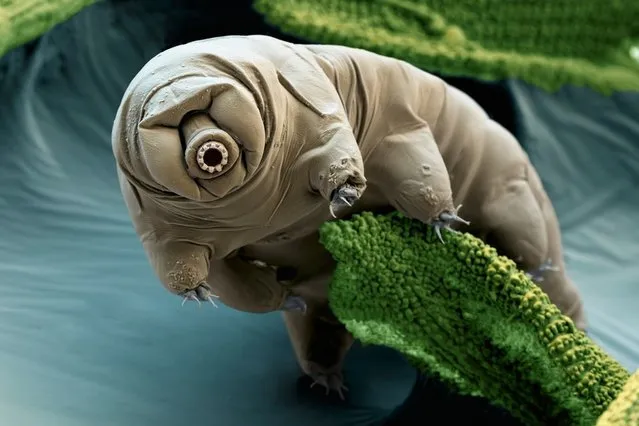
Tardigrades (commonly known as waterbears or moss piglets). (Photo by SPL/East News)

“Tardigrades (commonly known as waterbears or moss piglets) are small, water-dwelling, segmented animals with eight legs. Tardigrades were first discovered in 1773 by Johann August Ephraim Goeze, who called them kleiner Wasserbär, meaning “little water bear” in German. The name Tardigrada means “slow walker” and was given by Lazzaro Spallanzani in 1777. The name water bear comes from the way they walk, reminiscent of a bear's gait. The biggest adults may reach a body length of 1.5 millimetres (0.059 in), the smallest below 0.1 mm. Freshly hatched tardigrades may be smaller than 0.05 mm”. – Wikipedia. Photo: Tardigrades. (Photo by SPL/East News)
Details
26 Sep 2012 09:55:00
English singer-songwriter Dua Lipa (R) holds onto a friend in a pool in the last decade of August 2022. (Photo by dualipa/Instagram)

English singer-songwriter Dua Lipa (R) holds onto a friend in a pool in the last decade of August 2022. (Photo by dualipa/Instagram)
Details
10 Sep 2022 04:13:00