Yulin, a city in southern China, celebrates the summer solstice by throwing a festival that involves the slaughter and consumption of as many as 10,000 dogs. Not everyone in China supports such practices, however; 65-year-old Yang Xiaoyun, a retired teacher who runs an animal shelter in Tianjin, traveled more than 2,400 km (1,500 miles) and spent more than 7,000 yuan ($1,100 or €990) to save 100 dogs from certain death.
A glamour model Lacey Banghard attends a photocall for PETA to encourage pet owners to have their cats and dogs sterilised at Picadilly Circus on January 22, 2013 in London, England. (Photo by Ben Pruchnie)
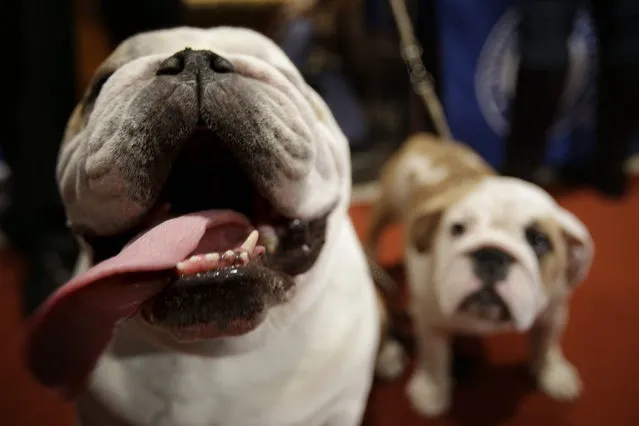
A bulldog named Munch, left, and a puppy named Dominique attend a news conference at the American Kennel Club in New York, Wednesday, January 30, 2013. The club announced their list of the most popular dog breeds in 2012 where the bulldog takes the fifth place spot from the Yorkshire terrier. (Photo by Seth Wenig/AP Photo)
Yoandri Hernandez Garrido, 37, proudly displays his 12 fingers in Baracoa, Guantanamo province, Cuba. His condition, known as polydactyly, is relatively common, but it's rare for extra digits to be so perfect.
Polydactyly or polydactylism (from Ancient Greek πολύς (polus) "many" + δάκτυλος (daktulos) "finger"), also known as hyperdactyly, is a congenital physical anomaly in humans, dogs, and cats having supernumerary fingers or toes. Polydactyly is the opposite of oligodactyly (fewer fingers or toes).
Animal rights activists dressed up as rabbit carry signs that read “Ajinomoto Stop Animal Testing” as they protest outside Ajinomoto headquarters in Kuala Lumpur on January 20, 2023, ahead of Lunar New Year. Activists call for the end of Japanese food company testing on rabbits, dogs, pigs and other animals. (Photo by Arif Kartono/AFP Photo)
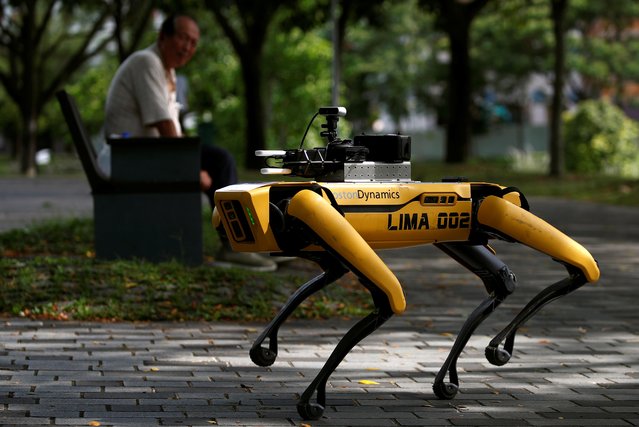
A four-legged robot dog called SPOT patrols a park as it undergoes testing to be deployed as a safe distancing ambassador, following the coronavirus disease (COVID-19) outbreak, in Singapore on May 8, 2020. (Photo by Edgar Su/Reuters)
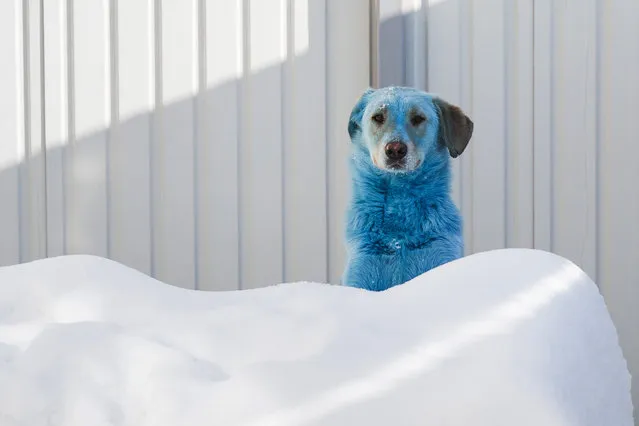
A dog at the Zoozashchita-NN veterinary clinic in Nizhny Novgorod, Russia on February 19, 2021. On February 13, 13 stray dogs with bright blue fur were found and caught at the Dzerzhinskoye Steklo (Dzerzhinsk Glass) factory producing acrylic glass and prussic acid in the city of Dzerzhinsk. The dogs' fur tested positive for the Prussian blue pigment; now the dogs are under supervision at the Zoozashchita-NN vet clinic in Nizhny Novgorod. (Photo by Mikhail Solunin/TASS)