Loading...
Done
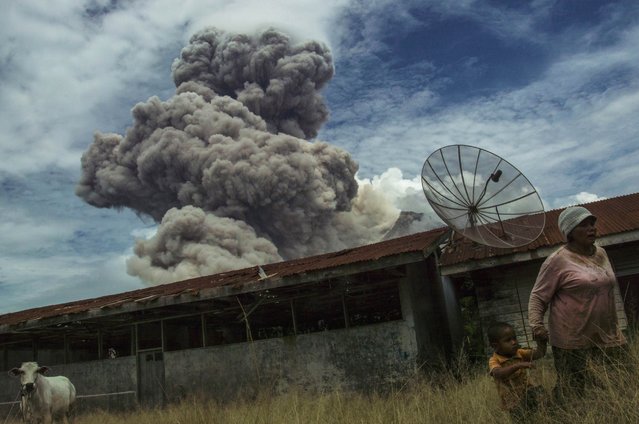
In this photograph taken on April 1, 2015, an Indonesian resident and child walk away from an abandoned school building as Mount Sinabung erupts in Karo district on the Indonesian island of Sumatra. According to authorities about 3,500 people were displaced after the February 2014 eruption of Mount Sinabung volcano and many are still living in evacuation centers as the volcano remains active. (Photo by Sutanta Aditya/AFP Photo)

In this photograph taken on April 1, 2015, an Indonesian resident and child walk away from an abandoned school building as Mount Sinabung erupts in Karo district on the Indonesian island of Sumatra. According to authorities about 3,500 people were displaced after the February 2014 eruption of Mount Sinabung volcano and many are still living in evacuation centers as the volcano remains active. (Photo by Sutanta Aditya/AFP Photo)
Details
04 Apr 2015 10:32:00


Photos by Daniel Korjonov
Details
30 May 2012 03:43:00


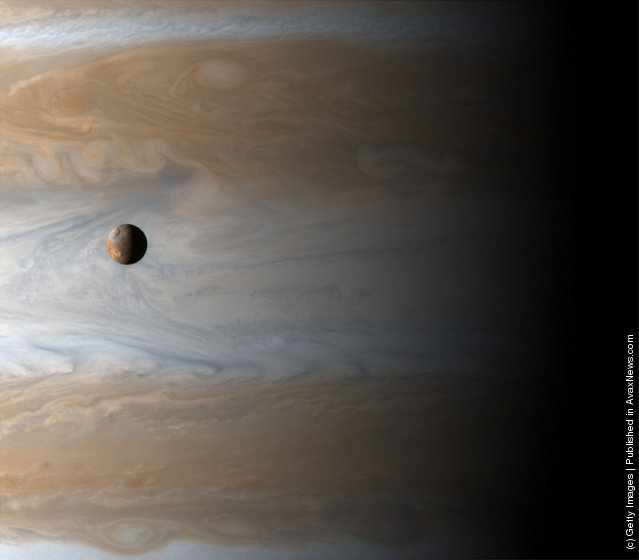
Gliding past the planet Jupiter, the Cassini spacecraft captures this awe inspiring view of active Io, Jupiter's third largest satellite, with the largest gas giant as a backdrop, offering a stunning demonstration of the ruling planet's relative size, April 20, 2001. The Cassini spacecraft itself was about 10 million kilometers from Jupiter when recording the image data. (Photo courtesy of NASA/Newsmakers)
Details
23 Mar 2011 10:32:00
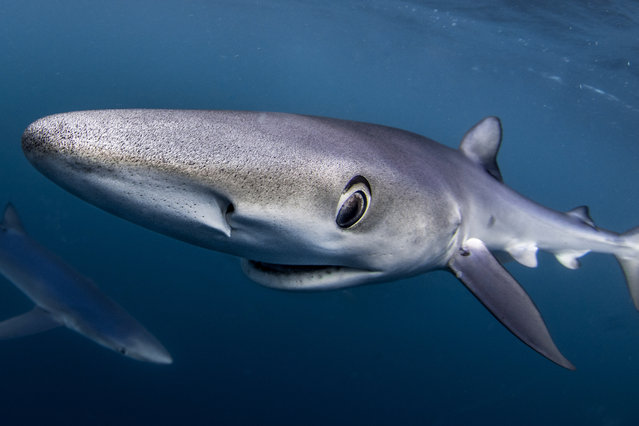
The rarely seen blue sharks photographed by Saeed Rashid in British waters. (Photo by Saeed Rashid/Caters News)

The rarely seen blue sharks photographed by Saeed Rashid in British waters. Elusive blue sharks have recently been spotted off the south coast of England, having moved to the UKs warmer waters to hunt. The carnivorous sharks have been lurking off the coast of the popular British holiday destination, Penzance, in Cornwall. (Photo by Saeed Rashid/Caters News)
Details
12 Oct 2016 10:48:00
Aerial photo taken on March 4, 2017 shows cole flower fields in Luoping County, southwest China's Yunnan Province. (Photo by Xinhua/Barcroft Images)

Aerial photo taken on March 4, 2017 shows cole flower fields in Luoping County, southwest China's Yunnan Province. (Photo by Xinhua/Barcroft Images)
Details
07 Mar 2017 00:03:00
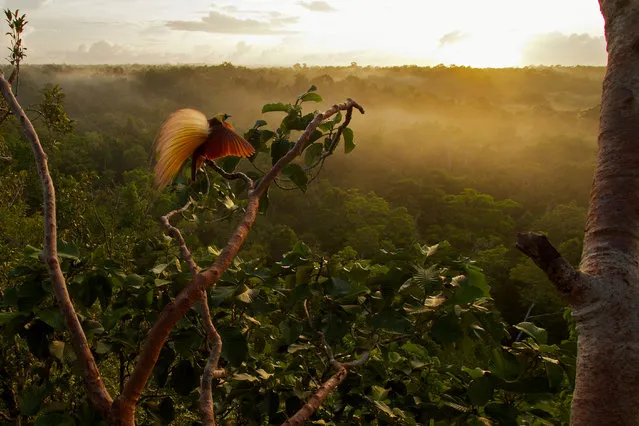
A greater bird of paradise (Paradisaea apoda) displaying in Badigaki Forest, Wokam Island (Aru Islands, Indonesia). Found here in Aru and on adjacent New Guinea, the greater bird of paradise represents about 40 different species of birds of paradise that depend on intact rainforest across the New Guinea region spanning eastern Indonesia and Papua New Guinea. With more than 80% of forest cover still intact, this region represents the largest remaining block of rainforest in the entire Asia-Pacific. (Photo by Tim Laman/naturepl.com/LDY Agency)

A greater bird of paradise (Paradisaea apoda) displaying in Badigaki Forest, Wokam Island (Aru Islands, Indonesia). Found here in Aru and on adjacent New Guinea, the greater bird of paradise represents about 40 different species of birds of paradise that depend on intact rainforest across the New Guinea region spanning eastern Indonesia and Papua New Guinea. With more than 80% of forest cover still intact, this region represents the largest remaining block of rainforest in the entire Asia-Pacific. (Photo by Tim Laman/naturepl.com/LDY Agency)
Details
14 Nov 2021 05:57:00
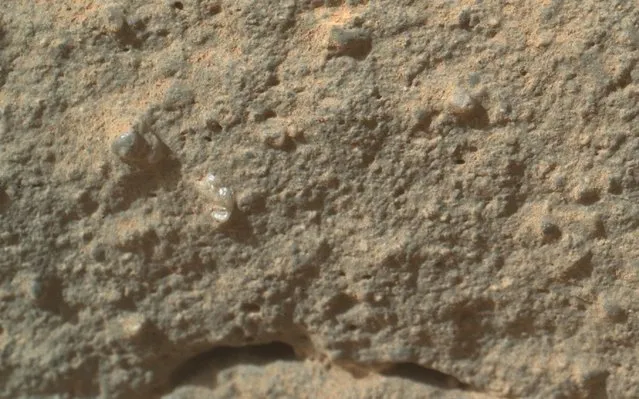
Scientists say that a “Martian flower”, seen here in an image from the Curiosity rover's Mars Hand Lens Imager, is a 2-millimeter-wide grain or pebble that's embedded in the surrounding rock. Another, darker-colored mineral grain can be seen above and to the left. (Photo by NASA)

“The scientists behind NASA's $2.5 billion Curiosity rover mission on Mars on Tuesday explained the nature of a tiny, gleaming "flower" embedded in Red Planet rock, and revealed where they'll be using the SUV-sized robot's drill for the first time”. – Alan Boyle via NBCNews.com

Photo: Scientists say that a “Martian flower”, seen here in an image from the Curiosity rover's Mars Hand Lens Imager, is a 2-millimeter-wide grain or pebble that's embedded in the surrounding rock. Another, darker-colored mineral grain can be seen above and to the left. (Photo by NASA)
Details
16 Jan 2013 11:12:00
On August 31, 2012, a long filament of solar material that had been hovering in the sun's atmosphere, the corona, erupted out into space at 4:36 p.m. EDT. The coronal mass ejection, or CME, traveled at over 900 miles per second. The CME did not travel directly toward Earth, but did connect with Earth's magnetic environment, or magnetosphere, causing aurora to appear on the night of Monday, September 3. (Photo by NASA/GSFC/SDO)

On August 31, 2012, a long filament of solar material that had been hovering in the sun's atmosphere, the corona, erupted out into space at 4:36 p.m. EDT. The coronal mass ejection, or CME, traveled at over 900 miles per second. The CME did not travel directly toward Earth, but did connect with Earth's magnetic environment, or magnetosphere, causing aurora to appear on the night of Monday, September 3. (Photo by NASA/GSFC/SDO via The Atlantic)
Details
14 Sep 2012 09:01:00