Loading...
Done
Dancers take part in the Karneval der Kulturen (Carnival of Cultures) street parade of ethnic minorities, in Berlin, Germany, May 24, 2015. (Photo by Hannibal Hanschke/Reuters)

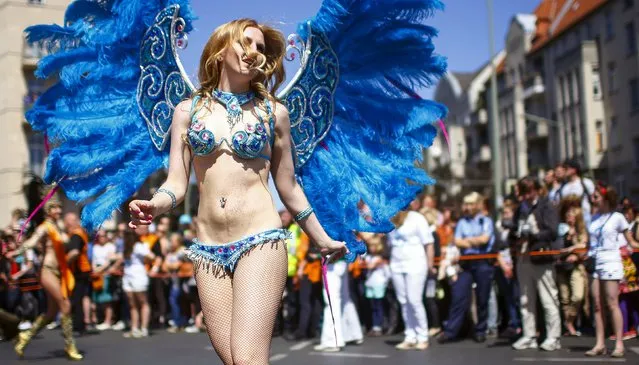
Dancers take part in the Karneval der Kulturen (Carnival of Cultures) street parade of ethnic minorities, in Berlin, Germany, May 24, 2015. A few dozen dancers, musicians and performers from dozens of communities took part in the urban festival on Sunday that aspires to reflect the multi-ethnic diversity of the German capital. (Photo by Hannibal Hanschke/Reuters)
Details
25 May 2015 09:20:00
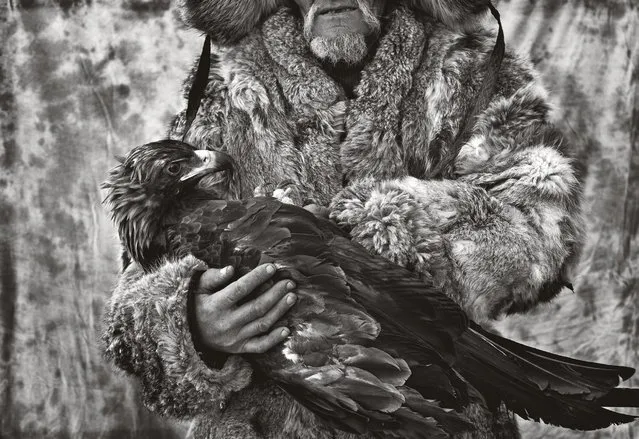
A Kazakh hunter has taken an eaglet from the nest, given it pride of place in their home and trained it. All hunters describe the eagle as part of their family. (Photo by Palani Mohan)

Kazakh nomads have been grazing their livestock in Mongolia for hundreds of years. Fascinated by the bond between hunter and eagle, photographer Palani Mohan has spent the last few years documenting the burkitshi. Mohan's photos of the landscape, isolation of the hunt, and most of all the trusting relationship between man and bird, convey the importance that the eagle plays in their lives. (Photo by Palani Mohan)
Details
11 Jan 2016 08:03:00


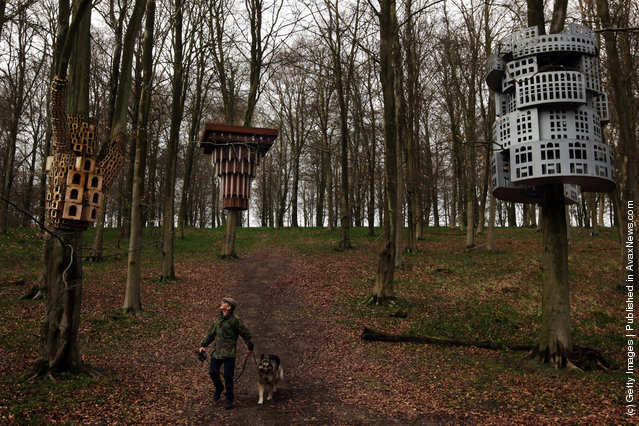
CHALLOCK, ENGLAND - MARCH 31: Tony Hall walks with his dog through an installation entitled 'Super Kingdom', which hangs in trees in King's Wood as part of the Stour Valley Arts project on March 31, 2011 in Challock, England. The works by artists Bruce Gilchrist and Jo Joelson of 'London Fieldworks' consist of a series of interesting animal habitats, modelled on the palaces of Stalin, Ceauscescu and Mussolini, and offer nesting sites to many native and migrant species. (Photo by Dan Kitwood/Getty Images)
Details
20 Nov 2011 19:03:00
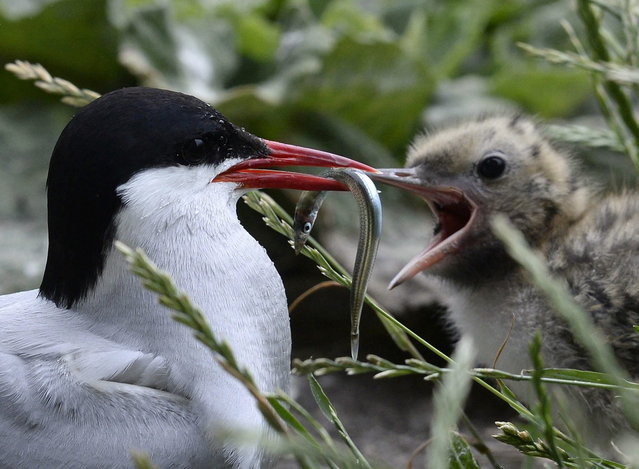
An arctic tern feeds its chick on the Farne Islands off the Northumberland coast, northern England July 8, 2013. (Photo by Nigel Roddis/Reuters)

An arctic tern feeds its chick on the Farne Islands off the Northumberland coast, northern England July 8, 2013. The Farne Islands, which lie off the coast of northeast England, are home to a huge array of wildlife. The islands are owned and protected by the British conservation charity, the National Trust, which says they host some 23 species of seabird, as well as a substantial colony of grey seals, who come to have their pups there in the autumn. Every five years the National Trust carries out a census of the islands' population of puffins, and this year's survey showed there were almost 40,000 nesting pairs on the islands – an 8 percent rise from 2008. (Photo by Nigel Roddis/Reuters)
Details
11 Dec 2013 09:21:00
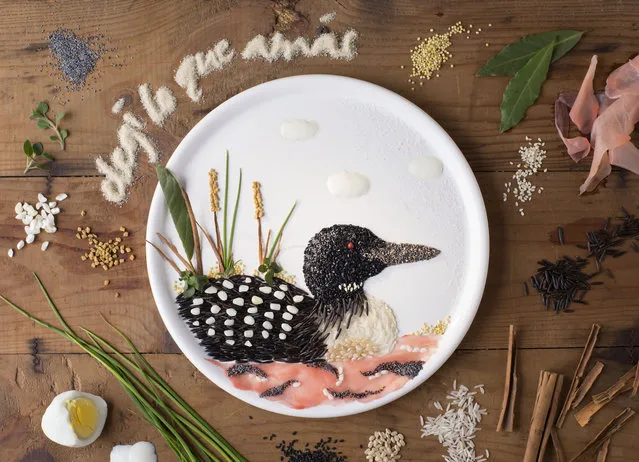
Meet the woman who has made playing with food her job and creates incredible pieces of edible art. From city landmarks to colorful animals, Anna Keville Joyce lets her imagination run wild as she creates a series of intricate art works made entirely from food. Using anything from vegetables to sausages, Annas pieces are so detailed that at first glance it is difficult to tell what they are made from. (Photo by Anna Keville Joyce/Caters News)

Meet the woman who has made playing with food her job and creates incredible pieces of edible art. From city landmarks to colorful animals, Anna Keville Joyce lets her imagination run wild as she creates a series of intricate art works made entirely from food. Using anything from vegetables to sausages, Annas pieces are so detailed that at first glance it is difficult to tell what they are made from. Here: a nesting bird. (Photo by Anna Keville Joyce/Caters News)
Details
20 Oct 2015 08:06:00
A woman with a snake on her body, taken in Rio de Janeiro, Brazil, April 2017. A holistic therapist uses snakes to massage her clients – claiming it cures depression and even helps victims of abuse. Instead of traditional massaging techniques, Sarah Zaad uses up to six pythons and boa constrictors on brave customers who want to relax or be treated for mental disorders. The flamboyant therapist from Rio de Janeiro, Brazil believes her snakes have a magic touch, which can benefit people by massaging their bodies. (Photo by Kadeh Ferreira/Barcroft Images)

A woman with a snake on her body, taken in Rio de Janeiro, Brazil, April 2017. A holistic therapist uses snakes to massage her clients – claiming it cures depression and even helps victims of abuse. Instead of traditional massaging techniques, Sarah Zaad uses up to six pythons and boa constrictors on brave customers who want to relax or be treated for mental disorders. The flamboyant therapist from Rio de Janeiro, Brazil believes her snakes have a magic touch, which can benefit people by massaging their bodies. (Photo by Kadeh Ferreira/Barcroft Images)
Details
15 Apr 2017 09:14:00


“A monowheel is a one-wheeled single-track vehicle similar to a unicycle. However, instead of sitting above the wheel, the rider sits either within it or next to it. The wheel is a ring, usually driven by smaller wheels pressing against its inner rim. Most are single-passenger vehicles, though multi-passenger models have been built.

Pedal-powered monowheels were built in the late 19th century; most built in the 20th century have been motorized. Some modern builders refer to these vehicles as monocycles, though that term is also sometimes used to describe motorized unicycles. Today, monowheels are generally built and used for fun and entertainment purposes, though from the 1860s through to the 1930s, they were proposed for use as serious transportation”. – Wikipedia

Photo: Cycle inventor Kerry McLean poses for the photographer 2000 in Walled Lake, Michigan. The “Monocycle” is equipped with a 40-horsepower engine, 4ft tire and is expected to reach speeds upwards of 100 mph. (Photo by Bill Pugliano/Liaison)
Details
02 Jul 2011 12:24:00
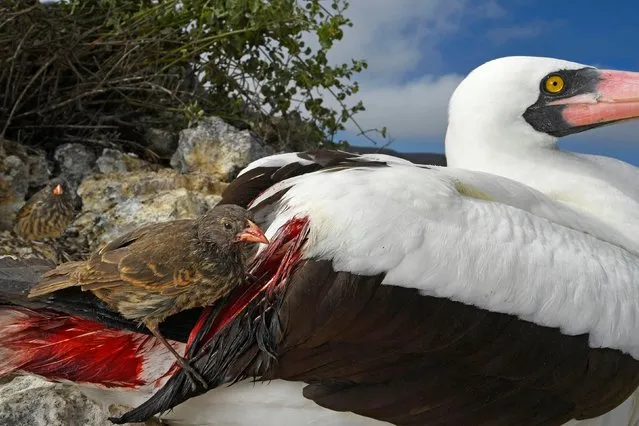
Bloodthirsty by Thomas P Peschak, Germany/South Africa — winner, Behaviour: birds. When rations run short on Wolf Island, in the remote northern Galápagos, the sharp-beaked ground finches become vampires. Their sitting targets are Nazca boobies and other large birds. The finches rely on a scant diet of seeds and insects, which regularly dries up, so they drink blood to survive. ‘I’ve seen more than half a dozen finches drinking from a single Nazca booby,’ says Tom. Rather than leave their nests the boobies tolerate the vampires, and the blood loss doesn’t seem to cause permanent harm. (Photo by Thomas P Peschak/2018 Wildlife Photographer of the Year)

Bloodthirsty by Thomas P. Peschak, Germany/South Africa — winner, Behaviour: birds. When rations run short on Wolf Island, in the remote northern Galápagos, the sharp-beaked ground finches become vampires. Their sitting targets are Nazca boobies and other large birds. The finches rely on a scant diet of seeds and insects, which regularly dries up, so they drink blood to survive. ‘I’ve seen more than half a dozen finches drinking from a single Nazca booby,’ says Tom. Rather than leave their nests the boobies tolerate the vampires, and the blood loss doesn’t seem to cause permanent harm. (Photo by Thomas P. Peschak/2018 Wildlife Photographer of the Year)
Details
19 Oct 2018 00:05:00