Loading...
Done
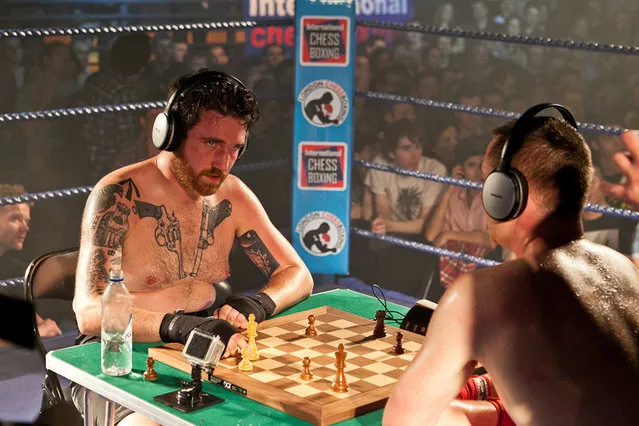
Chess boxing

Chess boxing is a hybrid sport that combines chess with boxing in alternating rounds. The sport was invented by Dutch artist Iepe Rubingh, who was inspired by a French comic book Le Froid Equateur by artist and filmmaker Enki Bilal. Chess boxing is a fast growing sport, with large followings in Berlin and London, where most events take place. Several other chessboxing events have taken place around the world, including in Los Angeles, Tokyo, Nantes (France), Reykjavík (Iceland), Amsterdam, Calcutta (India) and Krasnoyarsk (Russia). Participants must be skilled as both boxers and chess players, as a match may be won either way.
Details
17 Oct 2012 11:17:00
Photographers gather to take pictures of pilot Andre Borschberg (C) ahead of the take off of Solar Impulse 2-a solar powered plane- in Nanjing, China, May 31, 2015. The world's largest solar-powered airplane, Solar Impulse 2, took off from eastern China's Nanjing on Sunday to continue its round-the-world voyage. The Swiss-made plane left Nanjing's Lukou International Airport at 2:39 in the early morning, with former fighter pilot Borschberg at the controls alone for the entire 8,200-kilometer flight from Nanjing to Hawaii, the toughest leg of its marathon adventure.   REUTERS/Solar Impulse/Handout via Reuters

Photographers gather to take pictures of pilot Andre Borschberg (C) ahead of the take off of Solar Impulse 2-a solar powered plane- in Nanjing, China, May 31, 2015. The world's largest solar-powered airplane, Solar Impulse 2, took off from eastern China's Nanjing on Sunday to continue its round-the-world voyage. The Swiss-made plane left Nanjing's Lukou International Airport at 2:39 in the early morning, with former fighter pilot Borschberg at the controls alone for the entire 8,200-kilometer flight from Nanjing to Hawaii, the toughest leg of its marathon adventure. (Photo by Reuters/Solar Impulse)
Details
06 Jun 2015 12:09:00
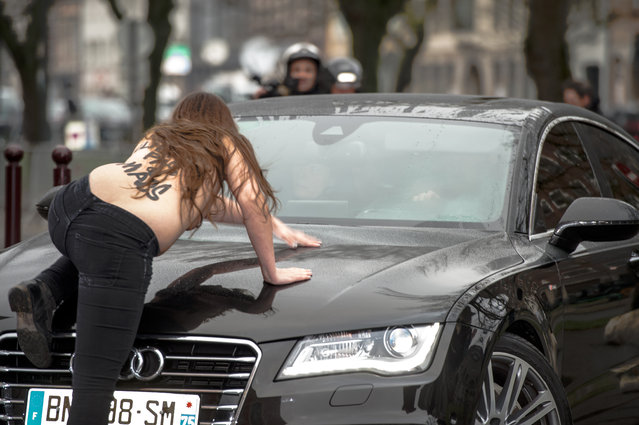
A topless Femen activist jumps on the car carrying former IMF chief Dominique Strauss-Kahn (not seen) as he arrives for his trial in Lille, northern France, on February 10, 2015. Three topless women from the protest group Femen jumped on the car of Dominique Strauss-Kahn as the former IMF chief arrived to testify at his trial for “aggravated pimping”. With slogans scrawled on their half-naked bodies and hurling insults at the car, the three protesters were quickly rounded up by police as the car entered an underground parking area. (Photo by Denis Charlet/AFP Photo)

A topless Femen activist jumps on the car carrying former IMF chief Dominique Strauss-Kahn (not seen) as he arrives for his trial in Lille, northern France, on February 10, 2015. Three topless women from the protest group Femen jumped on the car of Dominique Strauss-Kahn as the former IMF chief arrived to testify at his trial for “aggravated pimping”. With slogans scrawled on their half-naked bodies and hurling insults at the car, the three protesters were quickly rounded up by police as the car entered an underground parking area. (Photo by Denis Charlet/AFP Photo)
Details
07 Mar 2021 10:02:00
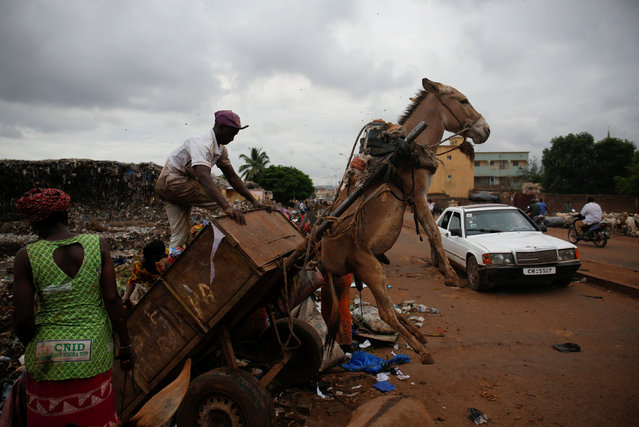
A waste picker unloads garbage at a waste transfer station in Bamako, Mali, August 19, 2018. In the Malian capital of Bamako, donkey carts driven by young men like 19-year-old Arouna Diabate play a vital role battling the fast-growing city's waste problem. Every morning before dawn, Diabate hitches his donkey to a cart and sets off on his rounds, going door-to-door to collect household garbage which he delivers to a local waste transfer station for a monthly salary of around $35. “I won't be picking up trash with a donkey cart for the rest of my life, but for now people appreciate us because we help clean up the homes of Bamako”, Diabate said. (Photo by Luc Gnago/Reuters)

A waste picker unloads garbage at a waste transfer station in Bamako, Mali, August 19, 2018. In the Malian capital of Bamako, donkey carts driven by young men like 19-year-old Arouna Diabate play a vital role battling the fast-growing city's waste problem. Every morning before dawn, Diabate hitches his donkey to a cart and sets off on his rounds, going door-to-door to collect household garbage which he delivers to a local waste transfer station for a monthly salary of around $35. “I won't be picking up trash with a donkey cart for the rest of my life, but for now people appreciate us because we help clean up the homes of Bamako”, Diabate said. (Photo by Luc Gnago/Reuters)
Details
18 Sep 2018 00:01:00
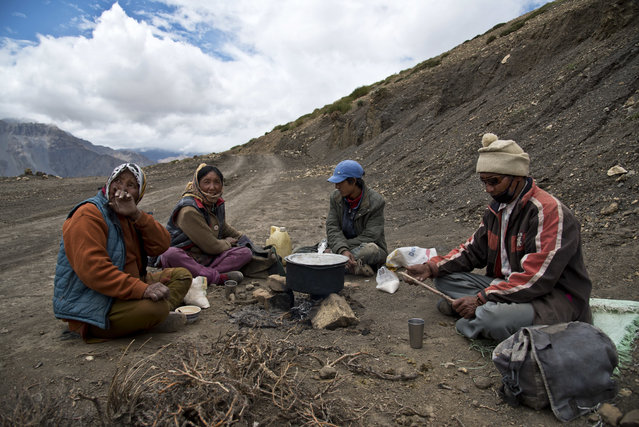
In this August 17, 2016, photo, from left to right, Chhering Chodom, 60, Tashi Yangzom, 50, Lobsang Chhering, 27, and Dorje Tandup, 58, drink milk tea on the side of the road. For centuries, the sleepy valley nestled in the Indian Himalayas remained a hidden Buddhist enclave forbidden to outsiders. Enduring the harsh year-round conditions of the high mountain desert, the people of Spiti Valley lived by a simple communal code – share the Earth's bounty, be hospitable to neighbors, and eschew greed and temptation at all turns. That's all starting to change, for better or worse. Since India began allowing its own citizens as well as outsiders to visit the valley in the early 1990s, tourism and trade have boomed. And the marks of modernization, such as solar panels, asphalt roads and concrete buildings, have begun to appear around some of the villages that dot the remote landscape at altitudes above 4,000 meters (13,000 feet). (Photo by Thomas Cytrynowicz/AP Photo)

In this August 17, 2016, photo, from left to right, Chhering Chodom, 60, Tashi Yangzom, 50, Lobsang Chhering, 27, and Dorje Tandup, 58, drink milk tea on the side of the road. For centuries, the sleepy valley nestled in the Indian Himalayas remained a hidden Buddhist enclave forbidden to outsiders. Enduring the harsh year-round conditions of the high mountain desert, the people of Spiti Valley lived by a simple communal code – share the Earth's bounty, be hospitable to neighbors, and eschew greed and temptation at all turns. That's all starting to change, for better or worse. (Photo by Thomas Cytrynowicz/AP Photo)
Details
15 Sep 2016 09:22:00
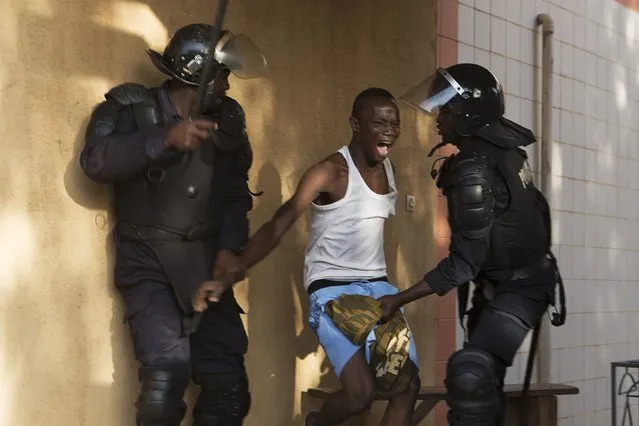
Riot police arrest an anti-government protester in Ouagadougou, capital of Burkina Faso, October 30, 2014. Thousands of protesters marched on Burkina Faso's presidential palace after burning the parliament building and ransacking state television offices on Thursday, forcing President Blaise Compaore to scrap a plan to extend his 27-year rule. (Photo by Joe Penney/Reuters)

Riot police arrest an anti-government protester in Ouagadougou, capital of Burkina Faso, October 30, 2014. Thousands of protesters marched on Burkina Faso's presidential palace after burning the parliament building and ransacking state television offices on Thursday, forcing President Blaise Compaore to scrap a plan to extend his 27-year rule. Emergency services said at least three protesters were shot dead and several others wounded by security forces when the crowd tried to storm the home of Compaore's brother. Security forces also fired live rounds and tear gas at protesters near the presidency in the Ouaga 2000 neighborhood. (Photo by Joe Penney/Reuters)
Details
02 Nov 2014 10:43:00
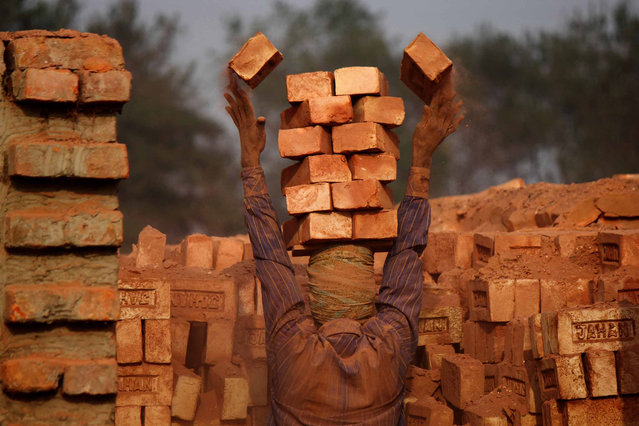
CGAP Photo Contest – South Asia Regional Winner: Bricks Worker, Bangladesh. A private enterprise worker is working at a brick field. These small businesses are creating new job opportunities for many poor people. (Photo by Moksumul Haque)

The shoemaker in Turkey, the potato seller in Vietnam, and the weaver in Bolivia are among the billions of low-income entrepreneurs who make the world go round. They are also the type of people who can benefit significantly from microfinance. Every year, the Consultative Group To Assist The Poor (or CGAP) hosts a photo contest asking entrants to submit photos based around the idea of microfinance.The purpose of the contest is to give amateur and professional photographers a chance to show the different ways that poor households manage their financial lives and make their lives better through financial inclusion. Photo: South Asia Regional Winner – “Bricks Worker”, Bangladesh. A private enterprise worker is working at a brick field. These small businesses are creating new job opportunities for many poor people. (Photo by Moksumul Haque)
Details
14 Aug 2014 10:58:00
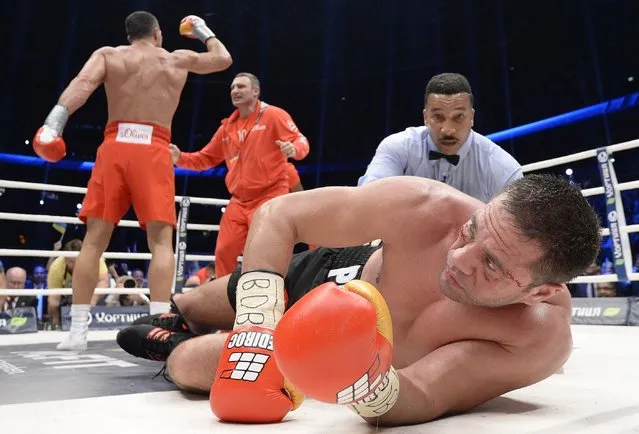
Challenger Bulgarian heavyweight boxer Kubrat Pulev (R) lies in the ring after being knocked down by Ukrainian WBA, WBO, IBO and IBF heavyweight boxing world champion Vladimir Klitschko (L), who celebrates with his brother Vitali (2nd L), as referee Tony Weeks checks on him after their title fight in Hamburg, November 15, 2014. (Photo by Fabian Bimmer/Reuters)

Challenger Bulgarian heavyweight boxer Kubrat Pulev (R) lies in the ring after being knocked down by Ukrainian WBA, WBO, IBO and IBF heavyweight boxing world champion Vladimir Klitschko (L), who celebrates with his brother Vitali (2nd L), as referee Tony Weeks checks on him after their title fight in Hamburg, November 15, 2014. World heavyweight champion Vladimir Klitschko knocked out Bulgarian challenger Kubrat Pulev with a fierce left hook in the fifth round on Saturday to retain his IBF title and end his opponent's unbeaten record. (Photo by Fabian Bimmer/Reuters)
Details
17 Nov 2014 12:34:00