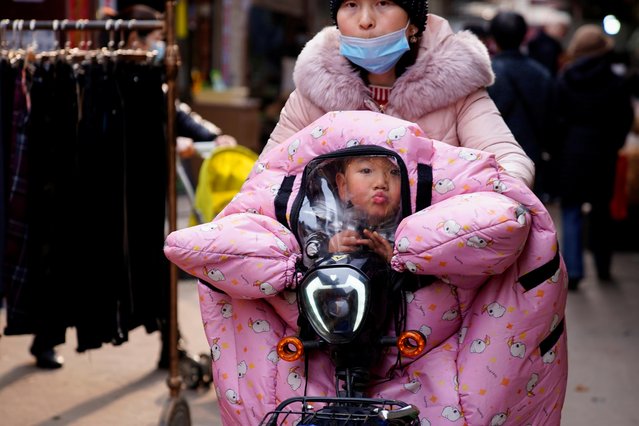
A woman wearing a face mask rides a bicycle with a child, following an outbreak of the coronavirus disease (COVID-19) in Wuhan, Hubei province, China on February 8, 2021. (Photo by Aly Song/Reuters)
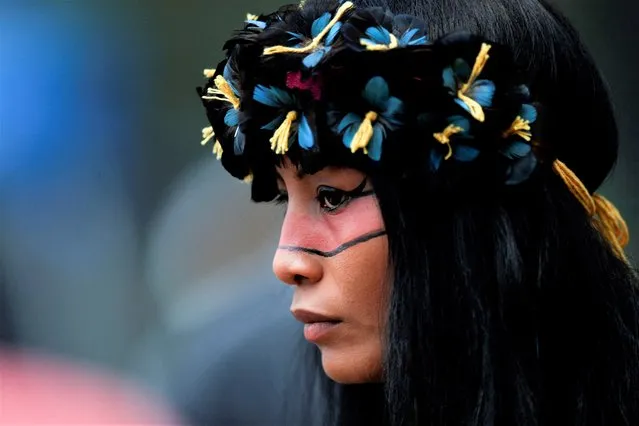
An indigenous woman looks on during the Terra Livre (Free Land) camp, a protest-camp to defend indigenous land and cultural rights that they say are threatened by the right-wing government of Brazil's President Jair Bolsonaro, in Brasilia, Brazil on April 4, 2022. (Photo by Adriano Machado/Reuters)
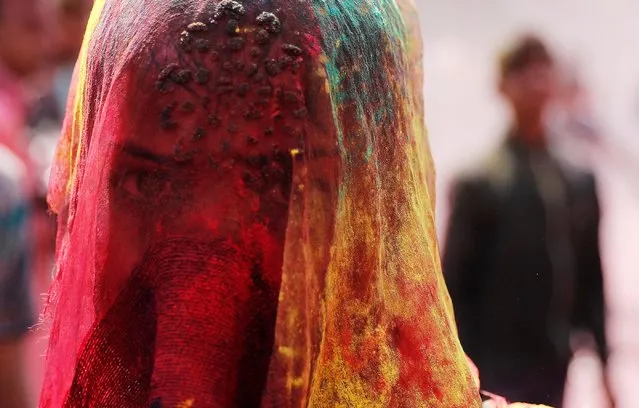
A girl covers her face as she is daubed in colours during the religious festival of Holi inside a temple in Nandgaon village, in the state of Uttar Pradesh, India, March 5, 2020. (Photo by Adnan Abidi/Reuters)
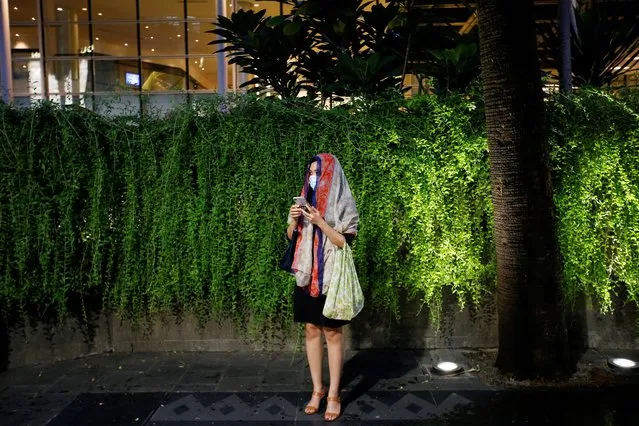
A woman wearing a protective mask stands as she waits for the bus at the sidewalk, after Indonesia confirmed its first cases of coronavirus, in Jakarta, Indonesia, March 4, 2020. (Photo by Willy Kurniawan/Reuters)
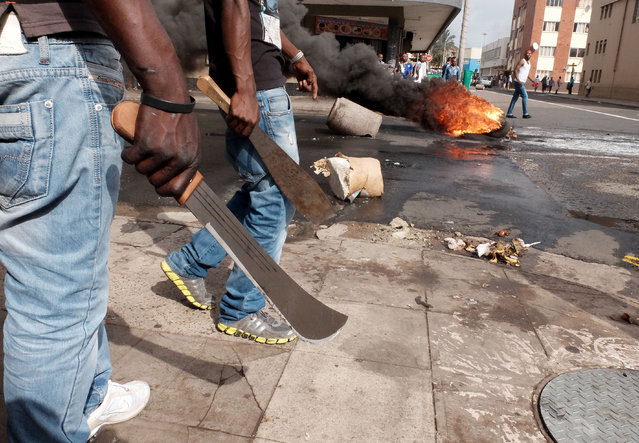
In this photo taken Tuesday, April 14, 2015, immigrant men armed with machetes make their way onto a Durban, South Africa, street during clashes with police and in search of locals that attacked foreign shop owners in the city center. (Photo by Tebogo Letsie/AP Photo)
In this Sunday, April 6, 2014 photo, Valery Palma prepares to blow out the candle on a birthday cake for her one-year-old dachshund Camila, at Camila's birthday party in Mexico City. Palma, who has two dogs, spent $300 on the birthday party for 11 canines and 16 people, complete with cake, presents and snacks, at a dog hotel featuring a gym and massage and aromatherapy services. (Photo by Rebecca Blackwell/AP Photo)
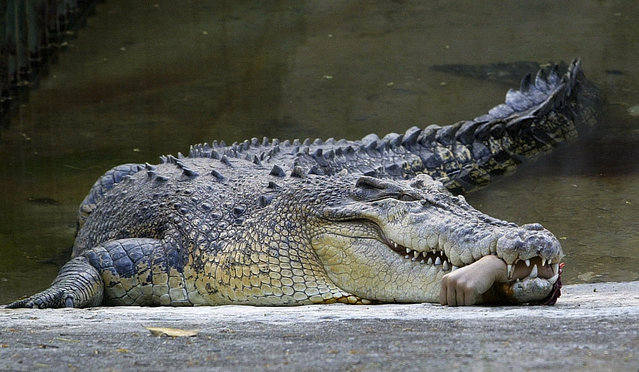
A crocodile at a zoo in the southern Taiwan city of Kaohsiung holds the forearm of a zoo veterinarian in its teeth, April 2007. Surgeons in Taiwan have reattached a vet's arm, after it was bitten off by a crocodile as he tried to give it an anaesthetic injection. His attacker is one of a pair of Nile crocodiles kept at Shoushan zoo. Nile crocodiles are known to be man-eaters, but are also listed as an endangered species. (Photo by Frank Lin/Reuters)
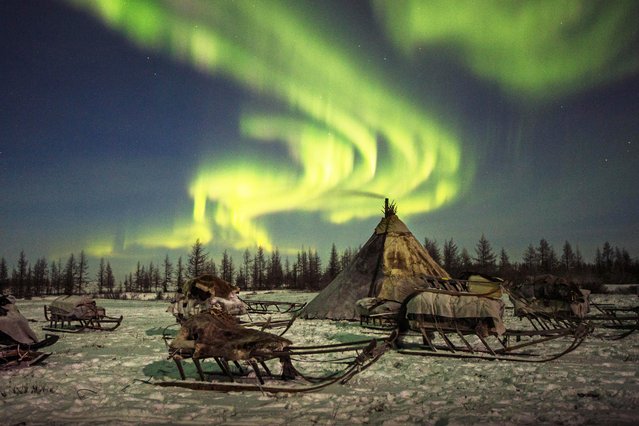
A British photographer has captured life at the “edge of the world”. Timothy Allen, best known for his work on BBC's Human Planet, trekked through the freezing Siberian wilderness for 16 days as he joined part of an 800km migration of reindeer in the Yamal-Nenets region – a name that roughly translates to “edge of the world”. The stunning pictures feature the nomadic Nenets tribe, who drink blood to survive in -45°C temperatures. Timothy's epic journey, which will be revealed in an eight-minute documentary on Animal Planet USA, saw him travel across the bleak terrain of the frozen Ob River with the Nenets people in December last year. Here: An empty camp is shown beneath a colourful sky in Siberia, December 2016. (Photo by Timothy Allen/Barcroft Productions)