Loading...
Done
Police officers hold a revolver as they offer prayers to their weapons as part of a ritual at their headquarters on the occasion of Dussehra, or Vijaya Dashami, festival in Ahmedabad, India, October 8, 2019. (Photo by Amit Dave/Reuters)

Police officers hold a revolver as they offer prayers to their weapons as part of a ritual at their headquarters on the occasion of Dussehra, or Vijaya Dashami, festival in Ahmedabad, India, October 8, 2019. (Photo by Amit Dave/Reuters)
Details
17 Oct 2019 00:01:00
A man smokes a marijuana cigarette to celebrate 420, in Times Square amid the coronavirus disease (COVID-19) pandemic in New York City, New York, U.S., April 20, 2021. (Photo by Carlo Allegri/Reuters)

A man smokes a marijuana cigarette to celebrate 420, in Times Square amid the coronavirus disease (COVID-19) pandemic in New York City, New York, U.S., April 20, 2021. (Photo by Carlo Allegri/Reuters)
Details
27 Apr 2021 09:44:00
Family members of a taxi driver offer prayer in front of their taxi during the Vishwakarma Puja or the festival of the Hindu deity of architecture and machinery in Kolkata, India, September 17, 2017. (Photo by Rupak De Chowdhuri/Reuters)

Family members of a taxi driver offer prayer in front of their taxi during the Vishwakarma Puja or the festival of the Hindu deity of architecture and machinery in Kolkata, India, September 17, 2017. (Photo by Rupak De Chowdhuri/Reuters)
Details
22 Sep 2017 07:09:00
A girl gets her arm sketched with a body paint tattoo depicting the traditional Dandiya dance, ahead of Navratri, a festival when devotees worship the Hindu goddess Durga, in Ahmedabad, India, September 25, 2016. (Photo by Amit Dave/Reuters)

A girl gets her arm sketched with a body paint tattoo depicting the traditional Dandiya dance, ahead of Navratri, a festival when devotees worship the Hindu goddess Durga, in Ahmedabad, India, September 25, 2016. (Photo by Amit Dave/Reuters)
Details
26 Sep 2016 06:59:00
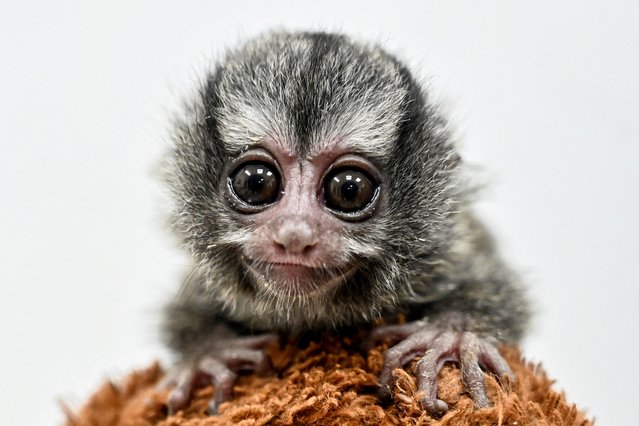
A grey-bellied Night Monkey (Aotus Lemurinus) plays with a teddy bear at the veterinary clinic of the Cali Zoo in Cali, Colombia on January 27, 2020. They monkey is being raised by personnel of the Cali Zoo after a worker found it near the complex. Apparently it fall from a tree with his father who had health problems. (Photo by Luis Robayo/AFP Photo)

A grey-bellied Night Monkey (Aotus Lemurinus) plays with a teddy bear at the veterinary clinic of the Cali Zoo in Cali, Colombia on January 27, 2020. They monkey is being raised by personnel of the Cali Zoo after a worker found it near the complex. Apparently it fall from a tree with his father who had health problems. (Photo by Luis Robayo/AFP Photo)
Details
30 Dec 2020 00:05:00
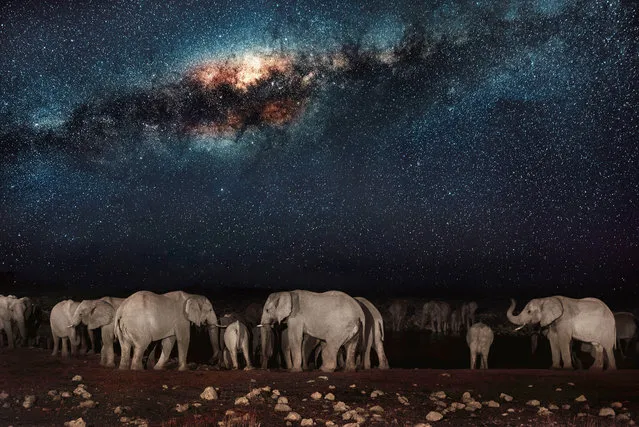
This watering hole is the social hub of the veldt; the scrubby grasslands that stretch across Namibia. The scorched earth supports sometimes fragile populations of magnificent wildlife – from endangered predators to plentiful herds of game. But these gentle giraffes and elephants need to be careful: lions don’t sleep at night, they hunt! The spectacular starscape above southern Africa is unchanged since explorers first mapped the continent. The photographer, Pietro Olivetta from Italy, said he had to be patient to capture these shots – but it was worth the wait. (Photo by Pietro Olivetta/Caters News)

This watering hole is the social hub of the veldt; the scrubby grasslands that stretch across Namibia. The scorched earth supports sometimes fragile populations of magnificent wildlife – from endangered predators to plentiful herds of game. But these gentle giraffes and elephants need to be careful: lions don’t sleep at night, they hunt! The spectacular starscape above southern Africa is unchanged since explorers first mapped the continent. The photographer, Pietro Olivetta from Italy, said he had to be patient to capture these shots – but it was worth the wait. (Photo by Pietro Olivetta/Caters News)
Details
20 Feb 2017 00:05:00
Life reconstruction of the new oviraptorosaurian dinosaur species Anzu wyliei in its 66 million-year-old environment in western North America as seen in an undated handout illustration by Mark A. Klinger, Carnegie Museum of Natural History. Some 18,000 species, great and small, were discovered in 2014, adding to the 2 million already known, scientists said on May 21, 2015 as they released a “Top 10” list that highlights the diversity of life. (Photo by Mark A. Klingler/Reuters/Carnegie Museum of Natural History)

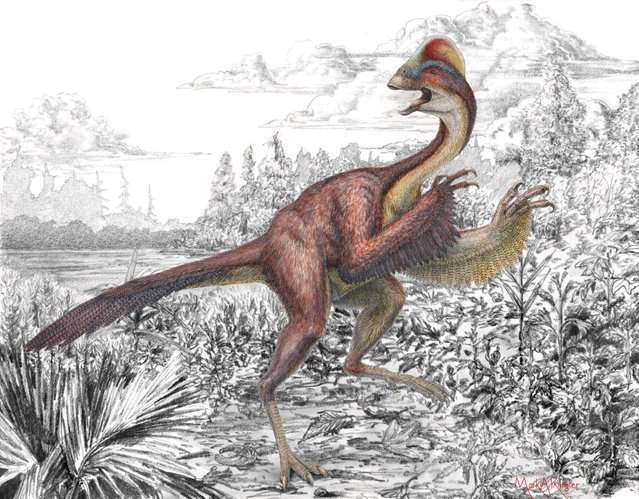
Life reconstruction of the new oviraptorosaurian dinosaur species Anzu wyliei in its 66 million-year-old environment in western North America as seen in an undated handout illustration by Mark A. Klinger, Carnegie Museum of Natural History. Some 18,000 species, great and small, were discovered in 2014, adding to the 2 million already known, scientists said on May 21, 2015 as they released a “Top 10” list that highlights the diversity of life. Anzu wyliei, one of the top 10, dubbed “the chicken from hell”, is extinct. The feathered dinosaur whose partial skeletons were unearthed in the Dakotas was a contemporary of T. rex and Triceratops. (Photo by Mark A. Klingler/Reuters/Carnegie Museum of Natural History)

Details
22 May 2015 12:31:00
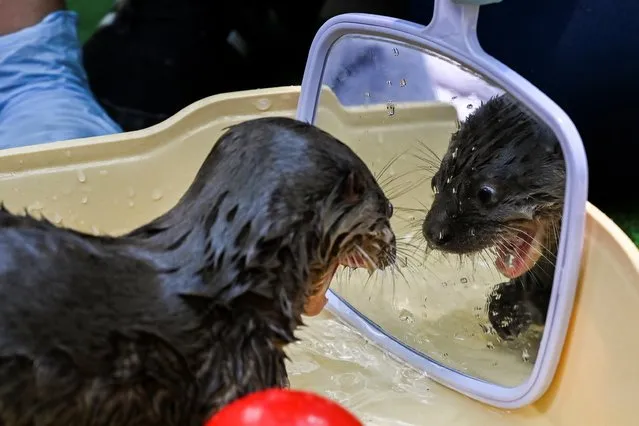
A river otter (lontra longicaudis) of 6-weeks-old looks in the mirror during a bath in the Animal Welfare Unit of the Zoo in Cali, Colombia, on October 22, 2019. The baby otter was found abandoned brought to the Cali Zoo for breeding, for its extensive experience in raising these species. According to the International Union for Conservation of Nature the river otter (lontra longicaudis) are in danger of extinction, because of mining, agriculture, pollution of rivers and housing construction in their habitat. (Photo by Luis Robayo/AFP Photo)

A river otter (lontra longicaudis) of 6-weeks-old looks in the mirror during a bath in the Animal Welfare Unit of the Zoo in Cali, Colombia, on October 22, 2019. The baby otter was found abandoned brought to the Cali Zoo for breeding, for its extensive experience in raising these species. According to the International Union for Conservation of Nature the river otter (lontra longicaudis) are in danger of extinction, because of mining, agriculture, pollution of rivers and housing construction in their habitat. (Photo by Luis Robayo/AFP Photo)
Details
27 Oct 2019 00:03:00