Loading...
Done
Baby Fennec Fox

“The fennec fox is a small nocturnal fox found in the Sahara of North Africa. Its most distinctive feature is unusually large ears. The name “fennec” comes from the Arabic word for fox, and the species name zerda has a Greek origin that refers to its habitat. The fennec is the smallest species of canid in the world; coat, ears and kidney functions have adapted to a high-temperature, low-water, desert environment. In addition, its hearing is sensitive enough to hear prey moving underground”. – Wikipedia

Photo: A Baby Fennec is seen at Sunshine International Aquarium on June 24, 2009 in Tokyo, Japan. The small nocturnal fox babies were born on May 17 2009. (Photo by Junko Kimura/Getty Images)
Details
16 Sep 2011 12:02:00
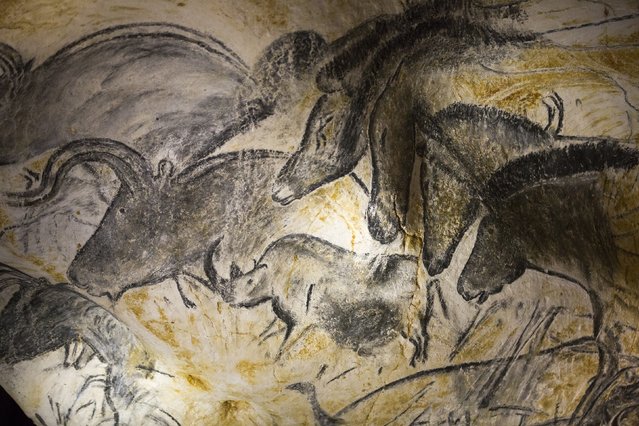
A replica of pre-historic drawings showing horses, rhinoceros and aurochs is seen on a wall during a press visit at the site of the Cavern of Pont-d'Arc project in Vallon Pont d'Arc April 8, 2015. (Photo by Robert Pratta/Reuters)

A replica of pre-historic drawings showing horses, rhinoceros and aurochs is seen on a wall during a press visit at the site of the Cavern of Pont-d'Arc project in Vallon Pont d'Arc April 8, 2015. The Cavern of Pont-d'Arc project is a replica of the pre-historic Decorated Cave of Pont-d'Arc known as Grotte Chauvet, in Vallon Pont-d'Arc in the Ardeche region, containing the world's earliest known art which was recently named a UNESCO World Heritage site. The facsimile cavern, which condenses some 8000m² of the original site into 3000m², will display faithful reproductions of paintings and engravings and will be inaugurated on April 10 and will open to the public on April 25. (Photo by Robert Pratta/Reuters)
Details
09 Apr 2015 14:23:00
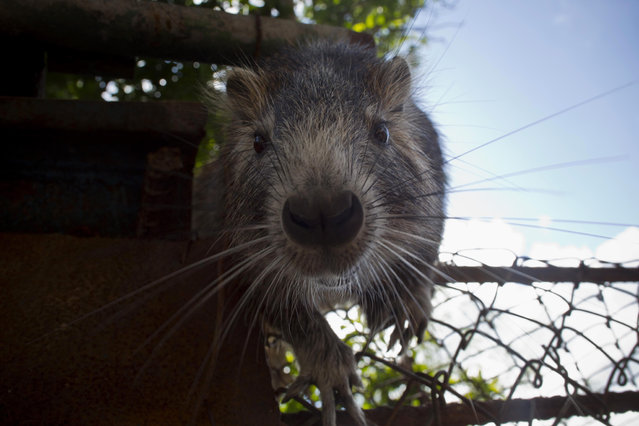
In this November 17, 2014 photo, Pancho, a domesticated huitia, confronts a camera, in Bainoa, Cuba. With their rope-like, dark tails, long front teeth, and whiskers that appear to be vibrating, huitias look like giant rats. They measure nearly a foot long (about 30 centimeters), with the largest ones weighing in bigger than a small dog. (Photo by Ramon Espinosa/AP Photo)

In this November 17, 2014 photo, Pancho, a domesticated huitia, confronts a camera, in Bainoa, Cuba. With their rope-like, dark tails, long front teeth, and whiskers that appear to be vibrating, huitias look like giant rats. They measure nearly a foot long (about 30 centimeters), with the largest ones weighing in bigger than a small dog. (Photo by Ramon Espinosa/AP Photo)
Details
21 Nov 2014 12:58:00
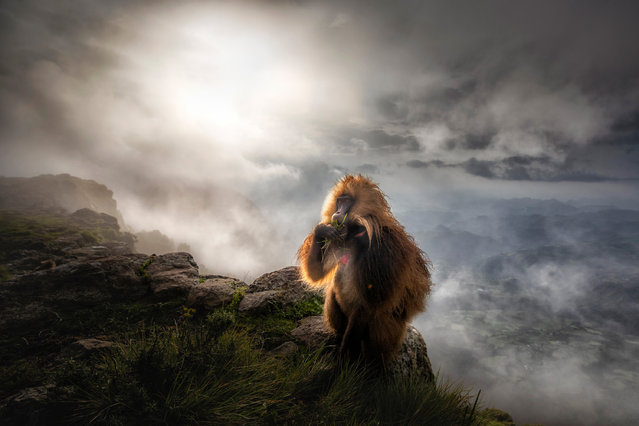
Highly commended, mammals: Gelada after the storm – Marco Gaiotti (Italy). “Gelada baboons are the only monkey species in the world that feed on grasses. They are native to the tableland of Ethiopia. Every morning large family groups wander from their sleeping places in the steep rock face, up to 1,000 metres high, to the feeding grounds at the tablelands. This image clearly depicts their feeding strategy: they pull out bunches of grass, sort the stalks and then lift them to their mouth. This shot was taken towards the end of the rainy season after a heavy storm”. (Photo by Marco Gaiotti/2019 GDT European Wildlife Photographer of the Year)

Highly commended, mammals: Gelada after the storm – Marco Gaiotti (Italy). “Gelada baboons are the only monkey species in the world that feed on grasses. They are native to the tableland of Ethiopia. Every morning large family groups wander from their sleeping places in the steep rock face, up to 1,000 metres high, to the feeding grounds at the tablelands. This image clearly depicts their feeding strategy: they pull out bunches of grass, sort the stalks and then lift them to their mouth. This shot was taken towards the end of the rainy season after a heavy storm”. (Photo by Marco Gaiotti/2019 GDT European Wildlife Photographer of the Year)
Details
31 Oct 2019 00:03:00
A vendor prepares paan, a betel nut-based chewable stimulant at a flower market in Kolkata, India, January 18, 2016. (Photo by Rupak De Chowdhuri/Reuters)

A vendor prepares paan, a betel nut-based chewable stimulant at a flower market in Kolkata, India, January 18, 2016. (Photo by Rupak De Chowdhuri/Reuters)
Details
04 Feb 2016 11:29:00
Visitors browse in the starry Art Museum. Shanghai, China, May 13, 2020. The exhibition hall uses a large number of mirror devices, combined with the layout of acousto-optic, to create a visual scene and spatial effect. (Photo by Costfoto/Barcroft Media via Getty Images)

Visitors browse in the starry Art Museum. Shanghai, China, May 13, 2020. The exhibition hall uses a large number of mirror devices, combined with the layout of acousto-optic, to create a visual scene and spatial effect. (Photo by Costfoto/Barcroft Media via Getty Images)
Details
21 May 2020 00:05:00
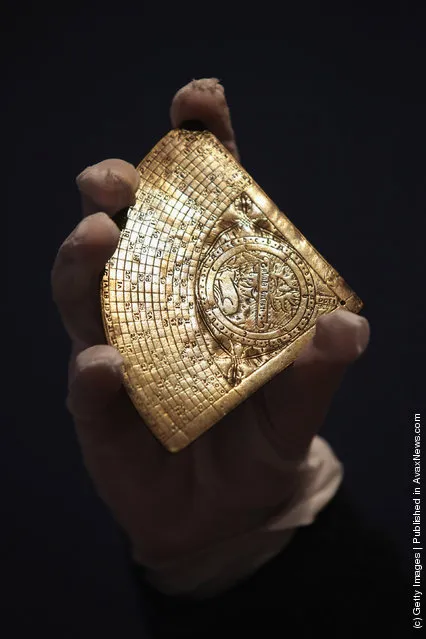
A rare 14th century time-telling device device in Bonhams auction house

A gallery assistant holds a rare 14th century time-telling device device in Bonhams auction house on December 9, 2011 in London, England. The instrument, which dates from 1396 and was discovered in a shed in Queensland, Australia, is due to be auctioned on December 13, 2011 and is expected to fetch 200,000 GBP. (Photo by Oli Scarff/Getty Images)
Details
10 Dec 2011 09:44:00
A vendor sleeps at his vegetables shop at a main market in Colombo, Sri Lanka May 31, 2016. (Photo by Dinuka Liyanawatte/Reuters)

A vendor sleeps at his vegetables shop at a main market in Colombo, Sri Lanka May 31, 2016. (Photo by Dinuka Liyanawatte/Reuters)
Details
01 Jun 2016 12:38:00