Loading...
Done
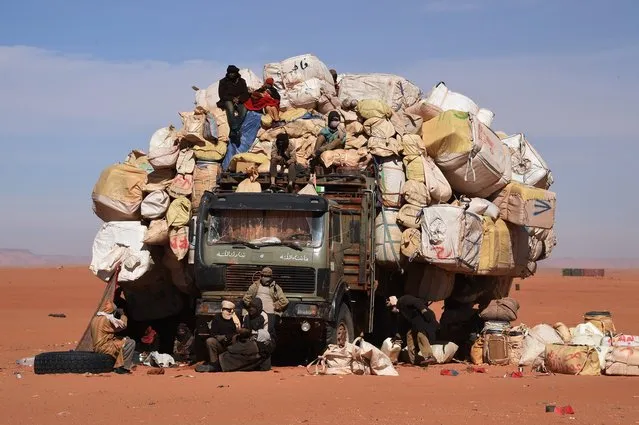
People sit near a fully loaded in Madama near the border with Lybia on January 1, 2015. French Defence Minister Jean-Yves Le Drian paid a surprise visit to northern Niger on January 1, to visit a base being built to combat the growing flow of weapons and jihadists from neighbouring Libya. Le Drian travelled from Chad to Madama, a desert outpost about 100 kilometres from Libya, where he saw in the New Year with troops at a French base. (Photo by Dominique Faget/AFP Photo)

People sit near a fully loaded in Madama near the border with Lybia on January 1, 2015. French Defence Minister Jean-Yves Le Drian paid a surprise visit to northern Niger on January 1, to visit a base being built to combat the growing flow of weapons and jihadists from neighbouring Libya. Le Drian travelled from Chad to Madama, a desert outpost about 100 kilometres from Libya, where he saw in the New Year with troops at a French base. Madama is situated on the route used by jihadists and arms smugglers in southern Libya to reach northern Mali and Niger. (Photo by Dominique Faget/AFP Photo)
Details
03 Jan 2015 13:27:00
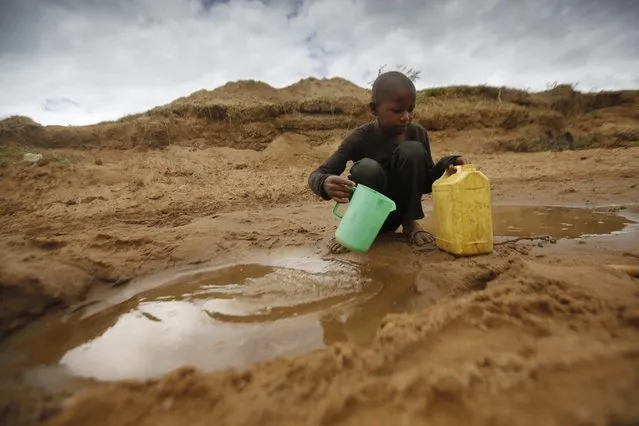
A young boy scoops water from a hand-dug well in the dry riverbed near Matinyani, in the semi-arid Kitui County in southeastern Kenya, 22 March 2015, the World Water Day. Residents of Kitui County and other arid and semi-arid areas of the country have been hard-hit by extremely poor rainfall this year while the government said in previous month that some 1.6 million people countrywide are facing acute starvation due to the drought and will need relief food over the next six months. (Photo by Dai Kurokawa/EPA)

A young boy scoops water from a hand-dug well in the dry riverbed near Matinyani, in the semi-arid Kitui County in southeastern Kenya, 22 March 2015, the World Water Day. Residents of Kitui County and other arid and semi-arid areas of the country have been hard-hit by extremely poor rainfall this year while the government said in previous month that some 1.6 million people countrywide are facing acute starvation due to the drought and will need relief food over the next six months. Residents of Matinyani say they haven't seen a drop of rain in nearly four months. Thousands of Kenyans in rural areas walk tens of kilometers just to fetch water to drink and to be used in their homes. According to an estimate by UNESCO (United Nations Educational, Scientific and Cultural Organization), 17 million people lack access to safe water in Kenya, where the drought is a perennial problem. (Photo by Dai Kurokawa/EPA)
Details
23 Mar 2015 11:01:00
A performer wearing a lion mask performs the Ise Daikagura lion dance at the remote village of Yamanawa on February 08, 2021 in Ryuo, Japan. Ise Daikagura is a group of traditional Lion Dance performers who pray in front of farmers houses and businesses for good grain harvests and disease-free lives. Performers play sacred music using drums and flutes with two lion mask dancers. A lion mask is considered a symbol of God, who enters the house and performs in front of the Shinto God, a statue placed inside the house, mostly in the kitchen. These prayers are called “Kamodo Barai”. After the prayers, they are gifted with money, rice, sake and Japanese sweets from the householders. A group can travel for more than one hundred days to thousands of households and businesses throughout rural-villages in western Japan, and pray to those who are unable to visit the country’s most sacred shrine, the Grand Ise Shrine in Mie Prefecture. The group started its performance in the Edo era between 1603 to 1868 according to Japanese history. The Japanese government designated it as an important folk cultural national property in 1981. (Photo by Buddhika Weerasinghe/Getty Images)

A performer wearing a lion mask performs the Ise Daikagura lion dance at the remote village of Yamanawa on February 08, 2021 in Ryuo, Japan. Ise Daikagura is a group of traditional Lion Dance performers who pray in front of farmers houses and businesses for good grain harvests and disease-free lives. (Photo by Buddhika Weerasinghe/Getty Images)
Details
18 Feb 2021 09:27:00
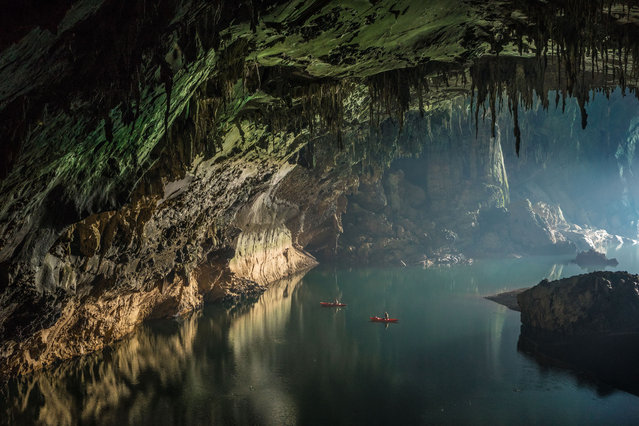
Floating on clear deep water and reflections near the cave entrance. Visitors can either bring their own kayaks or rent boats from the local community to paddle deep inside the cave and marvel at its wonders on March 2015 at Tham Khoun Ex, Laos. Tham Khoun Xe, commonly known as the Xe Bang Fai River Cave, in Laos, has over 15km of passages filled with awe-inspiring views and wide expanses of water. (Photo by John Spies/Barcroft Media/ABACAPress)

Floating on clear deep water and reflections near the cave entrance. Visitors can either bring their own kayaks or rent boats from the local community to paddle deep inside the cave and marvel at its wonders on March 2015 at Tham Khoun Ex, Laos. Tham Khoun Xe, commonly known as the Xe Bang Fai River Cave, in Laos, has over 15km of passages filled with awe-inspiring views and wide expanses of water. Photographer, John Spies, 59, captured scenes from the entrances of the huge underground river passages, intricate cave formations and views from a passage high above the water. The cave is formed by the Xe Bang Fai river, a major tributary of the Mekong and in the dry season can be traversed using inflatable kayaks. (Photo by John Spies/Barcroft Media/ABACAPress)
Details
11 Apr 2015 09:56:00
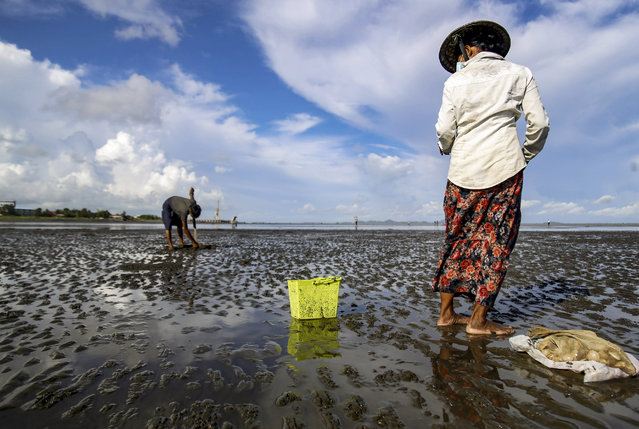
People search for shells on a beach in Sittwe, Rakhine State, Myanmar, 17 September 2020. International Coastal Cleanup Day is observed annually on the third Saturday of September and will occur on 19 September this year. The day was established to encourage global efforts to clean up garbage on beaches and coastal areas and raise awareness on protecting the world's oceans and waterways. According to a report released by the US-based nonprofit environmental advocacy group Ocean Conservancy on 08 September 2020, plastic food packaging topped the list of most common items found in beach trash. Close to five million food wrappers were collected in a single day during the International Coastal Cleanup Day in 2019. An approximate 11 million metric tons of plastic enters the ocean every year according to a 2016 analysis, affecting more than 800 marine species and causing contamination to human food chains and drinking water. (Photo by Nyunt Win/EPA/EFE/Rex Features/Shutterstock)

People search for shells on a beach in Sittwe, Rakhine State, Myanmar, 17 September 2020. International Coastal Cleanup Day is observed annually on the third Saturday of September and will occur on 19 September this year. (Photo by Nyunt Win/EPA/EFE/Rex Features/Shutterstock)
Details
24 Oct 2020 00:05:00
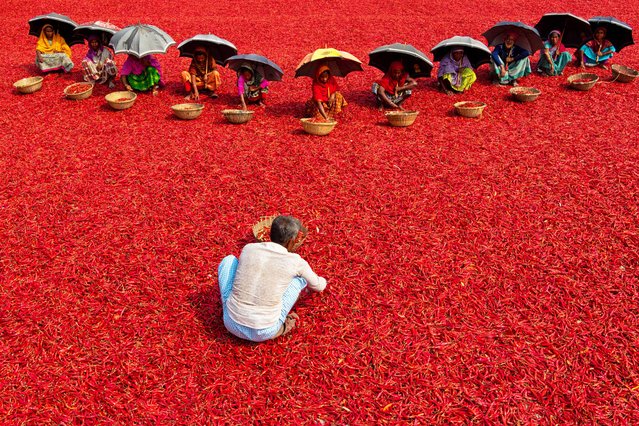
Rows of workers shelter under umbrellas from the scorching heat as they painstakingly sort through a red carpet of millions of chilli peppers in Bogra, Bangladesh on October 3, 2023. They sort the rotten and broken chilli peppers out to separate the poor quality ones which won't sell. In a line, the pickers who are paid less than £3 for a 10-hour shift slowly move forward with their baskets to separate the bad from the good after the chilies have been dried in the sun for a week. The dried & sorted chillies are then packaged and taken to the local market where they are brought mainly by companies to be made into chilli powder. The workers sort them in a warm environment, with temperatures reaching up to 45°C. More than 5,000 people work in almost 100 chilli farms in the Bogra district of Bangladesh to supply local spice companies with chillies for their recipes. Known as “Lal Morich” to the locals, chilli peppers are a major part of Bengali cuisine and are used as part of a combination of spices for various meat dishes, including chicken and beef. (Photo by Joy Saha/Rex Features/Shutterstock)

Rows of workers shelter under umbrellas from the scorching heat as they painstakingly sort through a red carpet of millions of chilli peppers in Bogra, Bangladesh on October 3, 2023. They sort the rotten and broken chilli peppers out to separate the poor quality ones which won't sell. In a line, the pickers who are paid less than £3 for a 10-hour shift slowly move forward with their baskets to separate the bad from the good after the chilies have been dried in the sun for a week. (Photo by Joy Saha/Rex Features/Shutterstock)
Details
21 Oct 2023 04:04:00
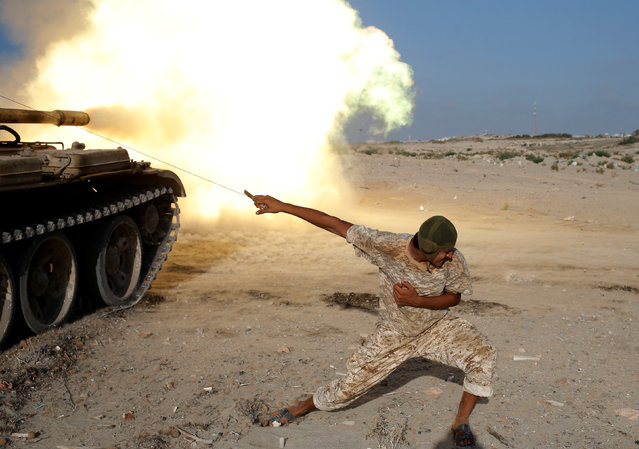
A fighter of Libyan forces allied with the U.N.-backed government fires a shell with Soviet made T-55 tank at Islamic State fighters in Sirte, Libya, August 2, 2016. (Photo by Goran Tomasevic/Reuters)

A fighter of Libyan forces allied with the U.N.-backed government fires a shell with Soviet made T-55 tank at Islamic State fighters in Sirte, Libya, August 2, 2016. (Photo by Goran Tomasevic/Reuters)
Details
03 Aug 2016 11:42:00
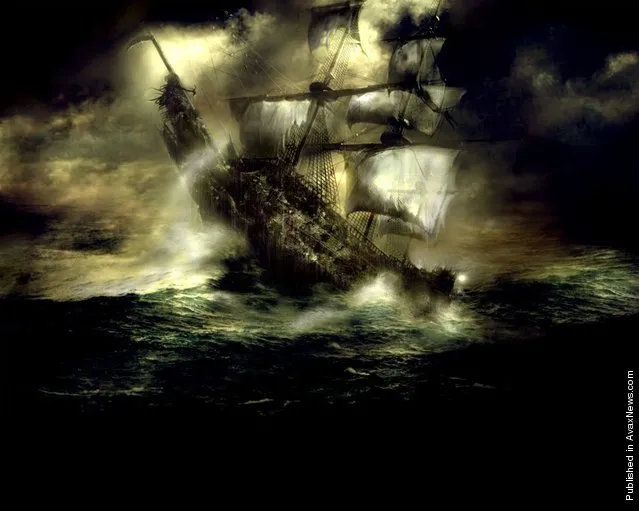
Ocean voyage

Do you think that history is a science? Well, not exactly. First, and foremost, history is the state's “legend of wars”, it’s official regalia. Of course, public historians are not interested in scientific truth – quite the opposite. In this respect, any attempt to present a state’s history as altruistic and benevolent as possible is welcomed and encouraged – as opposed to any revisionism attempts that may be more accurate. In this matter, Chinese have surpassed us all – they revised in highly creative manner (but rather shamelessly) the technology already invented by Europeans, a process that resulted in oldest state on the planet. Here is an interesting paradox: ask any sinologist about the Middle Kingdom during second century B.C., and he will describe it to you in such a vivid manner as if he has been living there all his life – but as soon as you will ask him to describe Chinese history in the 19-20th centuries… let's say, his eagerness will be greatly diminished. However, we will discuss China in a different article, and in the meantime we will try to understand how exactly historic “legend of wars” is formed and functions – based on a specific and well-known example. A great example is Ferdinand Magellan's first voyage around the world.
Details
14 Nov 2011 09:11:00