Loading...
Done
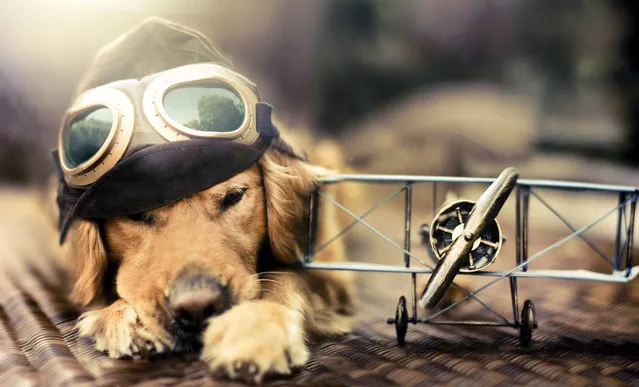
Dog photos by Jessica Trinh

I am 17 years old and an aspiring photographer. Ever since I set my hands on a camera, I knew I had unlocked a new dimension. One where you can expand your imagination and run for endless miles. Photography makes you look at things differently. You notice rain drops and the way the sun kisses the Earth. You breath in every moment of your life. You love to live and live to love. There is no time to waste because there is an urgency to capture each loving gesture, smile, and laugh in both humans and animals. Then every photograph becomes timeless and you smile, knowing that you hold a few split seconds in your hands. I live in a box called a camera with the lens as my window and everyday I sit on my couch watching the world outside through a different perspective. No worries, my dogs are right beside me looking at it the same way.

Jessica Trinh
Details
17 Dec 2012 13:46:00
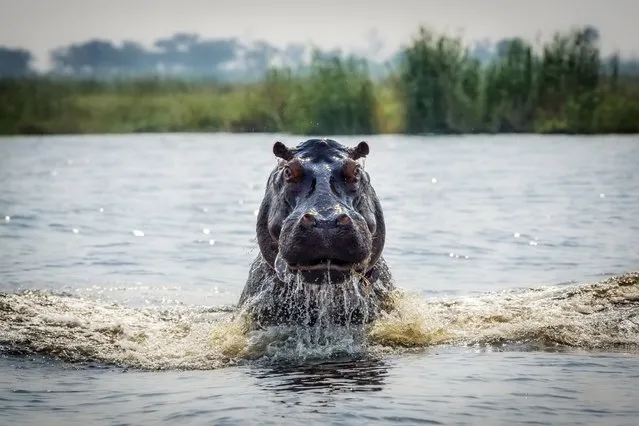
“Hippo Chase”. As we approached the camp the Selinda Reserve of northern Botswana our boat passed by a hippo resting in the water. I turned around to look back at the boat's wake and saw the hippo charging after us! The hippo must've been tired from an all-nighter because he was angry. (Photo and caption by Curtis Simmons/National Geographic Photo Contest)

“Hippo Chase”. As we approached the camp the Selinda Reserve of northern Botswana our boat passed by a hippo resting in the water. I turned around to look back at the boat's wake and saw the hippo charging after us! The hippo must've been tired from an all-nighter because he was angry. He rose way up out of the water three times trying to chase our boat! He was coming at us with such force that he created a wake of his own. Photo location: Selinda Reserve of northern Botswana. (Photo and caption by Curtis Simmons/National Geographic Photo Contest)
Details
06 Nov 2014 08:59:00
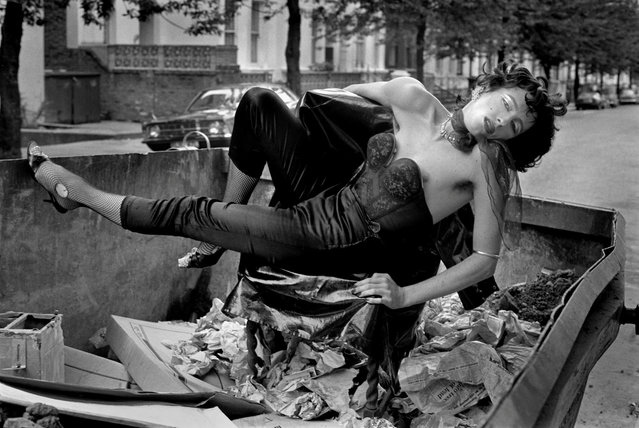
“A very delicate person, beneath the flamboyance”. Jasper, Ladbroke Grove, 1977. “In the 1970s, Australia was rather cut off. I’d always wanted to live abroad, so I moved to Rome and then London. I was an art historian, but started studying photography part-time. I was interested in the demi-monde culture and began mixing in all sorts of circles. Jasper was a rather wonderful character. He was from Sydney, but he was living downstairs from me in Ladbroke Grove, in a flat rented to some gay friends. It was fairly eclectic. Jasper was always playing around with clothes and makeup. If he was looking particularly wonderful, I might get out my lights and take a shot. Or he might put makeup on me. He wasn’t always in drag, but he was permanently in diva mode, dependably louche, funny and naughty. I think all that comes across in the image. He was actually a very delicate person, though, beneath the wit and flamboyance. Jasper floated through London all too briefly. His real name was Peter MacMahon, but to us he was only ever Jasper Havoc, an alter ego he’d created while part of a transvestite troupe called Sylvia and the Synthetics. They were legendary in Sydney gay culture. On this day, we’d been taking some pictures inside and had gone out into the streets to fool around some more. Jasper was wearing a corset and fishnets ensemble, with other bits and pieces, and we joked about him being trashy as he lay in the skip. We just took the shot for ourselves. It wasn’t done with any publication in mind, or anything else. This was way before the internet and people didn’t share images. If you dressed up, it was just for that moment”. (Photo by Jane England)

“A very delicate person, beneath the flamboyance”. Jasper, Ladbroke Grove, 1977. “In the 1970s, Australia was rather cut off. I’d always wanted to live abroad, so I moved to Rome and then London. I was an art historian, but started studying photography part-time. I was interested in the demi-monde culture and began mixing in all sorts of circles. Jasper was a rather wonderful character...”. (Photo by Jane England)
Details
26 Jun 2017 09:04:00
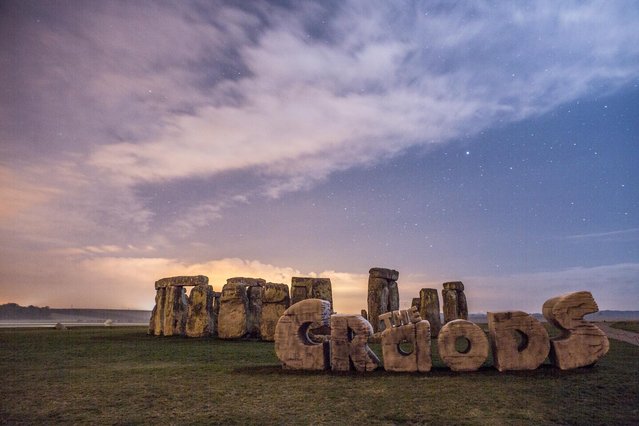
19th March 2013: In celebration of the Spring Solstice 2013 and in conjunction with the release of Twentieth Century Fox's 3D animation ‘THE CROODS’ - a family animation centered around the first ever pre historic road trip - a giant monument was erected at Stonehenge at sunrise today, Tuesday 19th March.  This marks the first time a modern structure has EVER been allowed on this historic site. The Spring Solstice or ‘Vernal Equinox’ recognises the first day of spring and each year sees druids and pagans gather at Stonehenge early in the morning to watch the sun rise above the prehistoric stones.  This year an additional monument, in the shape of ‘THE CROODS’, will become part of these special celebrations at daybreak. ‘Meet the first modern family, THE CROODS, whose world is rocked by generational clashes and seismic shifts that come to a head on a wild road trip filled with dazzling adventures, amazing firsts (like fire…and shoes), never before seen creatures and the epic discovery that they’ll have to stay one step ahead of the ever-changing world or get left in the prehistoric dust.’ DreamWorks Animation SKG presents THE CROODS. The film is directed by Chris Sanders & Kirk DeMicco, and produced by Kristine Belson and Jane Hartwell.  The screenplay is by Kirk DeMicco & Chris Sanders, with a story by John Cleese, Kirk DeMicco and Chris Sanders. The music is by Alan Silvestri. The film stars Nicolas Cage as Grug, Ryan Reynolds as Guy, Emma Stone as Eep, Catherine Keener as Ugga, Clark Duke as Thunk, and Cloris Leachman as Gran. THE CROODS presents an age known as the Croodaceous Period, which, says DeMicco, “fell between the Jurassic Age and the ‘Katzenzoic Era’– at least according to DreamWorks archaeologists.” It is a world of visual splendor and grandeur that holds innumerable challenges for the beleaguered clan

In celebration of the Spring Solstice 2013 and in conjunction with the release of Dreamworks’ 3D animation The Croods – a family animation centered around the first ever pre historic road trip – a giant monument was built at Stonehenge at sunrise on Tuesday March 19, 2013. This marks the first time a modern structure has Ever been allowed on this historic site. (Photo by Flashforwardpublicity.com)
Details
21 Mar 2013 10:21:00


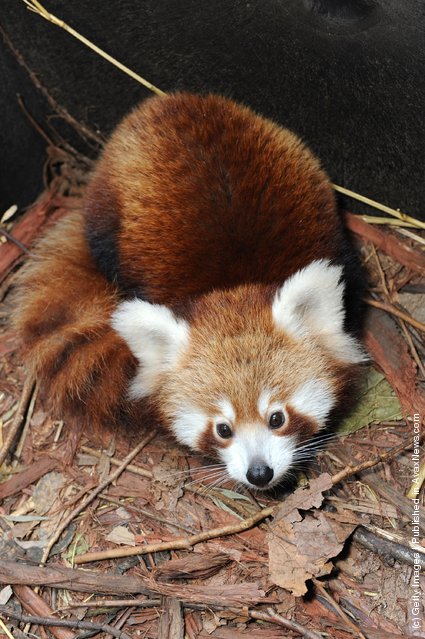
“The red panda (Ailurus fulgens, or shining-cat), is a small arboreal mammal native to the eastern Himalayas and southwestern China. It is the only species of the genus Ailurus. Slightly larger than a domestic cat, it has reddish-brown fur, a long, shaggy tail, and a waddling gait due to its shorter front legs. It feeds mainly on bamboo, but is omnivorous and may also eat eggs, birds, insects, and small mammals. It is a solitary animal, mainly active from dusk to dawn, and is largely sedentary during the day”. – Wikipedia

Photo: In this handout image provided by Taronga Zoo, Seba, a baby Red Panda, explores his new home at Taronga Zoo on April 7, 2011 in Sydney, Australia. The Red Panda cub was born at Christmas and is the 45th to be born at the zoo since 1977. (Photo by Peter Hardin/Taronga Zoo via Getty Images)
Details
07 Apr 2011 08:51:00


“The Red River Hog (Potamochoerus porcus), also known as the Bush Pig (but not to be confused with P. larvatus, common name “Bushpig”), is a wild member of the pig family living in Africa, with most of its distribution in the Guinean and Congolian forests. It is rarely seen away from rainforests, and generally prefers areas near rivers or swamps.

Red River Hogs eat grass, berries, roots, insects, molluscs, small vertebrates and carrion. They are capable of causing damage to plantations. Red River Hogs typically live in herds of 6-20 members led by a dominant boar. Sows rear 3-6 piglets at a time.”

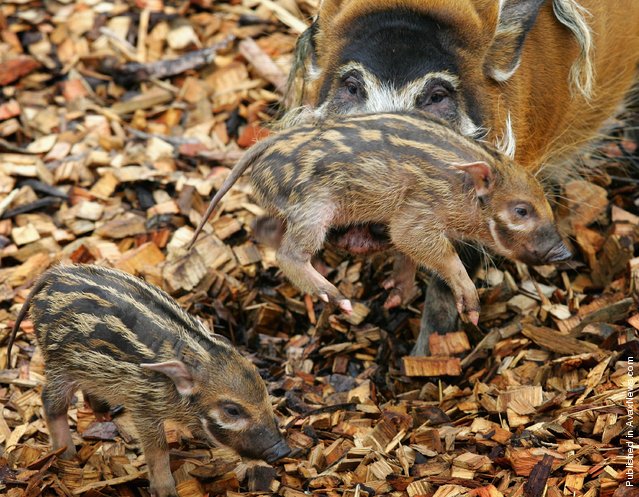
Photo: Two 17 day old red river hoglet twins forage for food next to their mother Bahiti at London Zoo on August 23, 2007 in London, England. Red River hoglets inhabit the forests and swamps of West and Central Africa. The recent additions to the London Zoo pig pen have been eagerly awaited by zoo keepers. (Photo by Chris Jackson/Getty Images)
Details
18 Mar 2011 15:15:00
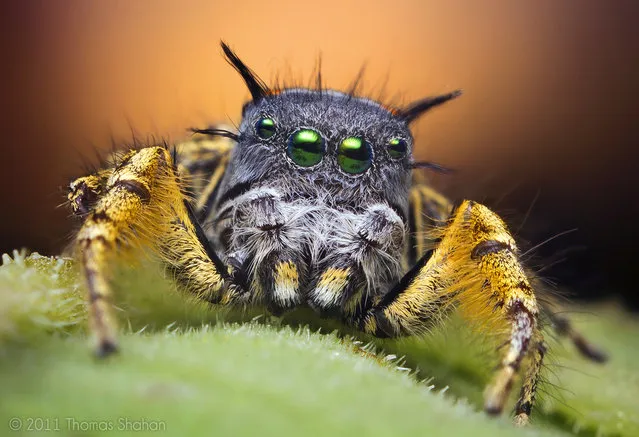
Adult Male Jumping Spider at Sunset – Phidippus mystaceus

“Hey! I'm Thomas Shahan, an artist and macrophotographer from Oklahoma. In my spare time over the past few years, I've been shooting portraiture of local arthropods. Why would I devote countless hours to tramping through forests, fields and the like searching for insects and spiders? Well, despite some common beliefs, arthropods (members of the phylum Arthropoda – insects, spiders, crustaceans...) represent an endlessly varied, wildly beautiful and fascinating bunch of animals with surprisingly personable faces and behavior. Often, all it takes is simply inspecting their lives on a closer level to turn repulsion to reverence”. – Thomas Shahan

Photo: Adult Male Jumping Spider at Sunset – Phidippus mystaceus. (Photo by Thomas Shahan; Source: Flickr)
Details
23 Apr 2012 14:07:00
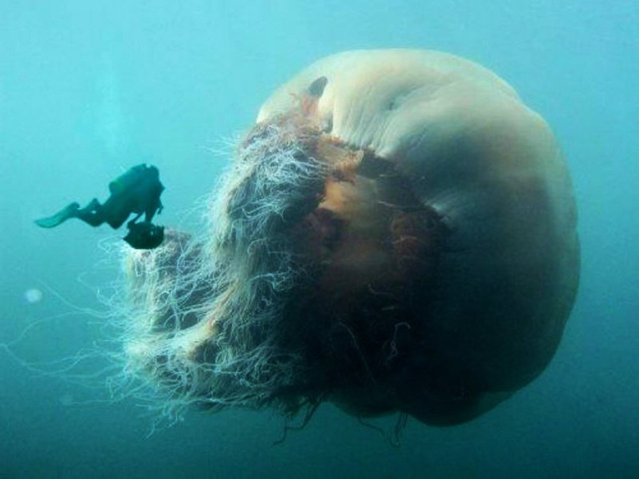
Giant Jellyfish Cyanea capillata

Cyanea capillata is the largest known species of jellyfish. Its range is confined to cold, boreal waters of the Arctic, northern Atlantic, and northern Pacific Oceans, seldom found farther south than 42°N latitude. Similar jellyfish, which may be the same species, are known to inhabit seas near Australia and New Zealand. The largest recorded specimen found, washed up on the shore of Massachusetts Bay in 1870, had a bell (body) with a diameter of 7 feet 6 inches (2.29 m) and tentacles 120 feet (37 m) long.Lion's mane jellyfish have been observed below 42°N latitude for some time—specifically in the larger bays of the east coast of the United States.
Details
24 Jul 2012 12:00:00