Loading...
Done
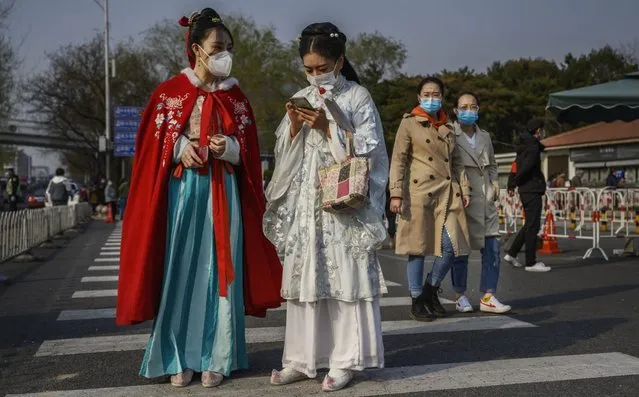
Chinese women wear protective masks as they are dressed in traditional clothing from the Qing Dynasty era outside a park on March 29, 2020 in Beijing, China. A limited section of the iconic tourist site was re-opened to the public this week allowing a smaller number of visitors to reserve tickets online in advance and to enter after passing health screening. With the pandemic hitting hard across the world, China recorded its first day with no new domestic cases of the coronavirus last week, since the government imposed sweeping measures to keep the disease from spreading. For two months, millions of people across China have been restricted in how they move from their homes, while other cities have been locked down in ways that appeared severe at the time but are now being replicated in other countries trying to contain the virus. Officials believe the worst appears to be over in China, though there are concerns of another wave of infections as the government attempts to reboot the worlds second largest economy. In Beijing, it is mandatory to wear masks outdoors, retail stores operate on reduced hours, restaurants employ social distancing among patrons, and tourist attractions at risk of drawing large crowds remain closed. Monitoring and enforcement of virus-related measures and the quarantine of anyone arriving to Beijing is carried out by neighborhood committees and a network of Communist Party volunteers who wear red arm bands. A primary concern for Chinese authorities remains the arrival of flights from Europe and elsewhere, given the exposure of passengers in regions now regarded as hotbeds for transmission. Since January, China has recorded more than 81,000 cases of COVID-19 and at least 3200 deaths, mostly in and around the city of Wuhan, in central Hubei province, where the outbreak first started. (Photo by Kevin Frayer/Getty Images)

Chinese women wear protective masks as they are dressed in traditional clothing from the Qing Dynasty era outside a park on March 29, 2020 in Beijing, China. A limited section of the iconic tourist site was re-opened to the public this week allowing a smaller number of visitors to reserve tickets online in advance and to enter after passing health screening. (Photo by Kevin Frayer/Getty Images)
Details
01 Apr 2020 00:05:00
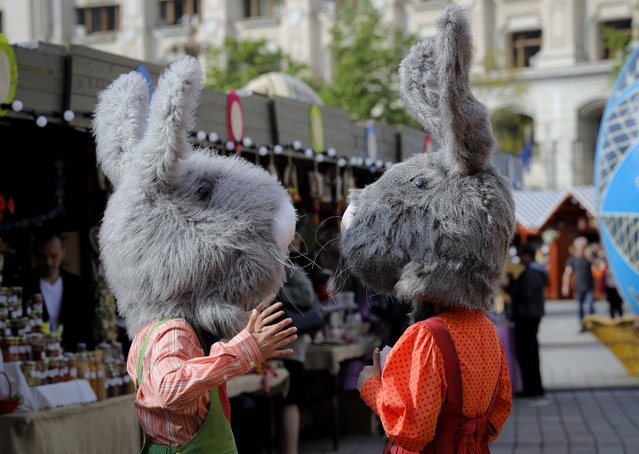
In this Thursday, April 13, 2017, picture entertainers wearing rabbit costumes speak at a fair in Bucharest, Romania. Ahead of Easter, celebrated by both Orthodox and Catholic believers on April 16 processions of priests clad in golden robes carrying foliage on Palm Sunday in a recreation of Jesus' ride into Jerusalem, mixed with more commercial flavored celebrations like an Easter fair outside the giant palace built by late Communist leader Nicolae Ceausescu where entertainers strutted around wearing giant rabbit heads. (Photo by Vadim Ghirda/AP Photo)

In this Thursday, April 13, 2017, picture entertainers wearing rabbit costumes speak at a fair in Bucharest, Romania. Ahead of Easter, celebrated by both Orthodox and Catholic believers on April 16 processions of priests clad in golden robes carrying foliage on Palm Sunday in a recreation of Jesus' ride into Jerusalem, mixed with more commercial flavored celebrations like an Easter fair outside the giant palace built by late Communist leader Nicolae Ceausescu where entertainers strutted around wearing giant rabbit heads. (Photo by Vadim Ghirda/AP Photo)
Details
17 Apr 2017 08:01:00
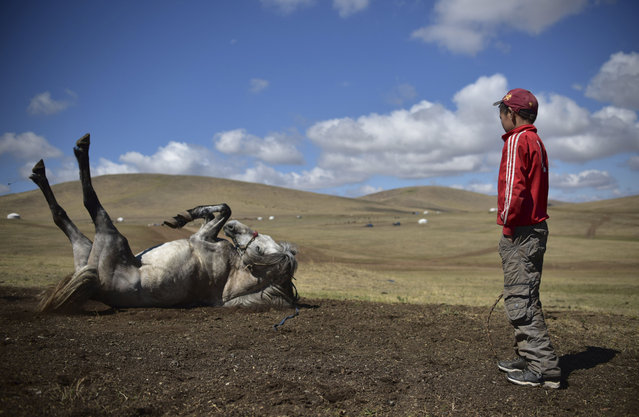
This picture taken on July 8, 2015 shows 13-year-old jockey Purevsurengiin Togtokhsuren (R) watching a horse rolling in the dirt after a training session in Khui Doloon Khudag, some 50 kms west of Ulan Bator. Despite being only 13 years old, Togtokhsuren is riding for the fifth time in the national races for Mongolia's summer festival, known as Naadam, lining up against some 170 other child jockeys. (Photo by Johannes Eisele/AFP Photo)

This picture taken on July 8, 2015 shows 13-year-old jockey Purevsurengiin Togtokhsuren (R) watching a horse rolling in the dirt after a training session in Khui Doloon Khudag, some 50 kms west of Ulan Bator. Despite being only 13 years old, Togtokhsuren is riding for the fifth time in the national races for Mongolia's summer festival, known as Naadam, lining up against some 170 other child jockeys. (Photo by Johannes Eisele/AFP Photo)
Details
17 Nov 2015 08:04:00
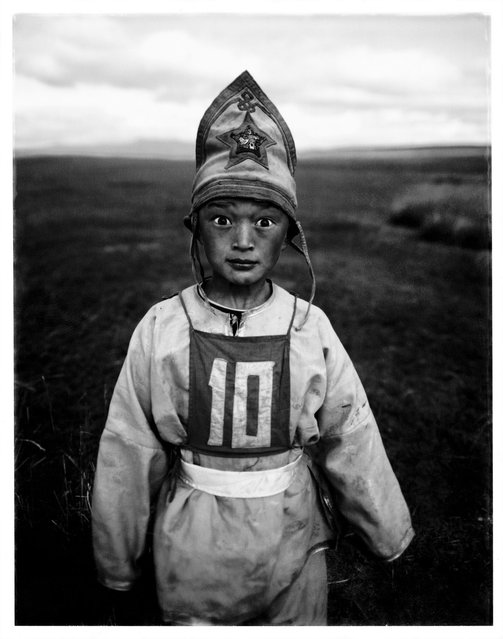
Mongolian Child Jockeys

Horse racing is part of Naadam, a festival organized every July in Mongolia to celebrate the People’s Revolution. Using children as jockeys in such races has a centuries-long tradition. Boys and girls as young as 5 (although the law imposes a minimum age limit of 7) ride in races that can be dangerous, with hundreds of horses running across the steppe at distances of 12 to 28 kilometres at great speeds. (Photo by Tomasz Gudzowaty)
Details
30 Apr 2012 11:02:00
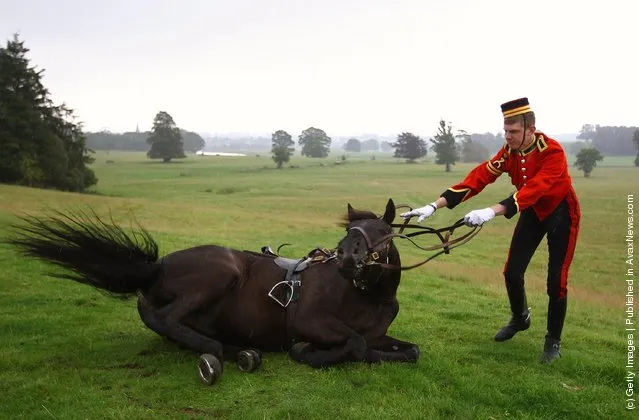
The Household Cavalry Prepare At Floors Castle Ahead Of Massed Pipe Bands Day

Lance Corpral Johnnie Miller of the Household Cavalry rehearses at Floors Castle in preparation for massed Pipe Band day on August 26, 2011 in Kelso, Scotland. The event, being held on August 28, will feature the first Scottish performance of the Household Cavalry's Musical ride in over 10 years. (Photo by Jeff J Mitchell/Getty Images)
Details
27 Aug 2011 14:31:00
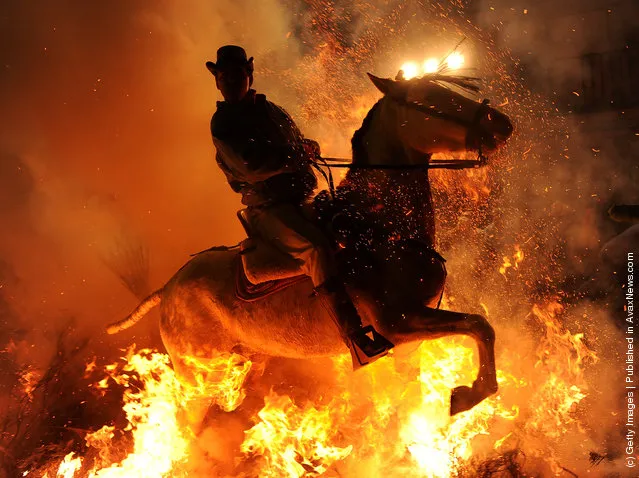
Las Luminarias de San Anton Festival

A man rides a horse through a bonfire on January 16, 2012 in the small village of San Bartolome de Pinares, Spain. In honor of San Anton, the patron saint of animals, horses are riden through the bonfires on the night before the official day of honoring animals in Spain. (Photo by Jasper Juinen/Getty Images)
Details
19 Jan 2012 09:00:00
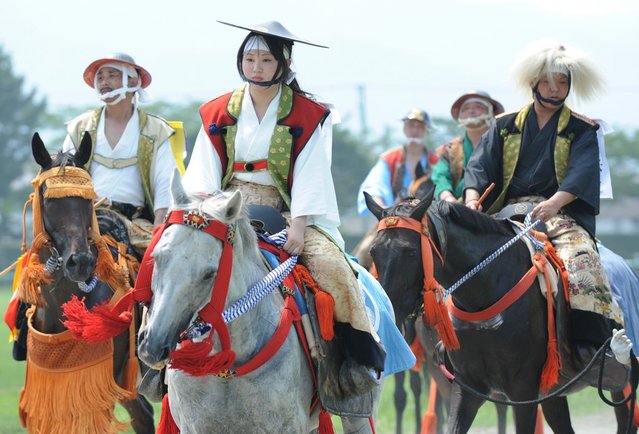
A young woman (C) clad in samurai costume leads other local poeple as she rides her horse during a parade at the annual Soma Nomaoi festival in Minamisoma, Fukushima Prefecture, on July 28, 2012.  The traditional full-scale festival kicked off for the first time after the accident of the Fukushima Dai-ichi Nuclear Power Plant following the massive earthquake and the tsunami on March 11, 2011. (Photo by Toru Yamanaka/AFP Photo)

Soma-Nomaoi is a festival that recreates a battle scene from more than 1,000 years ago. It is annually held for 4 days from July 22 to 25 in Haramachi City, Fukushima Prefecture, in the eastern part of Japan. In this historical event, 600 mounted samurai in traditional Japanese armor, with long swords at their side and ancestral flagstaffs streaming from their backs, ride across open fields. Soma-Nomaoi has been designated an Important Intangible Folk Cultural Property.

Photo: A young woman (C) clad in samurai costume leads other local poeple as she rides her horse during a parade at the annual Soma Nomaoi festival in Minamisoma, Fukushima Prefecture, on July 28, 2012. The traditional full-scale festival kicked off for the first time after the accident of the Fukushima Dai-ichi Nuclear Power Plant following the massive earthquake and the tsunami on March 11, 2011. (Photo by Toru Yamanaka/AFP Photo)
Details
02 Aug 2012 12:59:00
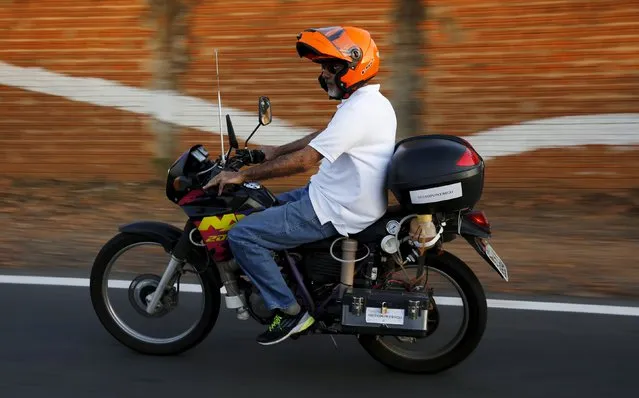
Ricardo Azevedo rides his Honda NX 200 motorbike, which he converted to be powered by water, in Salto, northwest of Sao Paulo, Brazil, August 6, 2015. The Sao Paulo civil servant built the motorbike which can cover up to 500 kilometres (311 miles) fueled by just one liter of water. Dubbed "Moto Power H2O", the bike is powered by a process of electrolysis by which the water molecule is broken down into its constituent elements. (Photo by Nacho Doce/Reuters)

Ricardo Azevedo rides his Honda NX 200 motorbike, which he converted to be powered by water, in Salto, northwest of Sao Paulo, Brazil, August 6, 2015. The Sao Paulo civil servant built the motorbike, which can cover up to 500 kilometres (311 miles) fuelled by just one litre of water. Dubbed “Moto Power H2O” the bike is powered by the process of electrolysis, which breaks the water molecule down into its constituent elements. (Photo by Nacho Doce/Reuters)
Details
13 Aug 2015 12:00:00