Loading...
Done
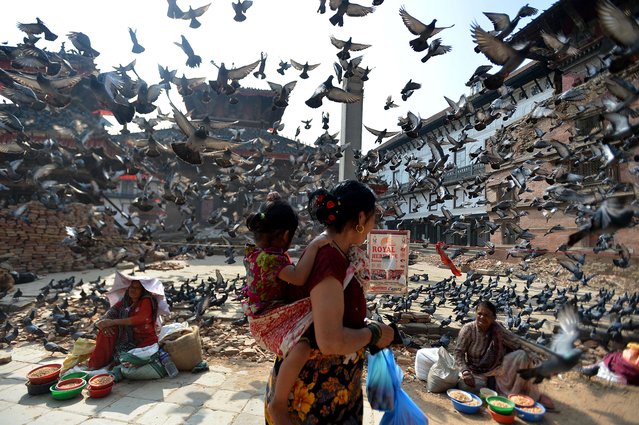
Flying pigeons pass over Nepalese street vendors near the earthquake damaged UNESCO World Heritage Site, Durbar Square in Kathmandu on May 20, 2015. Nearly 8,500 people have now been confirmed dead in the disaster, which destroyed more than half a million homes and left huge numbers of people without shelter with just weeks to go until the monsoon rains. (Photo by Ishara S. Kodikara/AFP Photo)

Flying pigeons pass over Nepalese street vendors near the earthquake damaged UNESCO World Heritage Site, Durbar Square in Kathmandu on May 20, 2015. Nearly 8,500 people have now been confirmed dead in the disaster, which destroyed more than half a million homes and left huge numbers of people without shelter with just weeks to go until the monsoon rains. (Photo by Ishara S. Kodikara/AFP Photo)
Details
23 May 2015 10:25:00
Russia's synchronised swimming duet Aleksandr Maltsev (L) and Darina Valitova compete in the Mixed Duet Technical preliminary during the synchronised swimming competition at the 2015 FINA World Championships in Kazan on July 25, 2015. (Photo by Christophe Simon/AFP Photo)

Russia's synchronised swimming duet Aleksandr Maltsev (L) and Darina Valitova compete in the Mixed Duet Technical preliminary during the synchronised swimming competition at the 2015 FINA World Championships in Kazan on July 25, 2015. (Photo by Christophe Simon/AFP Photo)
Details
25 Jul 2015 13:06:00
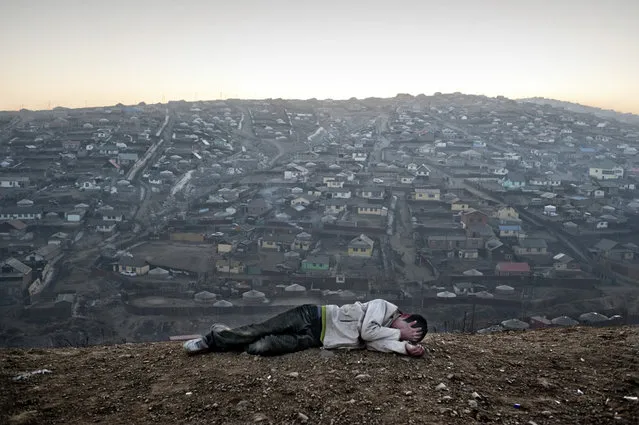
Asia, Mongolia, March 27, 2011. A view of Ulaan Baator over the shoulder of a slumbering drunk. Alcoholism is a huge problem in the city, home to almost half of Mongolia's people. The capital's population has doubled in the past two years, expanding outward in a haphazard sprawl, and many inhabitants live in slums known as the “Gher District”. (Photo by Alessandro Grassani)

“Environmental Migrants: The Last Illusion” by photographer Alessandro Grassani, documents the life of people in Kenya, Mongolia and Bangladesh who migrate to escape environmental stresses to the city of their own countries in hopes for a better life. Here: Asia, Mongolia, March 27, 2011. A view of Ulaan Baator over the shoulder of a slumbering drunk. Alcoholism is a huge problem in the city, home to almost half of Mongolia's people. The capital's population has doubled in the past two years. High levels of unemployment and poverty await herders who abandon rural areas and arrive in the city, illiterate and untrained in any skills necessary for urban jobs. (Photo by Alessandro Grassani)
Details
21 Jul 2015 10:10:00
Izzy Paskowitz helps Nixee Grace Chanowsky, 4, catch a wave Monday, August 18, 2014 at Wrightsville Beach, N.C. during the Annual Surfers Healing event for children with autism. Hundreds of people made their way to the beach to watch and cheer on the camp that was founded by Israel and Danielle Paskowitz. (Photo by Mike Spencer/AP Photo/The Star-News)

Izzy Paskowitz helps Nixee Grace Chanowsky, 4, catch a wave Monday, August 18, 2014 at Wrightsville Beach, N.C. during the Annual Surfers Healing event for children with autism. Hundreds of people made their way to the beach to watch and cheer on the camp that was founded by Israel and Danielle Paskowitz. (Photo by Mike Spencer/AP Photo/The Star-News)
Details
23 Aug 2014 12:03:00
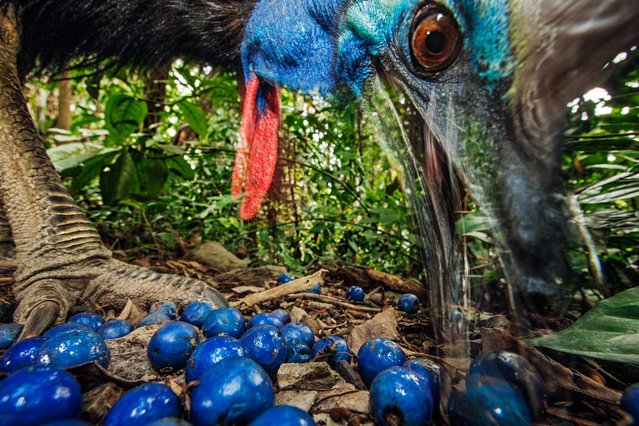
“Cassowaries are large, flightless birds related to emus and (more distantly) to ostriches, rheas, and kiwis”, writes Olivia Judson in the September issue of National Geographic magazine. (Photo by Christian Ziegler/National Geographic)

“Cassowaries are large, flightless birds related to emus and (more distantly) to ostriches, rheas, and kiwis”, writes Olivia Judson in the September issue of National Geographic magazine. How large? People-size: Adult males stand well over five foot five and top 110 pounds. Females are even taller, and can weigh more than 160 pounds. Dangerous when roused, they’re shy and peaceable when left alone. But even birds this big and tough are prey to habitat loss. The dense New Guinea and Australia rain forests where they live have dwindled. Today cassowaries might number 1,500 to 2,000. And because they help shape those same forests – by moving seeds from one place to another – “if they vanish”, Judson writes, “the structure of the forest would gradually change” too. (Photo by Christian Ziegler/National Geographic)
Details
06 Jan 2014 12:21:00
An Indonesian student protester runs after he caught fire while throwing a molotov cocktail towards police during a protest against the new president's decision to hike fuel prices this week in Makassar, South Sulawesi Province November 19,  2014. (Photo by Yusuf Ahmad/Reuters)

An Indonesian student protester runs after he caught fire while throwing a molotov cocktail towards police during a protest against the new president's decision to hike fuel prices this week in Makassar, South Sulawesi Province November 19, 2014. (Photo by Yusuf Ahmad/Reuters)
Details
22 Nov 2014 13:15:00
Participants climb over a wall at the “Tough Mudder” endurance event series in Arnsberg September 6, 2014. Competitors who took part in the endurance event saw themselves having to overcome various military style obstacles. (Photo by Ina Fassbender/Reuters)

Participants climb over a wall at the “Tough Mudder” endurance event series in Arnsberg September 6, 2014. Competitors who took part in the endurance event saw themselves having to overcome various military style obstacles. (Photo by Ina Fassbender/Reuters)
Details
13 Sep 2014 11:39:00
What the World Eats By Peter Menzel And Faith D'Aluisio Part 2

A stunning photographic collection featuring portraits of people from 30 countries and the food they eat in one day. In this fascinating study of people and their diets, 80 profiles are organized by the total number of calories each person puts away in a day. Featuring a Japanese sumo wrestler, a Massai herdswoman, world-renowned Spanish chef Ferran Adria, an American competitive eater, and more, these compulsively readable personal stories also include demographic particulars, including age, activity level, height, and weight. Essays from Harvard primatologist Richard Wrangham, journalist Michael Pollan, and others discuss the implications of our modern diets for our health and for the planet. This compelling blend of photography and investigative reportage expands our understanding of the complex relationships among individuals, culture, and food.
Details
02 May 2014 09:20:00