Loading...
Done
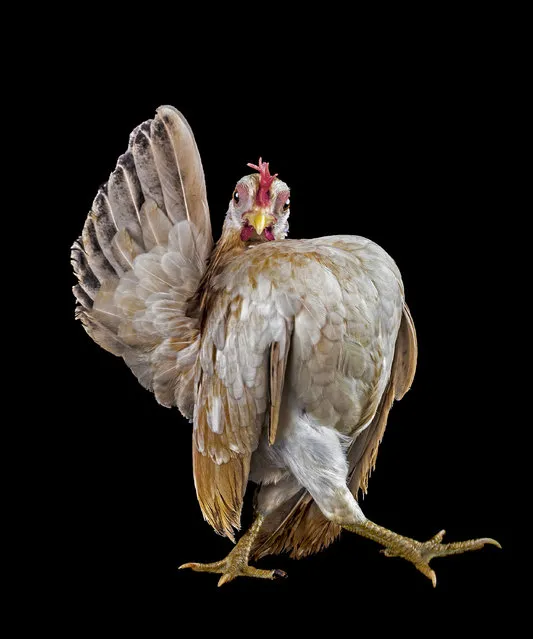
Ornamental chicken breeding clubs have emerged in Indonesia, Thailand, North America and even European countries such as the UK and France. Malaysia is however the epicenter of this cultural phenomenon. (Photo by Ernest Goh/2013 Sony World Photography Awards)

Ornamental chicken breeding clubs have emerged in Indonesia, Thailand, North America and even European countries such as the UK and France. Malaysia is however the epicenter of this cultural phenomenon. These chickens are prized for their build, size, behavior and showmanship by their owners and competitions or beauty contests as they are often described are held almost every week in at least one village in Malaysia. Judges sit around a square table inspecting each chicken for a few minutes trying to determine a champion specimen in its own weight class based on its stance, temperament and physical assets like wings, tails and comb. The walk or strut by an ornamental chicken in a beauty contest, much like a runway model, constitutes a large part of the scoring system. (Photo by Ernest Goh/2013 Sony World Photography Awards)
Details
28 Apr 2013 08:32:00
A Brazilian drug gang member nicknamed Pilintra, 26, poses with a gun atop a hill overlooking a slum in Salvador, Bahia State, April 11, 2013. One of Brazil's main tourist destinations and a 2014 World Cup host city, Salvador suffers from an unprecedented wave of violence with an increase of over 250% in the murder rate, according to the Brazilian Center for Latin American Studies (CEBELA). (Photo by Lunae Parracho/Reuters)

A Brazilian drug gang member nicknamed Pilintra, 26, poses with a gun atop a hill overlooking a slum in Salvador, Bahia State, April 11, 2013. One of Brazil's main tourist destinations and a 2014 World Cup host city, Salvador suffers from an unprecedented wave of violence with an increase of over 250% in the murder rate, according to the Brazilian Center for Latin American Studies (CEBELA). (Photo by Lunae Parracho/Reuters)
Details
04 May 2013 11:12:00
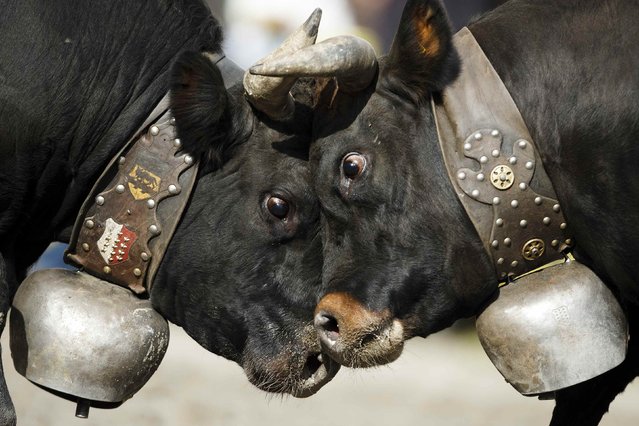
Two Herens cows lock horns during the qualification round of the annual “Battle of the Queens” cow fight finals in Aproz, in the western Alpine canton of Valais May 5, 2013. Each year when taken to the alpine pastures, the cows test their strength and fight for the herd's leadership. The competition continues until a new queen has forced all the other cows to retreat. (Photo by Valentin Flauraud/Reuters)

Two Herens cows lock horns during the qualification round of the annual “Battle of the Queens” cow fight finals in Aproz, in the western Alpine canton of Valais May 5, 2013. Each year when taken to the alpine pastures, the cows test their strength and fight for the herd's leadership. The competition continues until a new queen has forced all the other cows to retreat. (Photo by Valentin Flauraud/Reuters)
Details
06 May 2013 12:33:00
A girl in a vamire costume poses for pictures during the traditional park picnic on the first day of the annual Wave-Gotik Treffen, or Wave and Goth Festival, on May 17, 2013 in Leipzig, Germany. The four-day festival, in which elaborate fashion is a must, brings together over 20,000 Wave, Goth and steam punk enthusiasts from all over the world for concerts, readings, films, a Middle Ages market and workshops. (Photo by Marco Prosch)

A girl in a vamire costume poses for pictures during the traditional park picnic on the first day of the annual Wave-Gotik Treffen, or Wave and Goth Festival, on May 17, 2013 in Leipzig, Germany. The four-day festival, in which elaborate fashion is a must, brings together over 20,000 Wave, Goth and steam punk enthusiasts from all over the world for concerts, readings, films, a Middle Ages market and workshops. (Photo by Marco Prosch)
Details
18 May 2013 12:47:00
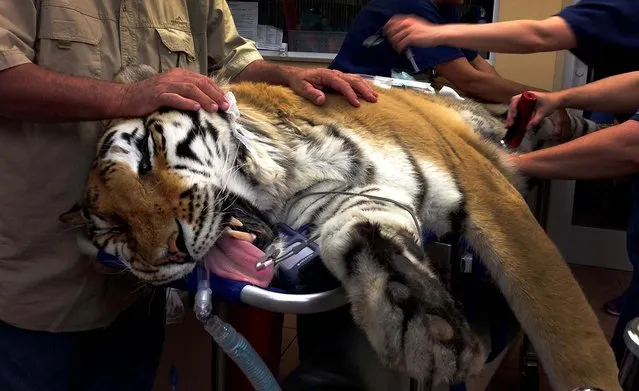
Vernon Yates, founder of Wildlife Rescue and Rehabilitation, lays his hands on Ty, a 400-pound tiger, as staff prepare to surgically extract a 4-pound hairball from the big cat, in Clearwater, Florida, on May 22, 2013. Ty is cared for by Wildlife Rescue and Rehabilitation in Seminole. The non-profit animal rescue group mainly serves by assisting Florida law enforcement with animals that have been seized. (Photo by James Judge/Courtesy BluePearl Veterinary Partners)

Vernon Yates, founder of Wildlife Rescue and Rehabilitation, lays his hands on Ty, a 400-pound tiger, as staff prepare to surgically extract a 4-pound hairball from the big cat, in Clearwater, Florida, on May 22, 2013. Ty is cared for by Wildlife Rescue and Rehabilitation in Seminole. The non-profit animal rescue group mainly serves by assisting Florida law enforcement with animals that have been seized. (Photo by James Judge/Courtesy BluePearl Veterinary Partners)
Details
26 May 2013 08:32:00


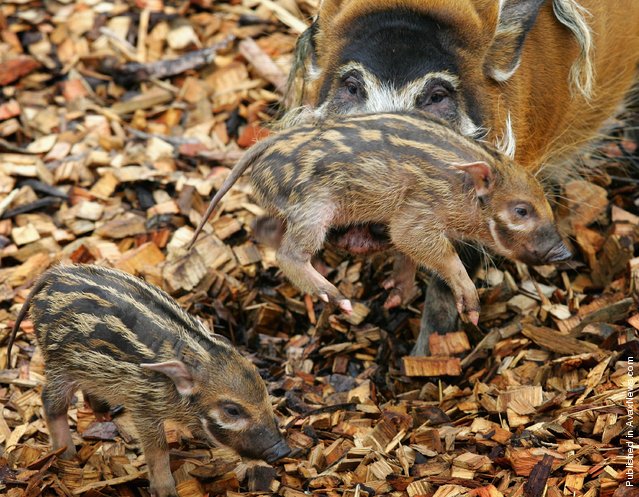
“The Red River Hog (Potamochoerus porcus), also known as the Bush Pig (but not to be confused with P. larvatus, common name “Bushpig”), is a wild member of the pig family living in Africa, with most of its distribution in the Guinean and Congolian forests. It is rarely seen away from rainforests, and generally prefers areas near rivers or swamps.

Red River Hogs eat grass, berries, roots, insects, molluscs, small vertebrates and carrion. They are capable of causing damage to plantations. Red River Hogs typically live in herds of 6-20 members led by a dominant boar. Sows rear 3-6 piglets at a time.”

Photo: Two 17 day old red river hoglet twins forage for food next to their mother Bahiti at London Zoo on August 23, 2007 in London, England. Red River hoglets inhabit the forests and swamps of West and Central Africa. The recent additions to the London Zoo pig pen have been eagerly awaited by zoo keepers. (Photo by Chris Jackson/Getty Images)
Details
18 Mar 2011 15:15:00


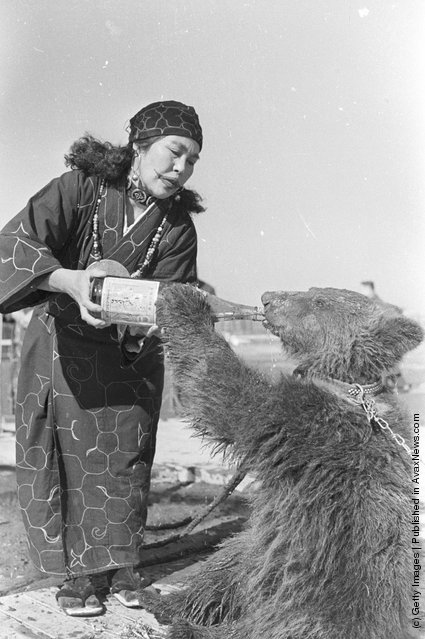
“The Ainu (アイヌ?), also called Aynu, Aino (アイノ), and in historical texts Ezo (蝦夷), are indigenous people or groups in Japan and Russia. Historically they spoke the Ainu language and related varieties and lived in Hokkaidō, the Kuril Islands, and much of Sakhalin. Most of those who identify themselves as Ainu still live in this same region, though the exact number of living Ainu is unknown. This is due to ethnic issues in Japan resulting in those with Ainu backgrounds hiding their identities and confusion over mixed heritages. In Japan, because of intermarriage over many years with Japanese, the concept of a 'pure Ainu' ethnic group is no longer feasible. Official estimates of the population are of around 25,000, while the unofficial number is upwards of 200,000 people”. – Wkipedia

Photo: A captive bear drinking from a large bottle held by an Ainu tribeswoman. (Photo by Evans/Three Lions/Getty Images). Circa 1955
Details
24 Mar 2011 14:01:00


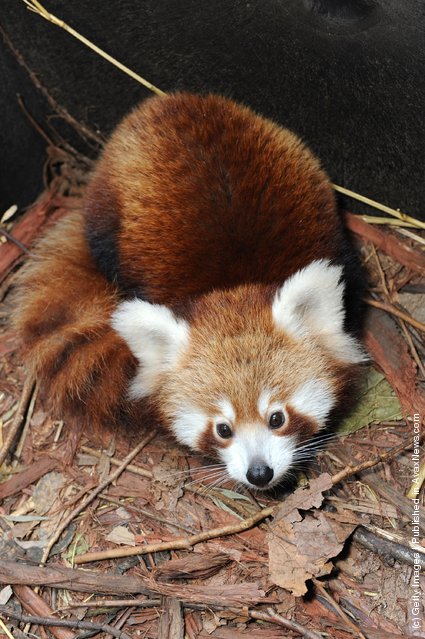
“The red panda (Ailurus fulgens, or shining-cat), is a small arboreal mammal native to the eastern Himalayas and southwestern China. It is the only species of the genus Ailurus. Slightly larger than a domestic cat, it has reddish-brown fur, a long, shaggy tail, and a waddling gait due to its shorter front legs. It feeds mainly on bamboo, but is omnivorous and may also eat eggs, birds, insects, and small mammals. It is a solitary animal, mainly active from dusk to dawn, and is largely sedentary during the day”. – Wikipedia

Photo: In this handout image provided by Taronga Zoo, Seba, a baby Red Panda, explores his new home at Taronga Zoo on April 7, 2011 in Sydney, Australia. The Red Panda cub was born at Christmas and is the 45th to be born at the zoo since 1977. (Photo by Peter Hardin/Taronga Zoo via Getty Images)
Details
07 Apr 2011 08:51:00