Loading...
Done
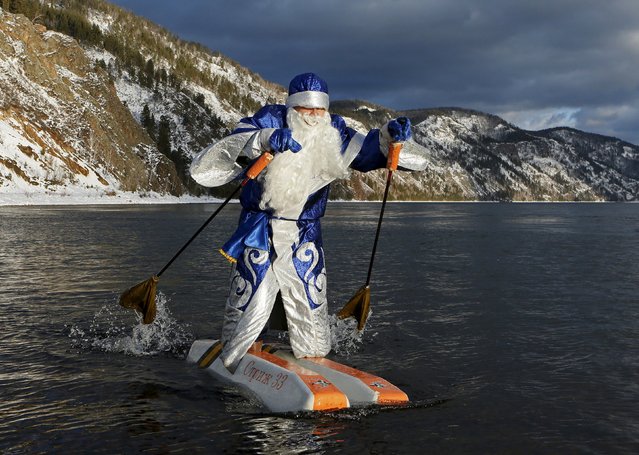
Nikolai Vasilyev, 62, dressed as Father Frost, Russian equivalent of Santa Claus, water-skis along the Yenisei River outside Siberian city of Krasnoyarsk, Russia, December 10, 2015. Vasilyev, a teacher of the Krasnoyarsk Aerospace Academy, constructed the self-made water skis to travel on the water surface. The skis are made of plastic foam and the sticks are designed to propel him forward. (Photo by Ilya Naymushin/Reuters)

Nikolai Vasilyev, 62, dressed as Father Frost, Russian equivalent of Santa Claus, water-skis along the Yenisei River outside Siberian city of Krasnoyarsk, Russia, December 10, 2015. Vasilyev, a teacher of the Krasnoyarsk Aerospace Academy, constructed the self-made water skis to travel on the water surface. The skis are made of plastic foam and the sticks are designed to propel him forward. (Photo by Ilya Naymushin/Reuters)
Details
12 Dec 2015 08:04:00
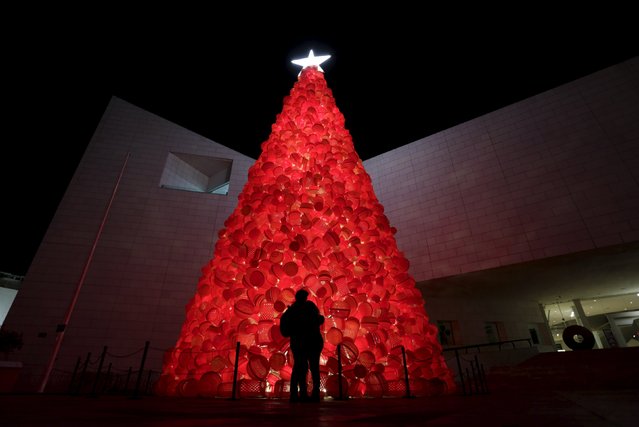
A couple hugs while standing near a Christmas tree made out of plastic bins and plastic hampers outside the Museum of History in Monterrey, Mexico, December 4, 2015. (Photo by Daniel Becerril/Reuters)

A couple hugs while standing near a Christmas tree made out of plastic bins and plastic hampers outside the Museum of History in Monterrey, Mexico, December 4, 2015. The humble Christmas tree has a rich history, from evergreen trees used to symbolise eternal life in Ancient Egypt to tree worship among pagan Europeans. The modern version has its origins in Germany, where the song “O Tannenbaum” is still a festive favourite. Today the traditional tree with lights and decorations appears in cities including Washington, Moscow and Beirut. Alternative constructions range from recycled rubbish in Mexico City to old window frames in Rakvere, Estonia. Whatever the shape or size, the message is the same: Merry Christmas. (Photo by Neil Hall/Reuters)
Details
23 Dec 2015 08:01:00
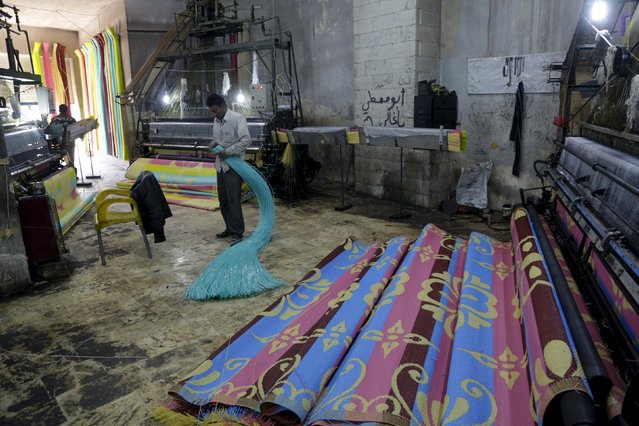
A man prepares plastic strings, used to produce mats, inside a mat factory in the rebel-controlled area of Maarshureen town in Idlib province, Syria, December 22, 2015. The town is known for the significant number of mat factories which exports its production mainly to nearby Iraq through checkpoints controlled by insurgents. But in the past months the business has declined due to heavy airstrikes against insurgents, vendors said. (Photo by Khalil Ashawi/Reuters)

A man prepares plastic strings, used to produce mats, inside a mat factory in the rebel-controlled area of Maarshureen town in Idlib province, Syria, December 22, 2015. The town is known for the significant number of mat factories which exports its production mainly to nearby Iraq through checkpoints controlled by insurgents. But in the past months the business has declined due to heavy airstrikes against insurgents, vendors said. (Photo by Khalil Ashawi/Reuters)
Details
24 Dec 2015 08:00:00
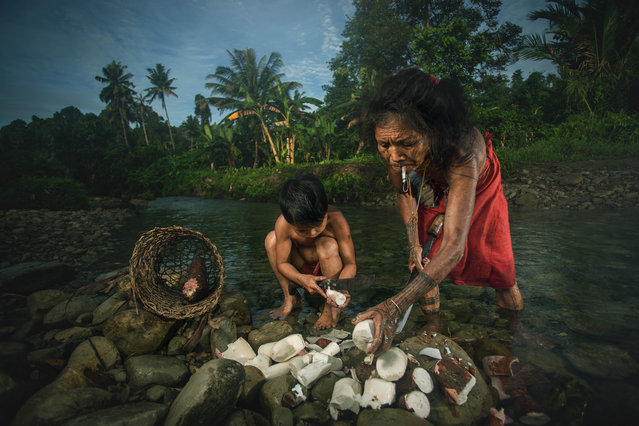
These stunning images document the everyday lives of the men, women and children of the Mentawai tribe. The Mentawai people, a native population in Indonesia, are famous for their decorative tattoos and for living a semi-nomadic life on the Mentawai Islands in West Sumatra. Shot by professional photographer Mohammed Saleh Bin Dollah, the series captures a glimpse of life on the island as the Mentawai men smoke and hunt for food and the children play in the river. (Photo by Muhamad Saleh Dollah/Barcroft Media)

These stunning images document the everyday lives of the men, women and children of the Mentawai tribe. The Mentawai people, a native population in Indonesia, are famous for their decorative tattoos and for living a semi-nomadic life on the Mentawai Islands in West Sumatra. Shot by professional photographer Mohammed Saleh Bin Dollah, the series captures a glimpse of life on the island as the Mentawai men smoke and hunt for food and the children play in the river. Here: A young boy helps a woman to prepare food taken on July 19, 2014 on the Mentawai Islands, Indonesia. (Photo by Muhamad Saleh Dollah/Barcroft Media)
Details
06 Feb 2016 13:09:00
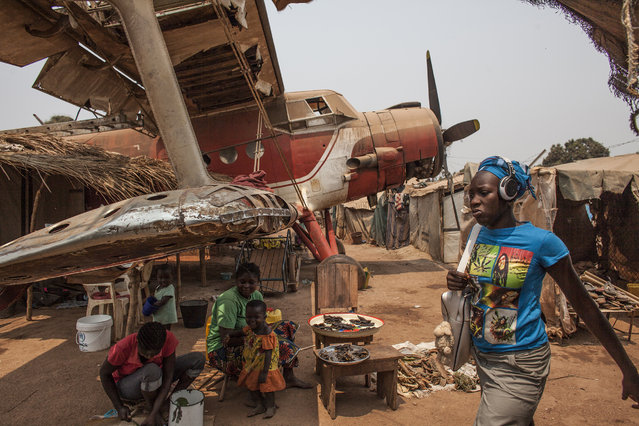
A women sell food under the wing of a plane wreckage being used as housing in M'Poko Internally Displaced Persons camp in Bangui, Central African Republic on Saturday, February 13, 2016. The M'Poko IDP camp, just outside the capitol's airport, currently houses close to 20,000 people displaced due to the ongoing conflict in Central African Republic. The camp was established in late 2013 and contained upto 70,000 people at the height of the crisis in 2014. (Photo by Jane Hahn/The Washington Post)

A women sell food under the wing of a plane wreckage being used as housing in M'Poko Internally Displaced Persons camp in Bangui, Central African Republic on Saturday, February 13, 2016. The M'Poko IDP camp, just outside the capitol's airport, currently houses close to 20,000 people displaced due to the ongoing conflict in Central African Republic. (Photo by Jane Hahn/The Washington Post)
Details
28 Feb 2016 11:09:00
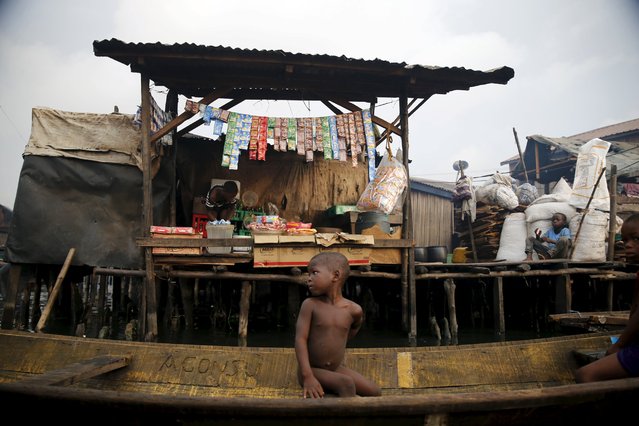
A boy sits in a canoe in front of a shed built on a raft in the Makoko fishing community on the Lagos Lagoon, Nigeria February 29, 2016. Makoko, a vast slum of houses on stilts in a Lagos lagoon, now boasts a new school – pyramid-shaped, floating and capable of withstanding the waterways' extreme weather, it is a beacon of hope for the nearly 100,000 Nigerians who live there.  (Photo by Akintunde Akinleye/Reuters)

A boy sits in a canoe in front of a shed built on a raft in the Makoko fishing community on the Lagos Lagoon, Nigeria February 29, 2016. In Makoko, a sprawling slum of Nigeria's megacity Lagos, a floating school capable of holding up to a hundred pupils has since November brought free education to the waterways known as the Venice of Lagos. It offers the chance of social mobility for youngsters who, like most of the city's 21 million inhabitants, lack a reliable electricity and water supply and whose water-based way of life is threatened by climate change as well as rapid urbanisation. (Photo by Akintunde Akinleye/Reuters)
Details
05 Mar 2016 12:01:00
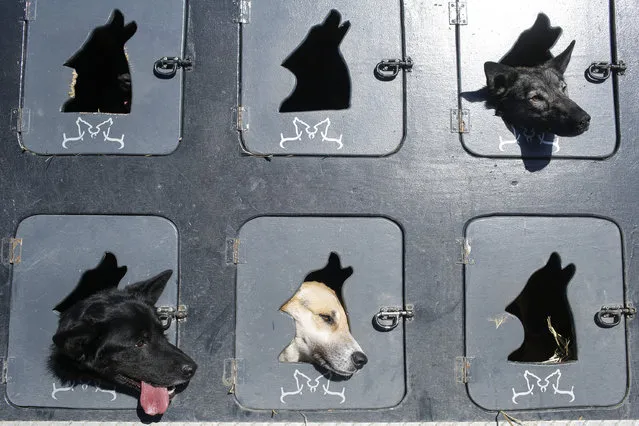
Musher Justin Savidis' dogs wait in the truck before the restart of the Iditarod Trail Sled Dog Race in Willow, Alaska March 6, 2016. Mushers and dog sled teams from around the world embark on the first leg of Alaska's grueling Iditarod Trail Sled Dog Race, starting a nearly 1,000-mile (1,609 km) journey through the state's unforgiving wilderness. (Photo by Nathaniel Wilder/Reuters)

Musher Justin Savidis' dogs wait in the truck before the restart of the Iditarod Trail Sled Dog Race in Willow, Alaska March 6, 2016. Mushers and dog sled teams from around the world embark on the first leg of Alaska's grueling Iditarod Trail Sled Dog Race, starting a nearly 1,000-mile (1,609 km) journey through the state's unforgiving wilderness. (Photo by Nathaniel Wilder/Reuters)
Details
08 Mar 2016 13:26:00
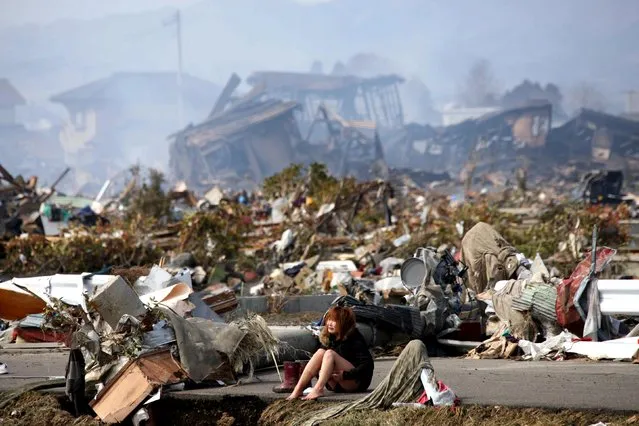
A woman cries while sitting on a road amid the destroyed city of Natori, Miyagi Prefecture in northern Japan March 13, 2011, after a massive earthquake and tsunami that are feared to have killed more than 10,000 people. (Photo by Asahi Shimbun/Reuters)

A woman cries while sitting on a road amid the destroyed city of Natori, Miyagi Prefecture in northern Japan March 13, 2011, after a massive earthquake and tsunami. Five years on from the tsunami that triggered meltdowns at Japan's Fukushima nuclear plant, the page is anything but turned. A magnitude 9 earthquake and towering tsunami on March 11, 2011 killed nearly 16,000 people along Japan's northeastern coast and left more than 2,500 missing. The 10-metre (33-foot) tsunami swept away everything in its path, including houses, ships, cars and farm buildings. (Photo by Asahi Shimbun/Reuters)
Details
09 Mar 2016 12:40:00