Loading...
Done
A Munduruku Indian child is pictured at the Planalto Palace, where a meeting with Minister of the General Secretariat of the Presidency of Brazil Gilberto Carvalho was being held with other Munduruku Indians, in Brasilia, June 4, 2013. (Photo by Ueslei Marcelino/Reuters)

A Munduruku Indian child is pictured at the Planalto Palace, where a meeting with Minister of the General Secretariat of the Presidency of Brazil Gilberto Carvalho was being held with other Munduruku Indians, in Brasilia, June 4, 2013. President Dilma Rousseff's government sought on Tuesday to defuse mounting conflicts with indigenous groups over its decision to stop setting aside farm land for Indians and plans to build more hydroelectric dams in the Amazon. The government flew 144 Munduruku Indians to Brasilia for talks to end a week-long occupation of the controversial Belo Monte dam on the Xingu river, a huge project aimed at feeding Brazil's fast-growing demand for electricity. (Photo by Ueslei Marcelino/Reuters)
Details
06 Jun 2013 09:25:00
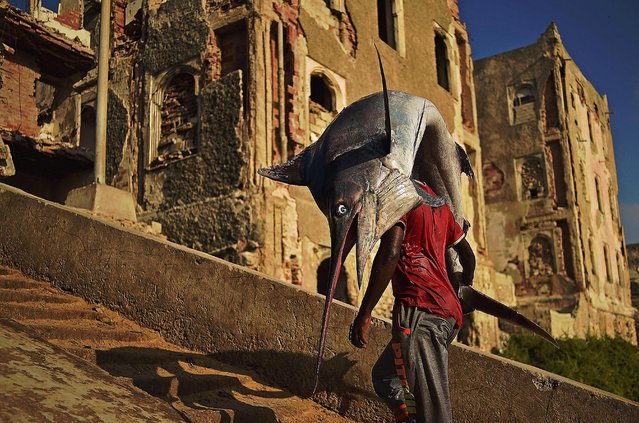
A man carrying a sailfish walks through Hamarweyne district in South Mogadishu on March 25, 2015. (Photo by Carl De Souza/AFP Photo)

A man carrying a sailfish walks through Hamarweyne district in South Mogadishu on March 25, 2015. (Photo by Carl De Souza/AFP Photo)
Details
28 Mar 2015 11:12:00
A singer drinks from a huge bowl of beer on-stage as he pays tribute to the customers after performing at an entertainment club in Beijing, on May 8, 2014. (Photo by Jason Lee/Reuters)

A singer drinks from a huge bowl of beer on-stage as he pays tribute to the customers after performing at an entertainment club in Beijing, on May 8, 2014. (Photo by Jason Lee/Reuters)
Details
10 May 2014 14:40:00
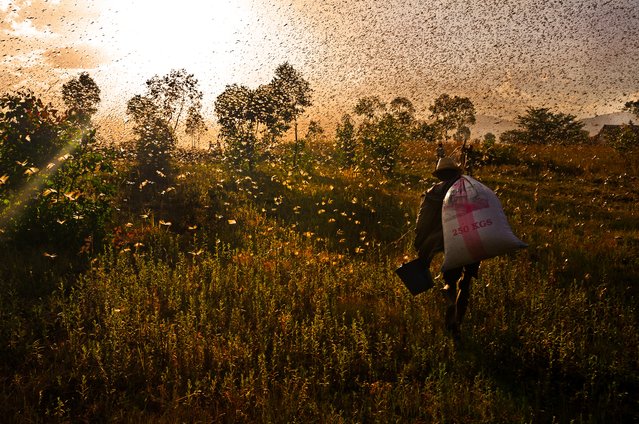
“Locusts & Men”. Oppression, interaction, collaboration. In the life cycle of nature nothing is lost, but the coexistence of different species is sometimes difficult. In Madagascar periodically returns the archaic antagonism between man and the migratory locust, in a circle of life where the two species are looking for space and food for their survival. Photo location: Madagascar, 2013. (Photo and caption by Michele Martinelli/National Geographic Photo Contest)

“Locusts & Men”. Oppression, interaction, collaboration. In the life cycle of nature nothing is lost, but the coexistence of different species is sometimes difficult. In Madagascar periodically returns the archaic antagonism between man and the migratory locust, in a circle of life where the two species are looking for space and food for their survival. At the end of the day a man walks home carrying on his shoulders the heavy bag which contains the locusts captured during the day. The insects provide nutritious meals for the man and his family. Photo location: Madagascar, 2013. (Photo and caption by Michele Martinelli/National Geographic Photo Contest)

ATTENTION! All pictures are presented in high resolution. To see Hi-Res images – just TWICE click on any picture. In other words, click small picture – opens the BIG picture. Click BIG picture – opens VERY BIG picture.
Details
03 Dec 2013 10:59:00
Israeli soldiers cry during a state memorial ceremony marking two years since the  2014 Gaza war “Operation Protective Edge” at Mount Herzl military cemetery in  in Jerusalem, Israel, 26 July 2016. More than 2.000 people were killed in the conflicts between Israel and Palestine. (Photo by Abir Sultan/EPA)

Israeli soldiers cry during a state memorial ceremony marking two years since the 2014 Gaza war “Operation Protective Edge” at Mount Herzl military cemetery in in Jerusalem, Israel, 26 July 2016. More than 2.000 people were killed in the conflicts between Israel and Palestine. (Photo by Abir Sultan/EPA)
Details
28 Jul 2016 14:02:00
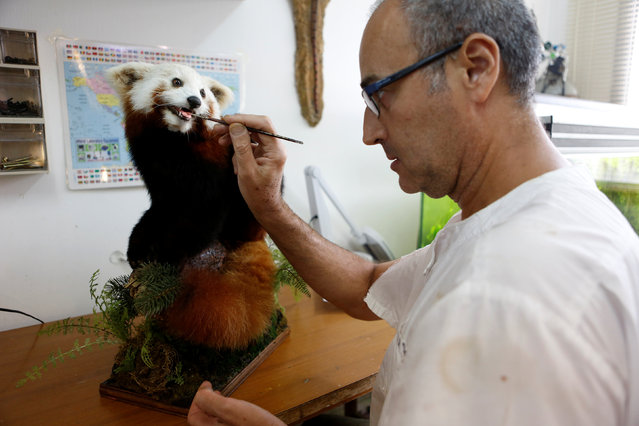
Igor Gavrilov, the main taxidermist of the Zoological centre at Tel Aviv University, works on a taxidermied animal, part of a collection which will be housed at the Steinhardt Museum of Natural History, a new Israeli natural history museum set to open next year in Tel Aviv, Israel June 8, 2016. Legions of insects, sea creatures and ancient fossils are lining up in a new museum shaped liked a giant Noah's Ark, telling the story of a crucial evolutionary byway across Israel. Experts say all humans and other animals had to pass through Israel on their first journey out of Africa into Europe and Asia. (Photo by Nir Elias/Reuters)

Igor Gavrilov, the main taxidermist of the Zoological centre at Tel Aviv University, works on a taxidermied animal, part of a collection which will be housed at the Steinhardt Museum of Natural History, a new Israeli natural history museum set to open next year in Tel Aviv, Israel June 8, 2016. Legions of insects, sea creatures and ancient fossils are lining up in a new museum shaped liked a giant Noah's Ark, telling the story of a crucial evolutionary byway across Israel. (Photo by Nir Elias/Reuters)
Details
25 Aug 2016 09:42:00
p*rn actresses take a break at the Venus erotic fair in Berlin, Germany, October 15, 2015. (Photo by Fabrizio Bensch/Reuters)

Pоrn actresses take a break at the Venus erotic fair in Berlin, Germany, October 15, 2015. The event, which represents the erotic business in the German capital, is open till October 18, 2015. (Photo by Fabrizio Bensch/Reuters)
Details
17 Oct 2015 08:07:00
Dynam employees say a greeting message as they receive customer-care training ahead of the grand opening of the company's pachinko parlour in Fukaya, north of Tokyo July 29, 2014. (Photo by Issei Kato/Reuters)

Dynam employees say a greeting message as they receive customer-care training ahead of the grand opening of the company's pachinko parlour in Fukaya, north of Tokyo July 29, 2014. Japan's once-booming pachinko industry, grappling with a greying customer base and the threat of new competition from casinos, is adopting a softer touch and smoke-free zones to lure a new generation of players, particularly women. Pachinko, a modified version of pinball, is a fading national obsession, with about 12,000 parlours nation-wide and one in thirteen people playing the game. But that figure is declining as the population shrinks and younger people prefer games on their mobile phones. (Photo by Issei Kato/Reuters)
Details
25 Aug 2014 10:18:00