Loading...
Done
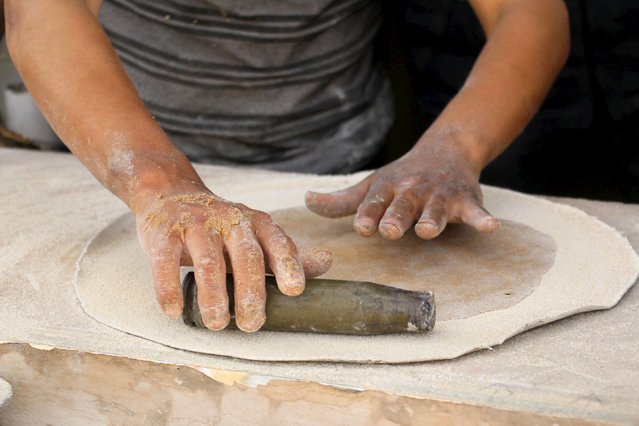
A boy uses remnants of ordnance as he prepares dough inside Abu Khaled's shop in the Douma neighborhood of Damascus April 28, 2015. Abu Khaled opened a shop for making “barley bread” using remnants of weapons including rockets, tank shells and other ordnance fired by forces loyal to Syria's President Bashar al-Assad. (Photo by Amer Almohibany/Reuters)

A boy uses remnants of ordnance as he prepares dough inside Abu Khaled's shop in the Douma neighborhood of Damascus April 28, 2015. Abu Khaled opened a shop for making “barley bread” using remnants of weapons including rockets, tank shells and other ordnance fired by forces loyal to Syria's President Bashar al-Assad. (Photo by Amer Almohibany/Reuters)
Details
09 Aug 2015 11:13:00
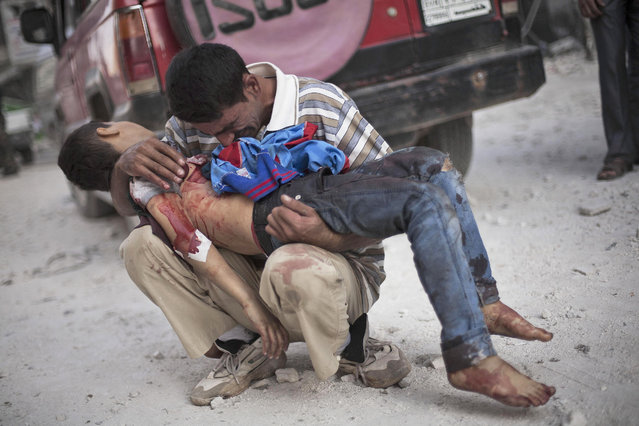
A Syrian man cries while holding the body of his son, killed by the Syrian Army, near Dar El Shifa hospital in Aleppo, Syria, Wednesday, October 3, 2012. (Photo by Manu Brabo/AP Photo)

Manu Brabo was born in Spain in 1981. After studying Photography in The School of Arts and Crafts in Oviedo, he moved to Madrid where he started Journalism in Carlos III University while he was working as a photographer for several humble newspapers and agencies. In 2011, Manu was held captive and then released by by Libyan forces. Brabo, along with fellow AP photographers were awarded the 2013 Pulitzer Prize for Breaking News Photography. Here: a Syrian man cries while holding the body of his son, killed by the Syrian Army, near Dar El Shifa hospital in Aleppo, Syria, Wednesday, October 3, 2012. (Photo by Manu Brabo/AP Photo)
Details
27 Oct 2015 08:04:00
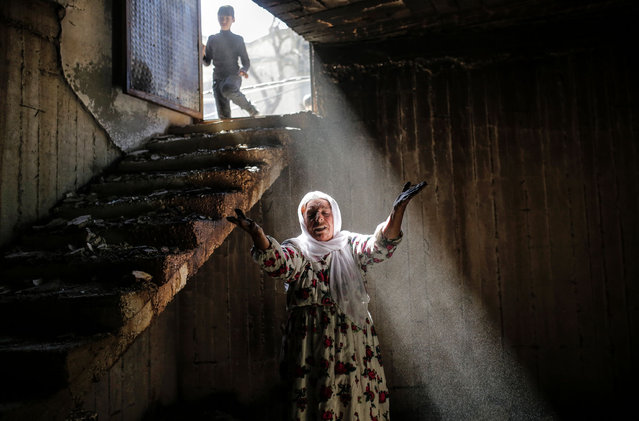
A woman reacts while walking among the ruins of damaged buildings following heavy fighting between government troops and Kurdish fighters, on March 2, 2016 in the southeastern Turkey Kurdish town of Cizre, near the border with Syria and Iraq. Thousands in Turkey's Kurdish-majority town of Cizre started returning to their homes today after authorities partially lifted a curfew in place since December for a controversial military operation to root out separatist rebels. (Photo by Yasin Akgül/AFP Photo)

A woman reacts while walking among the ruins of damaged buildings following heavy fighting between government troops and Kurdish fighters, on March 2, 2016 in the southeastern Turkey Kurdish town of Cizre, near the border with Syria and Iraq. Thousands in Turkey's Kurdish-majority town of Cizre started returning to their homes today after authorities partially lifted a curfew in place since December for a controversial military operation to root out separatist rebels. (Photo by Yasin Akgül/AFP Photo)
Details
03 Mar 2016 11:29:00
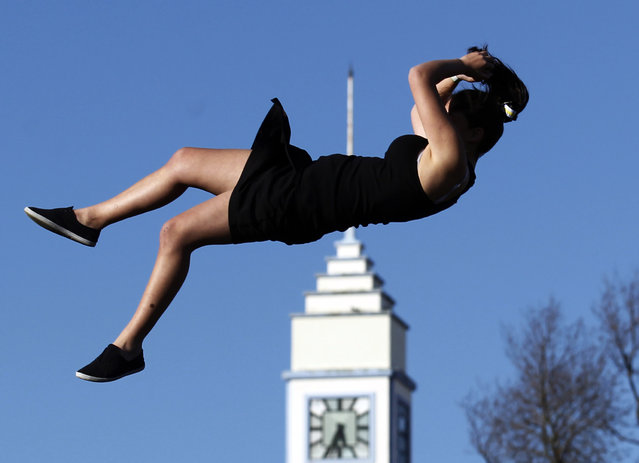
8. NEW ZEALAND: A woman dives from a platform into a giant air bed at a park in Palmerston North September 29, 2011. (Photo by Marcos Brindicci/Reuters)

The report, prepared by the Sustainable Development Solutions Network (SDSN) and the Earth Institute at Columbia University, showed Syria, Afghanistan and eight sub-Saharan countries as the 10 least happy places on earth to live. The top 10 this year were Denmark, Switzerland, Iceland, Norway, Finland, Canada, Netherlands, New Zealand, Australia, and Sweden. Denmark was in third place last year, behind Switzerland and Iceland. The bottom 10 were Madagascar, Tanzania, Liberia, Guinea, Rwanda, Benin, Afghanistan, Togo, Syria and Burundi. The United States came in at 13, the United Kingdom at 23, France at 32, and Italy at 50. Here: #8. NEW ZEALAND: A woman dives from a platform into a giant air bed at a park in Palmerston North September 29, 2011. (Photo by Marcos Brindicci/Reuters)
Details
26 Mar 2016 13:19:00
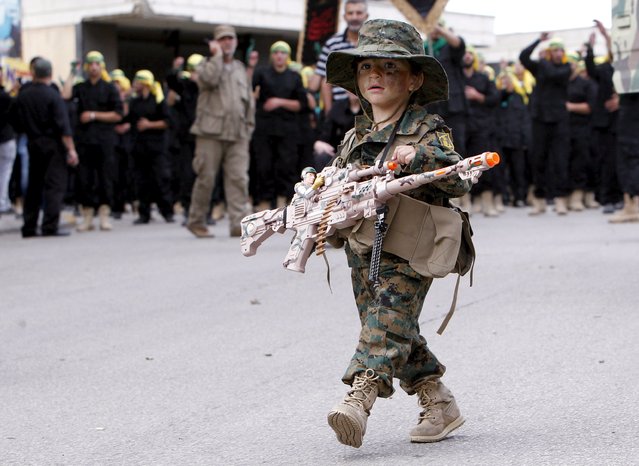
A boy wearing a Lebanon's Hezbollah military outfit and carrying a toy gun walks during the funeral of three Hezbollah fighters who were killed while fighting alongside Syrian army forces in Syria in Nabatieh town, southern Lebanon, October 27, 2015. (Photo by Ali Hashisho/Reuters)

A boy wearing a Lebanon's Hezbollah military outfit and carrying a toy gun walks during the funeral of three Hezbollah fighters who were killed while fighting alongside Syrian army forces in Syria in Nabatieh town, southern Lebanon, October 27, 2015. The fighters names are Hussein Hassan Shreifie, Ali al-Akbar Mohamad Khashfeh and Mohamad Saeed Fawaz. (Photo by Ali Hashisho/Reuters)
Details
30 Oct 2015 08:02:00
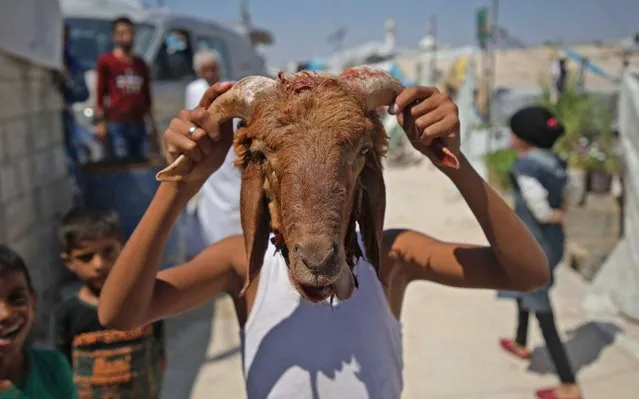
A Syrian boy plays with the head of a sacrificed sheep at a DIP camp for Interally Displaced Persons near the town of Aqrabat in Syria's northern Idlib province on August 12, 2019. Known as the “big” festival, Eid Al-Adha is celebrated each year by Muslims sacrificing various animals according to religious traditions, including cows, camels, goats and sheep. The festival marks the end of the Hajj pilgrimage to Mecca and commemorates Prophet Abraham's readiness to sacrifice his son to show obedience to God. (Photo by Aaref Watad/AFP Photo)

A Syrian boy plays with the head of a sacrificed sheep at a DIP camp for Interally Displaced Persons near the town of Aqrabat in Syria's northern Idlib province on August 12, 2019. Known as the “big” festival, Eid Al-Adha is celebrated each year by Muslims sacrificing various animals according to religious traditions, including cows, camels, goats and sheep. The festival marks the end of the Hajj pilgrimage to Mecca and commemorates Prophet Abraham's readiness to sacrifice his son to show obedience to God. (Photo by Aaref Watad/AFP Photo)
Details
15 Aug 2019 00:05:00
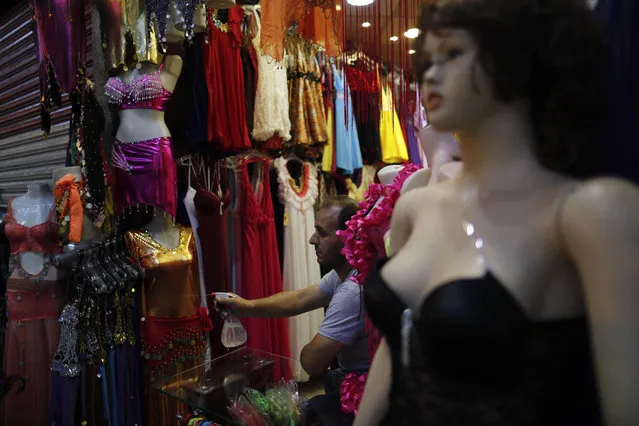
In this Thursday, July 19, 2018, photo, a Syrian shopkeeper spraying water as waits for customers at the Hamadiyah market, named after the 34th Sultan of the Ottoman Empire Abdul Hamid II, in the Old City of Damascus, Syria. The celebratory mood in government-controlled areas stems from successive military advances in the past year and an impression that President Bashar Assad, with massive support by unwavering allies Russia and Iran, has won the war or at least militarily defeated the opposition trying to topple him. (Photo by Hassan Ammar/AP Photo)

In this Thursday, July 19, 2018, photo, a Syrian shopkeeper spraying water as waits for customers at the Hamadiyah market, named after the 34th Sultan of the Ottoman Empire Abdul Hamid II, in the Old City of Damascus, Syria. The celebratory mood in government-controlled areas stems from successive military advances in the past year and an impression that President Bashar Assad, with massive support by unwavering allies Russia and Iran, has won the war or at least militarily defeated the opposition trying to topple him. (Photo by Hassan Ammar/AP Photo)
Details
13 Aug 2018 00:01:00
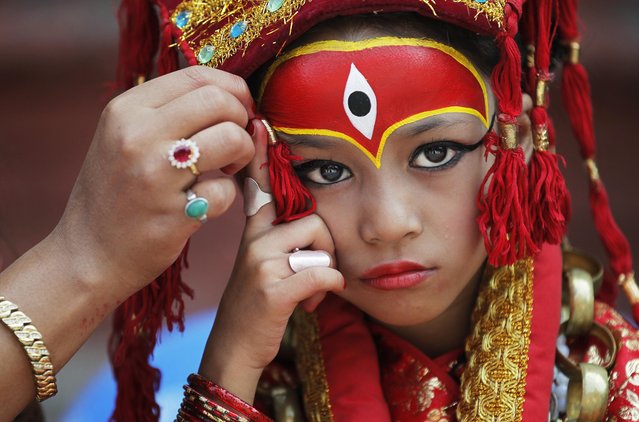
A Nepalese mother applies make up to her daughter dressed as the living goddess Kumari as they wait for Kumari puja to start at Hanuman Dhoka temple, in Kathmandu, Nepal, Wednesday, September 14, 2016. Girls under the age of nine gathered for the Kumari puja, a tradition of worshiping young prepubescent girls as manifestations of the divine female energy. The ritual holds a strong religious significance in the Newar community that seeks divine blessings to save small girls from diseases and bad luck in the years to come. (Photo by Niranjan Shrestha/AP Photo)

A Nepalese mother applies make up to her daughter dressed as the living goddess Kumari as they wait for Kumari puja to start at Hanuman Dhoka temple, in Kathmandu, Nepal, Wednesday, September 14, 2016. Girls under the age of nine gathered for the Kumari puja, a tradition of worshiping young prepubescent girls as manifestations of the divine female energy. The ritual holds a strong religious significance in the Newar community that seeks divine blessings to save small girls from diseases and bad luck in the years to come. (Photo by Niranjan Shrestha/AP Photo)
Details
15 Sep 2016 09:58:00