Loading...
Done
A woman shouts asking for help during an eviction in Rio de Janeiro, Brazil, Friday, April 11, 2014. Squatters in Rio de Janeiro are clashing with police after a Brazilian court ordered that 5,000 people be evicted from abandoned buildings of a telecommunications company. Officers have used tear gas and stun grenades to try to disperse the families. (Photo by Silvia Izquierdo/AP Photo)

A woman shouts asking for help during an eviction in Rio de Janeiro, Brazil, Friday, April 11, 2014. Squatters in Rio de Janeiro are clashing with police after a Brazilian court ordered that 5,000 people be evicted from abandoned buildings of a telecommunications company. Officers have used tear gas and stun grenades to try to disperse the families. (Photo by Silvia Izquierdo/AP Photo)
Details
13 Apr 2014 07:22:00
A military police officer patrols in the Roquette Pinto shantytown, part of the Mare slum complex in Rio de Janeiro, Brazil, Wednesday, April 1, 2015. The Brazilian army has begun to pull out of one of Rio de Janeiro's most violent slums, with police assuming responsibility for security in the area. (Photo by Felipe Dana/AP Photo)

A military police officer patrols in the Roquette Pinto shantytown, part of the Mare slum complex in Rio de Janeiro, Brazil, Wednesday, April 1, 2015. The Brazilian army has begun to pull out of one of Rio de Janeiro's most violent slums, with police assuming responsibility for security in the area. (Photo by Felipe Dana/AP Photo)
Details
02 Apr 2015 12:26:00
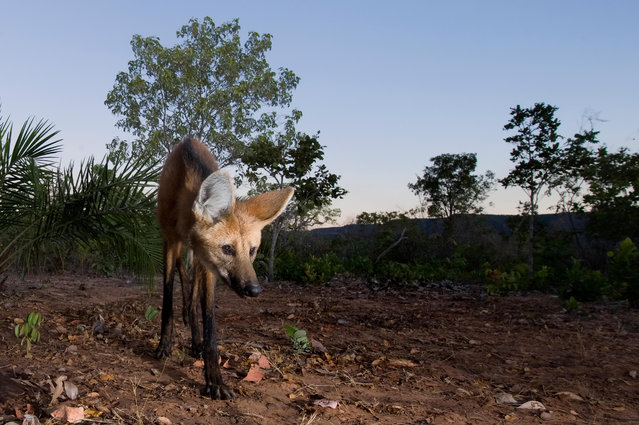
The maned wolf is among the large mammals in the Brazilian Cerrado that are threatened by the increasing conversion of grasslands into farmland for grazing and growing crops. (Photo by Ben Cranke/Nature Picture Library/Alamy Stock Photo)

Global wildlife populations will decline by 67% by 2020 unless urgent action is taken to reduce human impact on species and ecosystems, warns the biennial Living Planet Index report from WWF (World Wide Fund for Nature) and ZSL (Zoological Society of London). From elephants to eels, here are some of the wildlife populations most affected by human activity. Here: The maned wolf is among the large mammals in the Brazilian Cerrado that are threatened by the increasing conversion of grasslands into farmland for grazing and growing crops. (Photo by Ben Cranke/Nature Picture Library/Alamy Stock Photo)
Details
28 Oct 2016 10:47:00
Costume details featuring Joao Candido, a black sailor who led a revolt against the physical punishment of Brazilian Navy soldiers at the beginning of the 20th century, lie inside the Paraíso do Tuiuti Samba school at the Samba City complex in Rio de Janeiro, Brazil, Tuesday, January 16, 2024. Samba schools are gearing up for this year's Carnival, scheduled from Feb. 9-17. (Photo by Bruna Prado/AP Photo)

Costume details featuring Joao Candido, a black sailor who led a revolt against the physical punishment of Brazilian Navy soldiers at the beginning of the 20th century, lie inside the Paraíso do Tuiuti Samba school at the Samba City complex in Rio de Janeiro, Brazil, Tuesday, January 16, 2024. Samba schools are gearing up for this year's Carnival, scheduled from Feb. 9-17. (Photo by Bruna Prado/AP Photo)
Details
05 Apr 2025 02:24:00
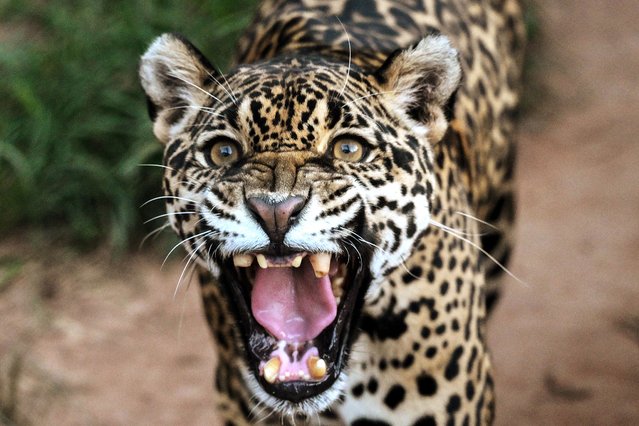
A jaguar (Panthera onca) growls at the Mata Ciliar association, an organization for the conservation of biodiversity, in Jundiai, Sao Paulo state, Brazil on May 29, 2025. Twenty-five pumas and ten jaguars are currently recovering at the Brazilian Center for the Conservation of Neotropical Felines at Mata Ciliar, a site as large as 40 football fields where monkeys, wild dogs, maned wolves, ocelots, and other regional animals are also rehabilitated. (Photo by Nelson Almeida/AFP Photo)

A jaguar (Panthera onca) growls at the Mata Ciliar association, an organization for the conservation of biodiversity, in Jundiai, Sao Paulo state, Brazil on May 29, 2025. Twenty-five pumas and ten jaguars are currently recovering at the Brazilian Center for the Conservation of Neotropical Felines at Mata Ciliar, a site as large as 40 football fields where monkeys, wild dogs, maned wolves, ocelots, and other regional animals are also rehabilitated. (Photo by Nelson Almeida/AFP Photo)
Details
22 Jun 2025 02:21:00


“Horst Ludwig Wessel (October 9, 1907 – February 23, 1930) was a German Nazi activist who was made a posthumous hero of the Nazi movement following his violent death in 1930. He was the author of the lyrics to the song “Die Fahne hoch” (“The Flag On High”), usually known as Horst-Wessel-Lied (“The Horst Wessel Song”), which became the Nazi Party anthem and, de facto, Germany's co-national anthem from 1933 to 1945”. – Wikipedia

Photo: German Nazi activist Horst Wessel (left) at the head of a parade of S.A. stormtroopers, or “brownshirts”, in Nuremberg, Germany, 1929. (Photo by Hulton Archive/Getty Images)
Details
08 Jul 2011 09:38:00
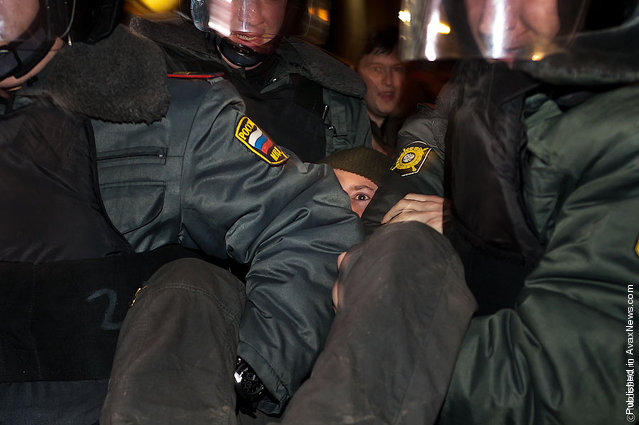
Police officers carry an opposition activist, who was detained while taking part in an unauthorized rally, at the Triumfalnaya Square in central Moscow

Police officers carry an opposition activist, who was detained while taking part in an unauthorized rally, at the Triumfalnaya Square in central Moscow, late on December 6, 2011.

Photo by: Sergey Muhamedov; Source: LiveJournal
Details
07 Dec 2011 12:35:00
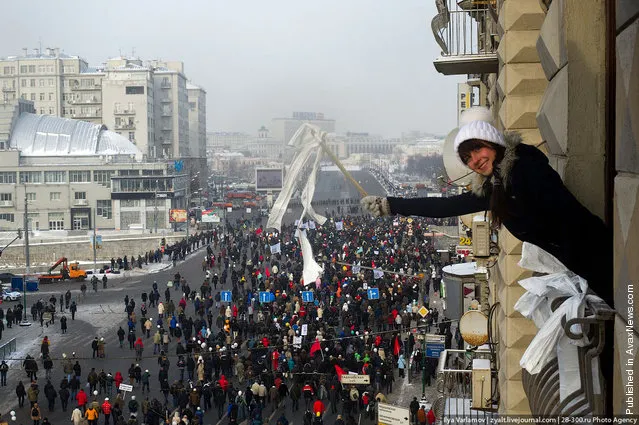
Russian oppostion activists take part in a rally and march to Bolotnaya Square on February 4, 2012 in Moscow, Russia

Russian oppostion activists take part in a rally and march to Bolotnaya Square on February 4, 2012 in Moscow, Russia. Demonstrators braved temperatures as low as -20 degrees celsius as they took to the streets exactly one month before the presidential elections in protest against Vladimir Putin's efforts to return to the Kremlin for an unprecedented third term as President. (Photo by: Ilya Varlamov; Source: LiveJournal)
Details
05 Feb 2012 13:07:00