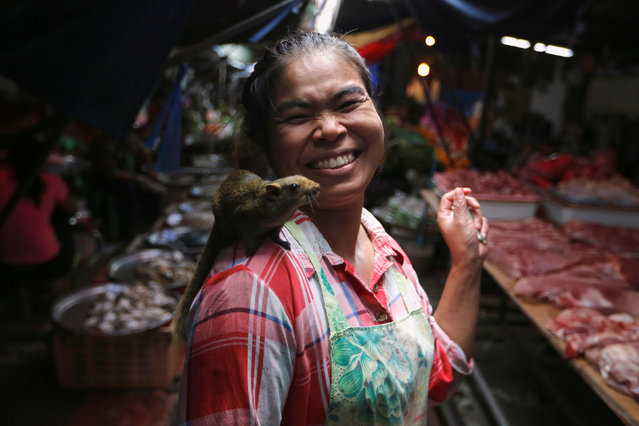
A woman walks with a squirrel on her shoulder at Maeklong market at the outskirts of Bangkok, Thailand September 20, 2016. (Photo by Jorge Silva/Reuters)
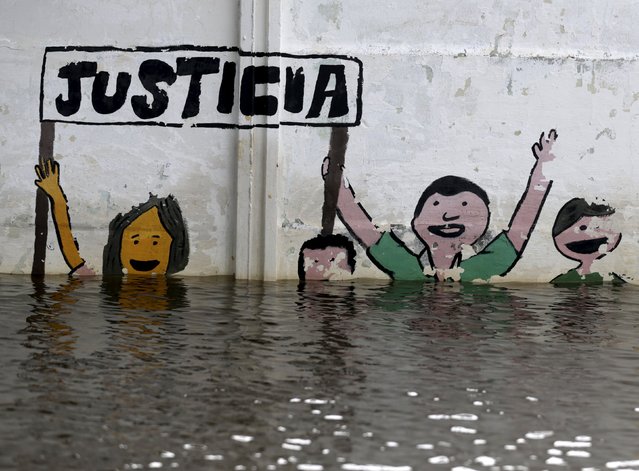
Graffiti saying “justice” partially seen above flood waters in Asuncion, December 27, 2015. More than 100,000 people have had to evacuate from their homes in the bordering areas of Paraguay, Uruguay, Brazil and Argentina due to severe flooding in the wake of heavy summer rains brought on by El Nino, authorities said on Saturday. (Photo by Jorge Adorno/Reuters)
A worker carries a bag of peeled carrots on her head outside a vegetable market in La Trinidad, Benguet in northern Philippines August 6, 2016. (Photo by Erik De Castro/Reuters)
A schoolgirl collects rubbish from Karachi's Clifton beach early morning April 22, 2013, during a cleaning campaign as part of the commemoration of Earth Day. (Photo by Akhtar Soomro/Reuters)
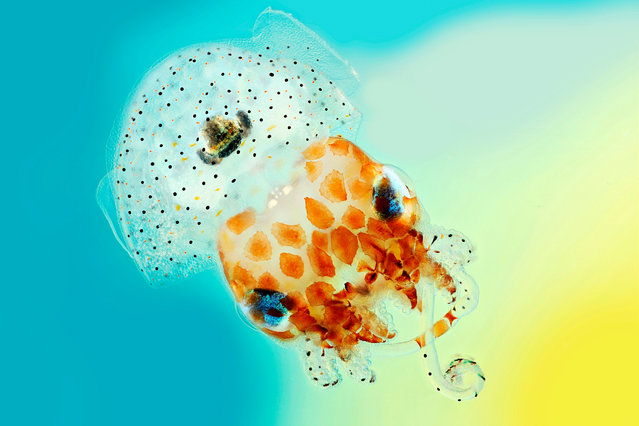
With its huge eyes, comical name and diminutive size, Mark R. Smith’s image of a baby Hawaiian bobtail squid can’t help but raise a smile. A curiously endearing creature, the cephalopod is just 1.5cm across, its mantle cavity bearing more than a passing resemblance to a rather natty shower cap. But it is also a beautiful example of symbiosis – nature’s version of “I’ll scratch your back if you scratch mine” – for on the underside of the squid is a light organ which houses bioluminescent bacteria. The squid offers the bacteria protection and food, while the bacteria emit a glow – a handy trait that the squid uses to offset its silhouette, helping it to evade predators in the depths below. Mark R. Smith’s entry combines several images of a Hawaiian bobtail squid with different focus lengths to create a final picture with greater depth of field than normal. (Photo by Mark R. Smith/Wellcome Images/Macroscopic Solutions)
Amanda Seyfried attends the premiere of 20th Century Fox's “The Art Of Racing In The Rain” at El Capitan Theatre on August 01, 2019 in Los Angeles, California. (Photo by Phillip Faraone/Getty Images)