Loading...
Done
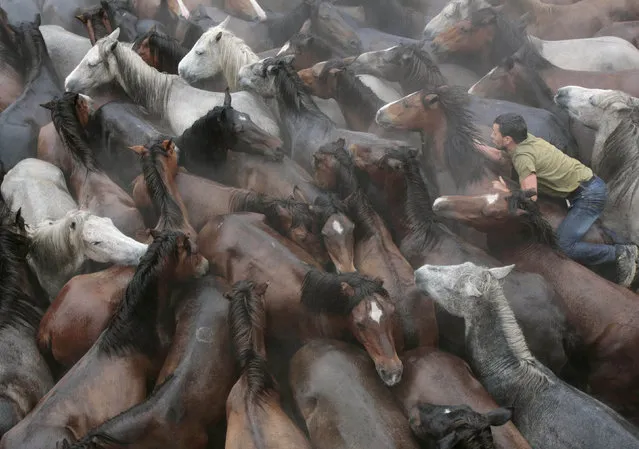
A reveller tries to hold on to a wild horse during the “Rapa Das Bestas” traditional event in the Spanish northwestern village of Sabucedo July 5, 2014. (Photo by Miguel Vidal/Reuters)

A reveller tries to hold on to a wild horse during the “Rapa Das Bestas” traditional event in the Spanish northwestern village of Sabucedo July 5, 2014. On the first weekend of the month of July, hundreds of wild horses are rounded up, trimmed and groomed in different villages in the Spanish northwestern region of Galicia. (Photo by Miguel Vidal/Reuters)
Details
07 Jul 2014 12:58:00
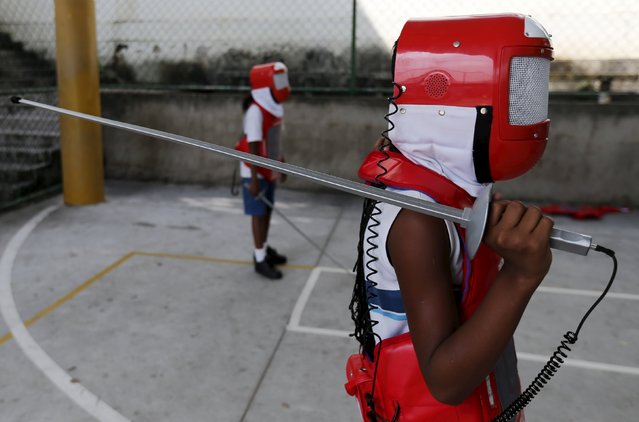
A child, from Municipal school Parana, poses during the project “Fencing School” in Rio de Janeiro, Brazil, March 30, 2016. (Photo by Sergio Moraes/Reuters)

A child, from Municipal school Parana, poses during the project “Fencing School” in Rio de Janeiro, Brazil, March 30, 2016. Children in Rio de Janeiro lift their sights and their swords to new idols, as a round of fencing workshops takes to public schools. The International Fencing Federation, together with the Brazilian and state federations, will reach 40 public schools in March and April. The aim is to whip up a following for the Olympic sport, little known in the soccer-mad nation, as Rio sets the stage for the Summer Games in August. (Photo by Sergio Moraes/Reuters)
Details
02 Apr 2016 09:25:00
Chess boxing

Chess boxing is a hybrid sport that combines chess with boxing in alternating rounds. The sport was invented by Dutch artist Iepe Rubingh, who was inspired by a French comic book Le Froid Equateur by artist and filmmaker Enki Bilal. Chess boxing is a fast growing sport, with large followings in Berlin and London, where most events take place. Several other chessboxing events have taken place around the world, including in Los Angeles, Tokyo, Nantes (France), Reykjavík (Iceland), Amsterdam, Calcutta (India) and Krasnoyarsk (Russia). Participants must be skilled as both boxers and chess players, as a match may be won either way.
Details
17 Oct 2012 11:17:00


Ron Mueck's “Big Baby” sculpture appears to look round at Jenny Saville's painting “Interfacing” at the Masterpieces Exhibition at Christie's on June 13, 2011 in London, England. The painting and sculpture feature in the exhibition, open to the public from 13th–15th June 2011, which showcases some of the Ј250 million worth of art for sale over the next four weeks. Artists including Michelangelo, Gainsborough, Goya, Stubbs, Monet, Picasso and Renoir are represented. (Photo by Peter Macdiarmid/Getty Images)
Details
14 Jun 2011 09:42:00
Atlantic Puffin Is AKA Puffins Or Puffin Birds

The Atlantic Puffin is definitely a curious-looking bird. The special coloring that this bird develops for the breeding season in the spring is very reminiscent of tropical birds. The bright colors of the beak and the markings around the eyes serve no particular advantage and have evolved as a result of sexual selection. However, Puffins don’t look that pretty all year round. They shed all these festive colors in partial moult after the breeding season is over. They lose the ornaments around their eyes, their face becomes darker, and their beak becomes very different. The natural habitat of these birds is the cold waters of the North Atlantic Ocean.
Details
12 Nov 2014 13:40:00
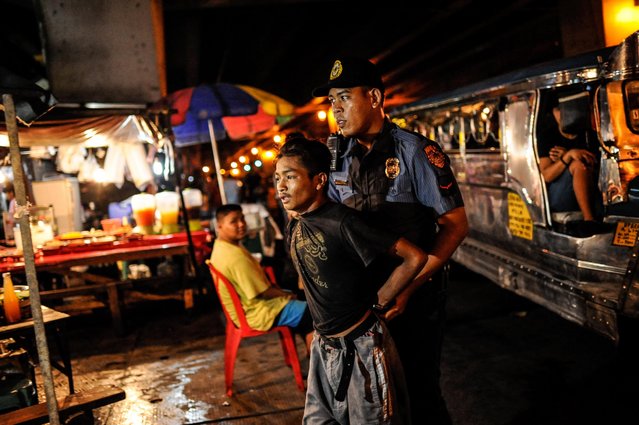
A suspected street robber is arrested by a policeman after a brief chase in the streets, June 20, 2016, in Manila, Philippines. (Photo by Dondi Tawatao/Getty Images)

A suspected street robber is arrested by a policeman after a brief chase in the streets, June 20, 2016, in Manila, Philippines. The president-elect of the Philippines, Rodrigo Duterte, declared a war on crime and drugs after sweeping an election on May 9 and has been living up to his nickname, “the punisher”. Philippine police have been conducting night raids almost on a daily basis and revived a curfew for minors that had not been enforced for years, rounding up minors drinking on the streets. (Photo by Dondi Tawatao/Getty Images)
Details
30 Jun 2016 11:38:00
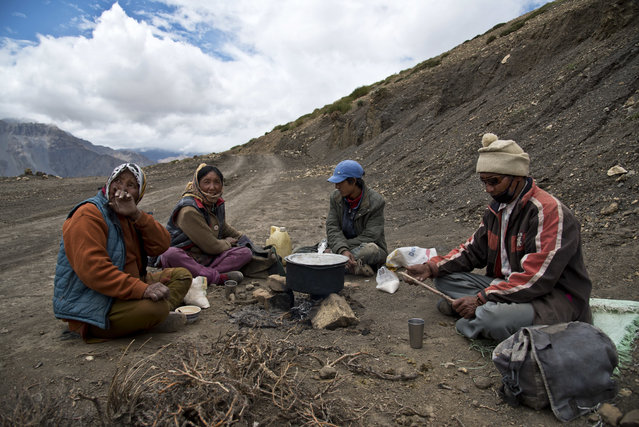
In this August 17, 2016, photo, from left to right, Chhering Chodom, 60, Tashi Yangzom, 50, Lobsang Chhering, 27, and Dorje Tandup, 58, drink milk tea on the side of the road. For centuries, the sleepy valley nestled in the Indian Himalayas remained a hidden Buddhist enclave forbidden to outsiders. Enduring the harsh year-round conditions of the high mountain desert, the people of Spiti Valley lived by a simple communal code – share the Earth's bounty, be hospitable to neighbors, and eschew greed and temptation at all turns. That's all starting to change, for better or worse. Since India began allowing its own citizens as well as outsiders to visit the valley in the early 1990s, tourism and trade have boomed. And the marks of modernization, such as solar panels, asphalt roads and concrete buildings, have begun to appear around some of the villages that dot the remote landscape at altitudes above 4,000 meters (13,000 feet). (Photo by Thomas Cytrynowicz/AP Photo)

In this August 17, 2016, photo, from left to right, Chhering Chodom, 60, Tashi Yangzom, 50, Lobsang Chhering, 27, and Dorje Tandup, 58, drink milk tea on the side of the road. For centuries, the sleepy valley nestled in the Indian Himalayas remained a hidden Buddhist enclave forbidden to outsiders. Enduring the harsh year-round conditions of the high mountain desert, the people of Spiti Valley lived by a simple communal code – share the Earth's bounty, be hospitable to neighbors, and eschew greed and temptation at all turns. That's all starting to change, for better or worse. (Photo by Thomas Cytrynowicz/AP Photo)
Details
15 Sep 2016 09:22:00
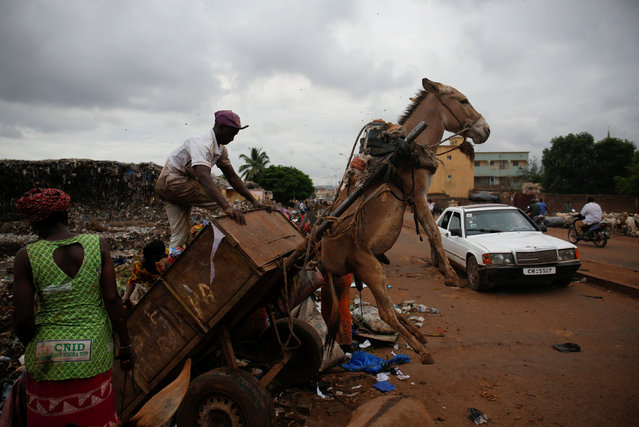
A waste picker unloads garbage at a waste transfer station in Bamako, Mali, August 19, 2018. In the Malian capital of Bamako, donkey carts driven by young men like 19-year-old Arouna Diabate play a vital role battling the fast-growing city's waste problem. Every morning before dawn, Diabate hitches his donkey to a cart and sets off on his rounds, going door-to-door to collect household garbage which he delivers to a local waste transfer station for a monthly salary of around $35. “I won't be picking up trash with a donkey cart for the rest of my life, but for now people appreciate us because we help clean up the homes of Bamako”, Diabate said. (Photo by Luc Gnago/Reuters)

A waste picker unloads garbage at a waste transfer station in Bamako, Mali, August 19, 2018. In the Malian capital of Bamako, donkey carts driven by young men like 19-year-old Arouna Diabate play a vital role battling the fast-growing city's waste problem. Every morning before dawn, Diabate hitches his donkey to a cart and sets off on his rounds, going door-to-door to collect household garbage which he delivers to a local waste transfer station for a monthly salary of around $35. “I won't be picking up trash with a donkey cart for the rest of my life, but for now people appreciate us because we help clean up the homes of Bamako”, Diabate said. (Photo by Luc Gnago/Reuters)
Details
18 Sep 2018 00:01:00