Loading...
Done
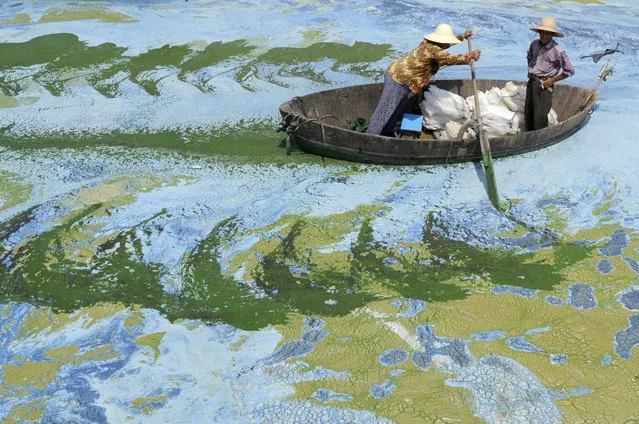
Fishermen row a boat in the algae-filled Chaohu Lake in Hefei, Anhui province, June 19, 2009. The country has invested 51 billion yuan ($7.4 billion) towards the construction of 2,712 projects for the treatment of eight rivers and lakes including Huaihe River, Haihe River, Liaohe River, Chaohu Lake, Dianchi Lake, Songhua River, the Three Gorges region of the Yangtze River and its upstream area, Xinhua News Agency reported. (Photo by Jianan Yu/Reuters)

Growing cities, overuse of fertilizers and factory wastewater have degraded China's water supplies to the extent that half the nation's rivers and lakes are severely polluted. China aims to spend $850 billion to improve filthy water supplies over the next decade, but even such huge outlays may do little to reverse damage caused by decades of pollution and overuse in Beijing's push for rapid economic growth. Photo: Fishermen row a boat in the algae-filled Chaohu Lake in Hefei, Anhui province, June 19, 2009. (Photo by Jianan Yu/Reuters)
Details
03 Aug 2014 08:01:00
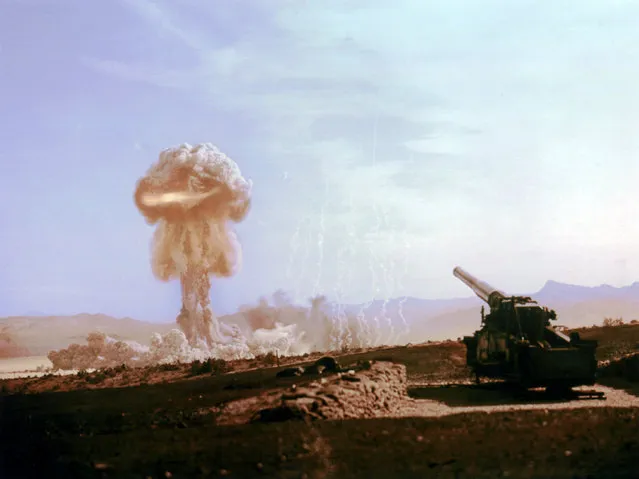
Atomic Annie at work during the Upshot-Knothole test series, 1953. (Photo by Los Alamos National Laboratory/US Army)

“A fter the former Soviet Union conducted its first nuclear test in August 1949, the US reevaluated its postwar defense policies. With the US monopoly on atomic weapons broken, military and political leaders chose to diversify the American stockpile by developing thermonuclear and tactical nuclear weapons. One of the more interesting concepts to come out of this period was atomic artillery, which was successfully tested at the Nevada Proving Grounds (now the Nevada Test Site) in May 1953”. – Alan Carr. Photo: Atomic Annie at work during the Upshot-Knothole test series, 1953. (Photo by Los Alamos National Laboratory/US Army)
Details
11 Mar 2013 11:43:00
Taylor's sister, who works in an animal rescue center, found this baby jackdaw who was in need of a little extra love and attention before being released into the wild

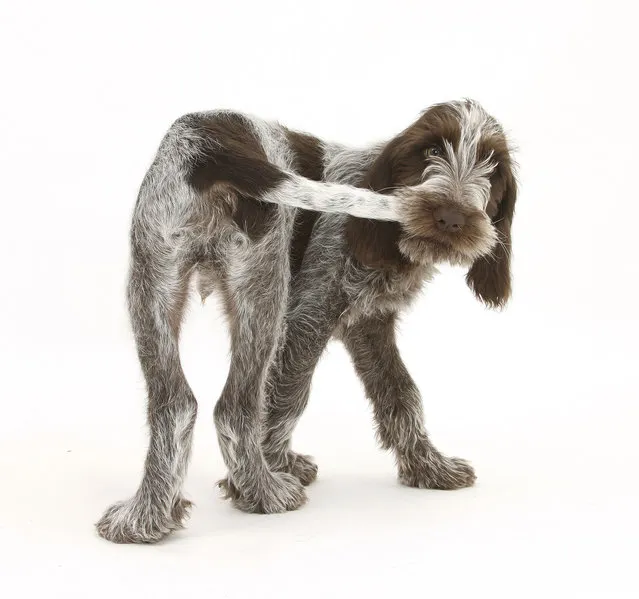
Mark Taylor may not have any training as a photographer, but that doesn’t stop him from taking amazing animal photos. From his studio in Southeast England, Taylor has made a big business out of photographing man’s best friends, following in the footsteps of his late mother, Jane Burton. Most of the animals he works with are babies, who are more comfortable in front of the camera than older animals.

Photo: Taylor often uses animals that belonged to friends of his late mother, including this Italian Spinone puppy chewing his tail. Baby animals make ideal subjects, as the older dogs and cats get, the warier they are of spending time in a studio. And his trick for getting this small subject to pose? Dog treats, of course. (Photo by Mark Taylor/Rex Features)
Details
27 Apr 2012 13:45:00
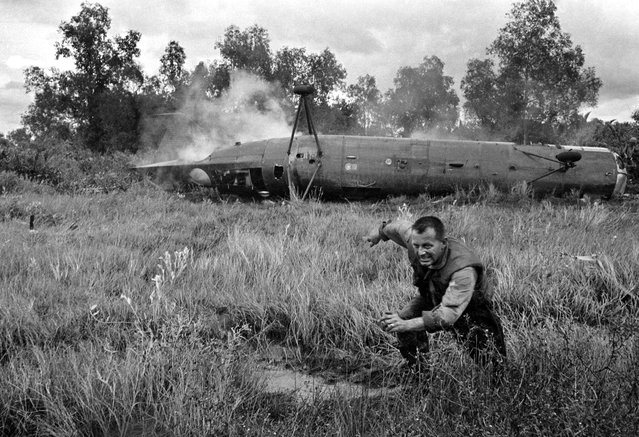
A U.S. crewman runs from a crashed CH-21 Shawnee troop helicopter near the village of Ca Mau in the southern tip of South Vietnam, Dec. 11, 1962

“Horst Faas (28 April 1933 – 10 May 2012) was a German photo-journalist and two-time Pulitzer Prize winner. He is best-known for his images of the Vietnam War”. – Wikipedia

Photo: A U.S. crewman runs from a crashed CH-21 Shawnee troop helicopter near the village of Ca Mau in the southern tip of South Vietnam, December 11, 1962. Two helicopters crashed without serious injuries during a government raid on the Viet Cong-infiltrated area. Both helicopters were destroyed to keep them out of enemy hands. (Photo by AP Photo/Horst Faas)
Details
24 May 2012 09:43:00
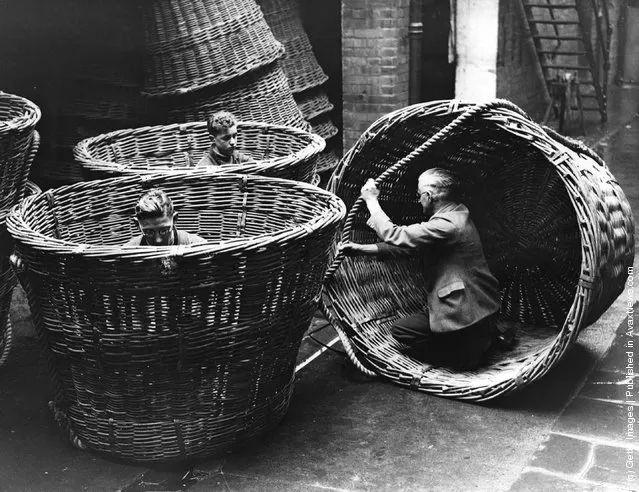
Men at work at the Cardiff Institute, making huge baskets, unique in size and construction, for loading oil cake in South Africa, 1938

Men at work at the Cardiff Institute, making huge baskets, unique in size and construction, for loading oil cake in South Africa. (Photo by Maeers/Getty Images). 1938
Details
05 Dec 2011 13:27:00
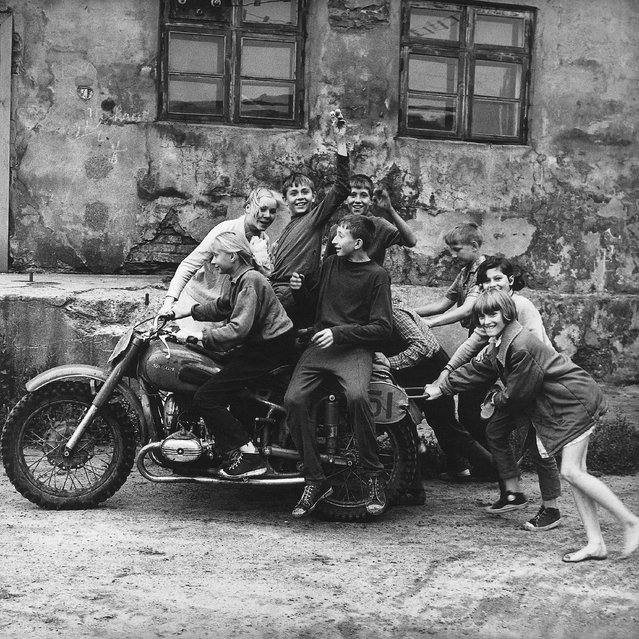
When he started using a camera there were very few documentary photographers working outside the government. Sutkus instead looked to writers and film-makers, and says he drew inspiration from the works of Franz Kafka, Jean-Paul Sartre, Ernest Hemingway and Vladimir Nabokov. Here: The first Lithuanian bikers, 1974. (Photo by Antanas Sutkus)

Rebelling against political propaganda, acclaimed photographer Antanas Sutkus embarked on a life-long journey to capture the everyday scenes around him. Antanas Sutkus, born in 1939, studied journalism at Vilnius University in the late 1950s before becoming disillusioned by the confines of the Soviet-controlled press. He began taking photographs instead, and soon co-founded the Lithuanian Association of Art Photographers. Here: The first Lithuanian bikers, 1974. (Photo by Antanas Sutkus)
Details
11 Apr 2016 10:54:00
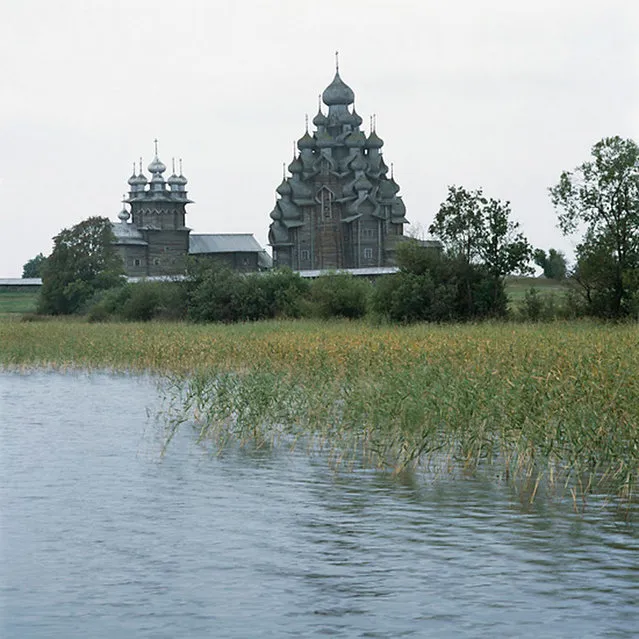
Wooden Churches - Travelling In The Russian North By Richard Davies Part 1

While communism, collectivism, worms, dry rot and casual looting failed to destroy the majestic wooden churches of Russia, it may be ordinary neglect that finally does them in. Dwindled now to several hundred remaining examples, these glories of vernacular architecture lie scattered amid the vastness of the world’s largest country. Just over a decade ago, Richard Davies, a British architectural photographer, struck out on a mission to record the fragile and poetic structures. Austerely beautiful and haunting, “Wooden Churches: Traveling in the Russian North” (White Sea Publishing; $132) is the result. Covering thousands of miles, Mr. Davies described how he and the writer Matilda Moreton tracked down the survivors from among the thousands of onion-domed structures built after Prince Vladimir converted to Christianity in 988.
Details
25 Nov 2013 12:47:00
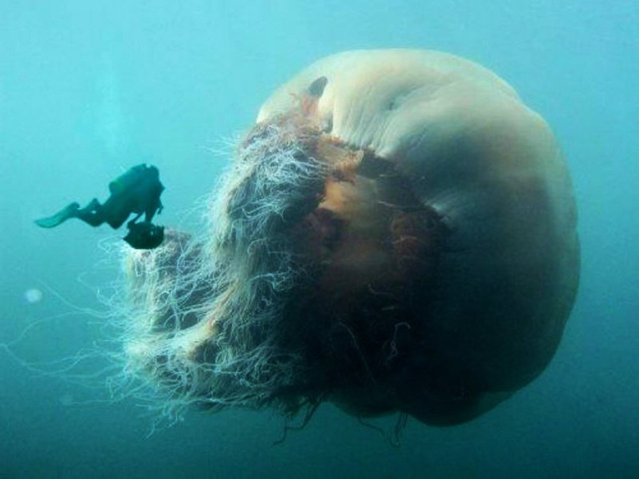
Giant Jellyfish Cyanea capillata

Cyanea capillata is the largest known species of jellyfish. Its range is confined to cold, boreal waters of the Arctic, northern Atlantic, and northern Pacific Oceans, seldom found farther south than 42°N latitude. Similar jellyfish, which may be the same species, are known to inhabit seas near Australia and New Zealand. The largest recorded specimen found, washed up on the shore of Massachusetts Bay in 1870, had a bell (body) with a diameter of 7 feet 6 inches (2.29 m) and tentacles 120 feet (37 m) long.Lion's mane jellyfish have been observed below 42°N latitude for some time—specifically in the larger bays of the east coast of the United States.
Details
24 Jul 2012 12:00:00