Loading...
Done
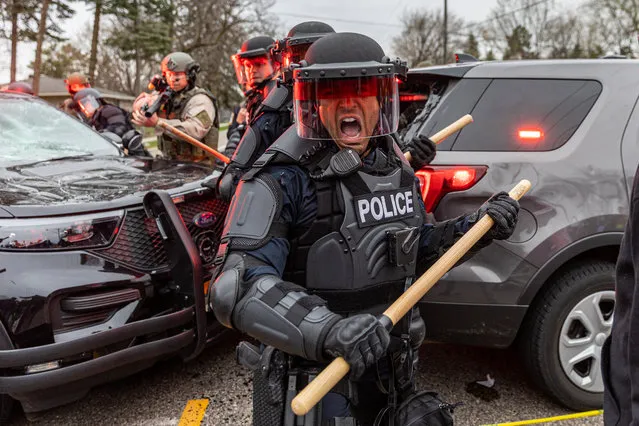
Police officers take cover as they clash with protesters after an officer shot and killed a black man in Brooklyn Center, Minneapolis, Minnesota on April 11,2021. Protests broke out April 11, 2021 night after US police fatally shot a young Black man in a suburb of Minneapolis – where a former police officer is currently on trial for the murder of George Floyd. Hundreds of people gathered outside the police station in Brooklyn Center, northwest of Minneapolis. Police fired teargas and flash bangs at the demonstrators, according to an AFP videojournalist at the scene. (Photo by Kerem Yucel/AFP Photo)

Police officers take cover as they clash with protesters after an officer shot and killed a black man in Brooklyn Center, Minneapolis, Minnesota on April 11,2021. Protests broke out April 11, 2021 night after US police fatally shot a young Black man in a suburb of Minneapolis – where a former police officer is currently on trial for the murder of George Floyd. Hundreds of people gathered outside the police station in Brooklyn Center, northwest of Minneapolis. Police fired teargas and flash bangs at the demonstrators, according to an AFP videojournalist at the scene. (Photo by Kerem Yucel/AFP Photo)
Details
15 Apr 2021 09:10:00
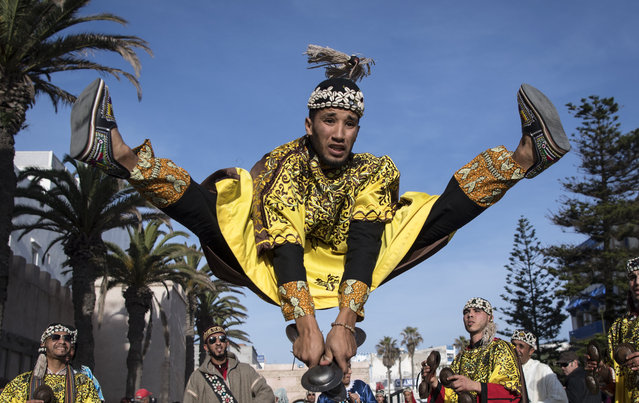
A Gnawa traditional group performs in the city of Essaouira on December 14, 2019, to celebrate the decision of adding the Gnawa culture to UNESCO's list of Intangible Cultural Heritage of Humanity. Gnawa culture, a centuries-old Moroccan practice rooted in music, African rituals and Sufi traditions, was added to UNESCO's list of Intangible Cultural Heritage of Humanity earlier in the week. Gnawa refers to a “set of musical productions, fraternal practices and therapeutic rituals where the secular mixes with the sacred”, according to the nomination submitted by Morocco. Often dressed in colourful outfits, Gnawa musicians play the guenbri, a type of lute with three strings, accompanied by steel castanets called krakebs. (Photo by Fadel Senna/AFP Photo)

A Gnawa traditional group performs in the city of Essaouira on December 14, 2019, to celebrate the decision of adding the Gnawa culture to UNESCO's list of Intangible Cultural Heritage of Humanity. Gnawa culture, a centuries-old Moroccan practice rooted in music, African rituals and Sufi traditions, was added to UNESCO's list of Intangible Cultural Heritage of Humanity earlier in the week. Gnawa refers to a “set of musical productions, fraternal practices and therapeutic rituals where the secular mixes with the sacred”, according to the nomination submitted by Morocco. Often dressed in colourful outfits, Gnawa musicians play the guenbri, a type of lute with three strings, accompanied by steel castanets called krakebs. (Photo by Fadel Senna/AFP Photo)
Details
18 Dec 2019 00:05:00
A young Bengal tiger cub smuggled into the US and seized at the Mexico border is displayed for the media during Operation Jungle Book at the US Fish and Wildlife Service in Torrance, California on October 20, 2017. Operation Jungle Book, a law enforcement initiative led by the US Fish and Wildlife Service that targeted wildlife smuggling, resulting in federal criminal charges against defendants who allegedly participated in the illegal importation and/ or transportation of numerous animal species – including a tiger, monitor lizards, cobras, Asian “lucky” fish, exotic songbirds and several coral species. (Photo by Mark Ralston/AFP Photo)

A young Bengal tiger cub smuggled into the US and seized at the Mexico border is displayed for the media during Operation Jungle Book at the US Fish and Wildlife Service in Torrance, California on October 20, 2017. Operation Jungle Book, a law enforcement initiative led by the US Fish and Wildlife Service that targeted wildlife smuggling, resulting in federal criminal charges against defendants who allegedly participated in the illegal importation and/ or transportation of numerous animal species – including a tiger, monitor lizards, cobras, Asian “lucky” fish, exotic songbirds and several coral species. (Photo by Mark Ralston/AFP Photo)
Details
29 Oct 2017 08:30:00
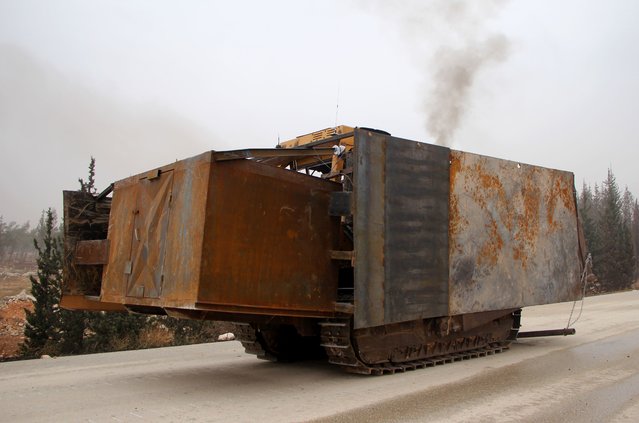
Rebel fighters from the Jaish al- Fatah (or Army of Conquest) brigades manoeuver an alleged explosive- rigged make- shift armoured vehicle during a major assault on Syrian government forces West of Aleppo city on October 28, 2016 Syrian opposition fighters launched a major assault on government forces to break a months- long siege of rebel- held neighbourhoods of the battered city of Aleppo. Rebel groups including the powerful Ahrar al- Sham faction and former Al- Qaeda affiliate Fateh al- Sham Front fired waves of rockets into government- held western Aleppo, killing at least 15 civilians, a monitor said. (Photo by Omar Haj Kadour/AFP Photo)

Rebel fighters from the Jaish al- Fatah (or Army of Conquest) brigades manoeuver an alleged explosive- rigged make- shift armoured vehicle during a major assault on Syrian government forces West of Aleppo city on October 28, 2016 Syrian opposition fighters launched a major assault on government forces to break a months- long siege of rebel- held neighbourhoods of the battered city of Aleppo. Rebel groups including the powerful Ahrar al- Sham faction and former Al- Qaeda affiliate Fateh al- Sham Front fired waves of rockets into government- held western Aleppo, killing at least 15 civilians, a monitor said. (Photo by Omar Haj Kadour/AFP Photo)
Details
29 Oct 2016 11:51:00
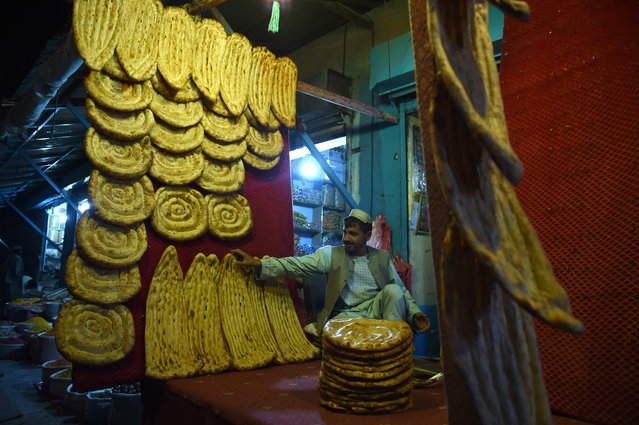
In this photograph taken on October 4, 2016, an Afghan baker prepares bread at his shop as he waits for customers in Lashkar Gah, the capital city of Helmand province For years Helmand was the centerpiece of the Western military intervention in Afghanistan only for it to slip deeper into a quagmire of instability, with almost the entire southern province teetering on the verge of collapse. Intensified fighting has killed hundreds and forced thousands to flee to besieged capital Lashkar Gah, sparking a humanitarian crisis as the city – one of the last government- held enclaves – risks falling to the Taliban' s repeated ferocious assaults. (Photo by Wakil Kohsar/AFP Photo)

In this photograph taken on October 4, 2016, an Afghan baker prepares bread at his shop as he waits for customers in Lashkar Gah, the capital city of Helmand province. For years Helmand was the centerpiece of the Western military intervention in Afghanistan only for it to slip deeper into a quagmire of instability, with almost the entire southern province teetering on the verge of collapse. Intensified fighting has killed hundreds and forced thousands to flee to besieged capital Lashkar Gah, sparking a humanitarian crisis as the city – one of the last government- held enclaves – risks falling to the Taliban' s repeated ferocious assaults. (Photo by Wakil Kohsar/AFP Photo)
Details
08 Dec 2016 12:41:00
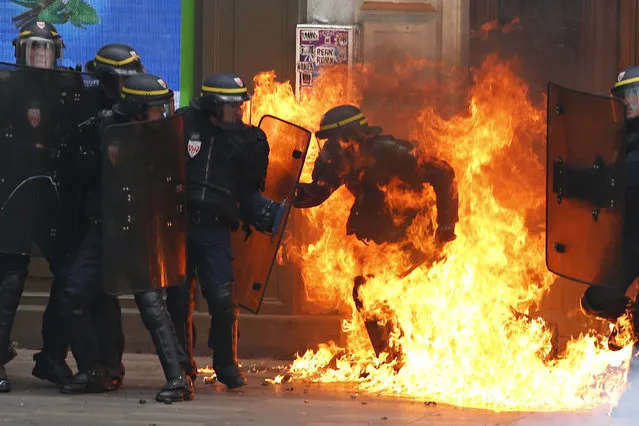
A French riot police officer is surrounded by flames, during a demonstration against the controversial labour reforms of the French government in Paris on September 15, 2016. Opponents of France's controversial labour reforms took to the streets on September 15, 2016 for the 14th time in six months in a last-ditch bid to quash the measures that lost the Socialist government crucial support on the left. Scores of flights in and out of France were cancelled as air traffic controllers went on strike to try to force the government to repeal the changes that became law in July. (Photo by Thomas Samson/AFP Photo)

A French riot police officer is surrounded by flames, during a demonstration against the controversial labour reforms of the French government in Paris on September 15, 2016. Opponents of France's controversial labour reforms took to the streets on September 15, 2016 for the 14th time in six months in a last-ditch bid to quash the measures that lost the Socialist government crucial support on the left. Scores of flights in and out of France were cancelled as air traffic controllers went on strike to try to force the government to repeal the changes that became law in July. (Photo by Thomas Samson/AFP Photo)
Details
16 Sep 2016 10:43:00
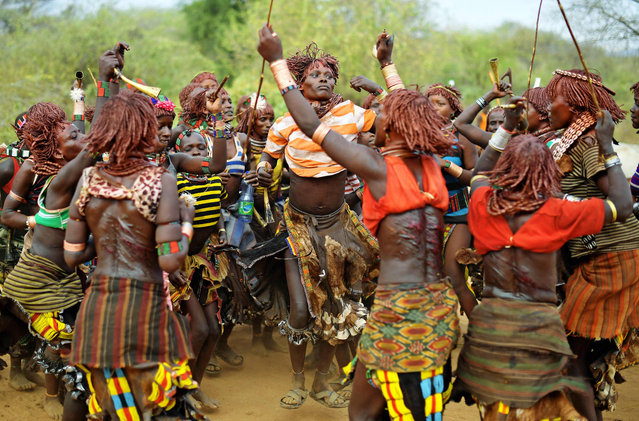
Hamar women dance before a bull jumping ceremony in Ethiopia's southern Omo Valley region near Turmi on September 19, 2016. The Hamar are a Nilotic ethnic group in Ethiopia. The construction of the Gibe III dam, the third largest hydroelectric plant in Africa, and large areas of very “thirsty” cotton and sugar plantations and factories along the Omo river are impacting heavily on the lives of tribes living in the Omo Valley who depend on the river for their survival and way of life. Human rights groups fear for the future of the tribes if they are forced to scatter, give up traditional ways through loss of land or ability to keep cattle as globalisation and development increases. (Photo by Carl De Souza/AFP Photo)

Hamar women dance before a bull jumping ceremony in Ethiopia's southern Omo Valley region near Turmi on September 19, 2016. The Hamar are a Nilotic ethnic group in Ethiopia. The construction of the Gibe III dam, the third largest hydroelectric plant in Africa, and large areas of very “thirsty” cotton and sugar plantations and factories along the Omo river are impacting heavily on the lives of tribes living in the Omo Valley who depend on the river for their survival and way of life. (Photo by Carl De Souza/AFP Photo)
Details
02 Oct 2016 08:45:00
People mourn at a makeshift memorial in front of the Russian embassy in Yerevan on March 23, 2024, a day after a gun attack on the Crocus City Hall in Russia's Krasnogorsk. Camouflaged assailants opened fire at the packed Crocus City Hall in Moscow's northern suburb of Krasnogorsk on March 22, 2024, evening ahead of a concert by Soviet-era rock band Piknik in the deadliest attack in Russia for at least a decade. Russia on March 23, 2024, said it had arrested 11 people – including four gunmen – over the attack on a Moscow concert hall claimed by Islamic State, as the death toll rose to 133 people. (Photo by Karen Minasyan/AFP Photo)

People mourn at a makeshift memorial in front of the Russian embassy in Yerevan on March 23, 2024, a day after a gun attack on the Crocus City Hall in Russia's Krasnogorsk. Camouflaged assailants opened fire at the packed Crocus City Hall in Moscow's northern suburb of Krasnogorsk on March 22, 2024, evening ahead of a concert by Soviet-era rock band Piknik in the deadliest attack in Russia for at least a decade. Russia on March 23, 2024, said it had arrested 11 people – including four gunmen – over the attack on a Moscow concert hall claimed by Islamic State, as the death toll rose to 133 people. (Photo by Karen Minasyan/AFP Photo)
Details
13 Apr 2024 05:18:00