Loading...
Done
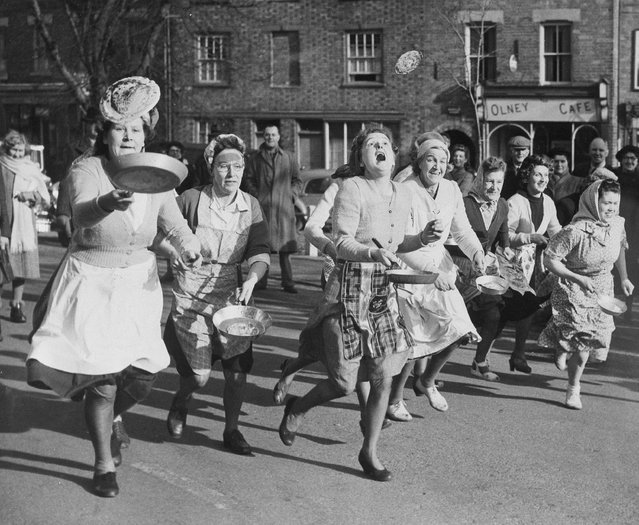
British housewives toss pancakes in skillets as they run through the streets of Olney, England, in the community's annual race which follows a 500-year-old tradition, February 6, 1951. Mrs. Isabel Dix, 22, extreme right, won the race covering the 415 yards from the Parish pump to the door of Sts. Peter and Paul church in one minute, 12.1 seconds. (Photo by AP Photo)

British housewives toss pancakes in skillets as they run through the streets of Olney, England, in the community's annual race which follows a 500-year-old tradition, February 6, 1951. Mrs. Isabel Dix, 22, extreme right, won the race covering the 415 yards from the Parish pump to the door of Sts. Peter and Paul church in one minute, 12.1 seconds. (Photo by AP Photo)
Details
20 Mar 2018 00:03:00
A biker shows his 12-year-old cat “Chiquinho” – which always rides with him on his motorbike – in Rio de Janeiro, Brazil, on June 19, 2016. (Photo by Yasuyoshi Chiba/AFP Photo)

A biker shows his 12-year-old cat “Chiquinho” – which always rides with him on his motorbike – in Rio de Janeiro, Brazil, on June 19, 2016. (Photo by Yasuyoshi Chiba/AFP Photo)
Details
21 Jun 2016 07:35:00
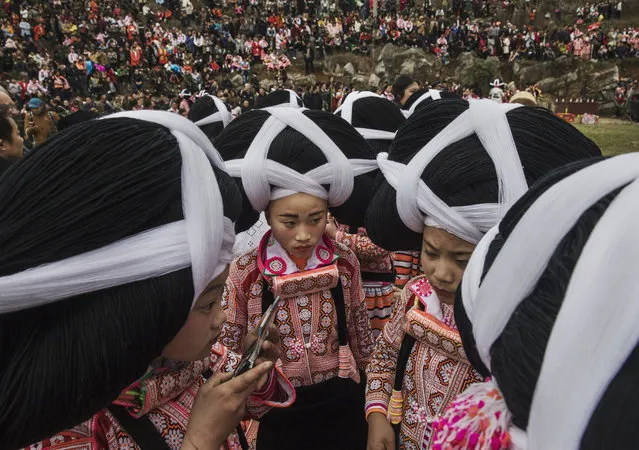
Girls of the Long Horn Miao ethnic minority group wear headdresses as they prepare gather for Tiaohua or Flower Festival as part of the Lunar New Year on February 6, 2017 in Longga village, Guizhou province, southern China. The Long Horn Miao are recognized for their declining practice of wrapping a blend of linen, wool, and the hair of their ancestors around animal horns or a wooden clip to make headdresses. Many young women say they now wear the headdresses only for special occasions and festivals, as the ornaments, which are attached by the horns to their real hair, have proved impractical for modern daily life in a fast changing world. China officially recognizes 56 different ethnic minorities, and statistics show over 7 million Chinese identifying themselves as Miao. But the small Long Horn Miao community counts only around 5000 people living in 12 villages, whose age-old traditions, language, and culture are fading. It is increasingly difficult in a modernizing China, as young people are drawn from remote rural villages to opportunities in bigger cities amongst wide-scale urbanization. Farming and labour remain the mainstays of life for the Long Horn Miao, leaving the area relatively poor in comparison with many parts of China. The government has invested significant amounts into local infrastructure and the tourism industry to try to bolster the local economy. (Photo by Kevin Frayer/Getty Images)

Girls of the Long Horn Miao ethnic minority group wear headdresses as they prepare gather for Tiaohua or Flower Festival as part of the Lunar New Year on February 6, 2017 in Longga village, Guizhou province, southern China. (Photo by Kevin Frayer/Getty Images)
Details
13 Feb 2017 00:01:00
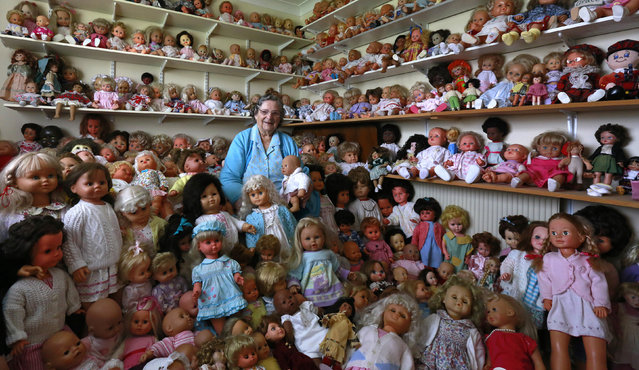
Mary Hickey poses with her collection of dolls at her home in Ashbourne, Ireland October 9, 2013. Hickey has been collecting the dolls for over thirty years and now owns over 420 dolls. (Photo by Cathal McNaughton/Reuters)

Mary Hickey poses with her collection of dolls at her home in Ashbourne, Ireland October 9, 2013. Hickey has been collecting the dolls for over thirty years and now owns over 420 dolls. (Photo by Cathal McNaughton/Reuters)
Details
16 Mar 2017 00:01:00
Dan Copeland, left, and Alex Morneau of Biddeford, Maine, former high school cheerleaders, perform back flips while enjoying the record breaking heat, Thursday, May 18, 2017, at Old Orchard Beach, Maine. The temperature climbed well into the 90s in many locations throughout the state. (Photo by Robert F. Bukaty/AP Photo)

Dan Copeland, left, and Alex Morneau of Biddeford, Maine, former high school cheerleaders, perform back flips while enjoying the record breaking heat, Thursday, May 18, 2017, at Old Orchard Beach, Maine. The temperature climbed well into the 90s in many locations throughout the state. (Photo by Robert F. Bukaty/AP Photo)
Details
13 Jul 2017 07:59:00
Seven year old Hungarian herding dog Derci runs along the Olympiaberg hill during stormy weather in Munich, southern Germany, Monday, January 4, 2016. (Photo by Matthias Balk/DPA via AP Photo)

Seven year old Hungarian herding dog Derci runs along the Olympiaberg hill during stormy weather in Munich, southern Germany, Monday, January 4, 2016. (Photo by Matthias Balk/DPA via AP Photo)
Details
09 Jan 2016 08:01:00
South Korea's Black Eagles aerobatics team performs an aerial display forming a Ying and Yang logo during the Singapore Airshow at Changi exhibition center in Singapore on February 16, 2016. (Photo by Roslan Rahman/AFP Photo)

South Korea's Black Eagles aerobatics team performs an aerial display forming a Ying and Yang logo during the Singapore Airshow at Changi exhibition center in Singapore on February 16, 2016. (Photo by Roslan Rahman/AFP Photo)
Details
18 Feb 2016 13:32:00
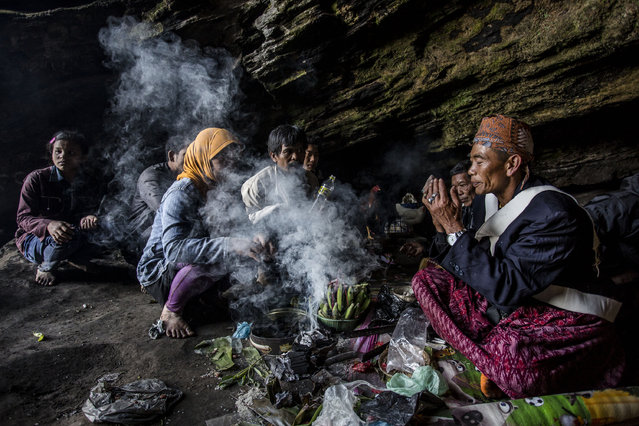
A Tenggerese shaman praying for worshippers at Widodaren cave during the Tenggerese Hindu Yadnya Kasada festival on July 31, 2015 in Probolinggo, East Java, Indonesia. The festival is the main festival of the Tenggerese people and lasts about a month. On the fourteenth day, the Tenggerese make the journey to Mount Bromo to make offerings of rice, fruits, vegetables, flowers and livestock to the mountain gods by throwing them into the volcano's caldera. (Photo by Ulet Ifansasti/Getty Images)

A Tenggerese shaman praying for worshippers at Widodaren cave during the Tenggerese Hindu Yadnya Kasada festival on July 31, 2015 in Probolinggo, East Java, Indonesia. The festival is the main festival of the Tenggerese people and lasts about a month. On the fourteenth day, the Tenggerese make the journey to Mount Bromo to make offerings of rice, fruits, vegetables, flowers and livestock to the mountain gods by throwing them into the volcano's caldera. The origin of the festival lies in the 15th century when a princess named Roro Anteng started the principality of Tengger with her husband Joko Seger, and the childless couple asked the mountain Gods for help in bearing children. The legend says the Gods granted them 24 children but on the provision that the 25th must be tossed into the volcano in sacrifice. The 25th child, Kesuma, was finally sacrificed in this way after initial refusal, and the tradition of throwing sacrifices into the caldera to appease the mountain Gods continues today. (Photo by Ulet Ifansasti/Getty Images)

Details
01 Aug 2015 12:07:00