Loading...
Done
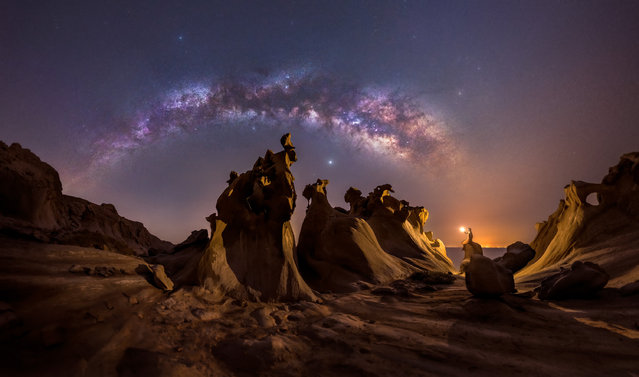
Night lovers; Hormozgan province, Iran. “In this picture, you can see the Milky Way rising on a fascinating spring night on the Persian Gulf coast. The stunning cliffs of this area make every viewer imagine and even talk to them! The light pollution from a faraway city was quite strong, so it was a challenging post-processing process. I’m a nightscaper who tries to achieve an artistic look in my images, and in this image, I tried to convey and capture the magic of this location”. (Photo by Mohammad Hayati/Milky Way Photographer of the Year)

Night lovers; Hormozgan province, Iran. “In this picture, you can see the Milky Way rising on a fascinating spring night on the Persian Gulf coast. The stunning cliffs of this area make every viewer imagine and even talk to them! The light pollution from a faraway city was quite strong, so it was a challenging post-processing process. I’m a nightscaper who tries to achieve an artistic look in my images, and in this image, I tried to convey and capture the magic of this location”. (Photo by Mohammad Hayati/Milky Way Photographer of the Year)
Details
01 Jun 2021 09:42:00
Special Merit Award. Mallory Franklin (2019). The British slalom canoeist has competed internationally since 2009 and won nine medals in total at the ICF Canoe Slalom World Championships with four golds, four silvers and a bronze. She has also won eleven medals at the European Championships. (Photo by Richard Pelham/World Sports Photography Awards 2021)

Special Merit Award. Mallory Franklin (2019). The British slalom canoeist has competed internationally since 2009 and won nine medals in total at the ICF Canoe Slalom World Championships with four golds, four silvers and a bronze. She has also won eleven medals at the European Championships. (Photo by Richard Pelham/World Sports Photography Awards 2021)
Details
05 Jun 2021 09:12:00
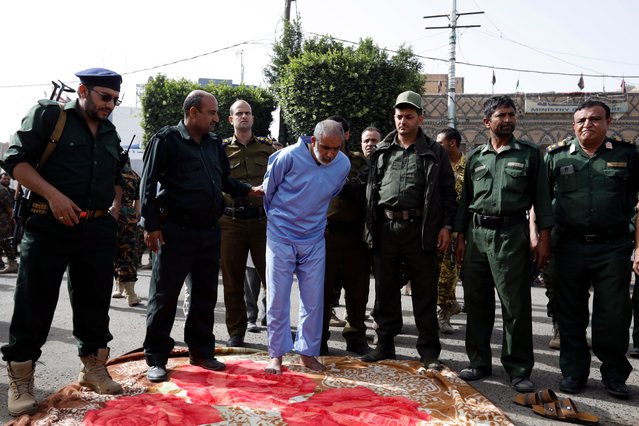
Ali al-Naami, convicted of murdering his three daughters, is placed on a carpet to be executed at a public square in Sana'a, Yemen, 16 June 2021. Defendant Ali al-Naami, 40, convicted of killing his daughters Rahaf, 7, Raghad, 12, and Malak, 14, in June 2019, was executed by an executioner in front of hundreds of spectators in a public square in Sana'a. He had admitted to strangling them and drowning them in a water tank after the mother left the house due to domestic disputes with him. (Photo by Yahya Arhab/EPA/EFE)

Ali al-Naami, convicted of murdering his three daughters, is placed on a carpet to be executed at a public square in Sana'a, Yemen, 16 June 2021. Defendant Ali al-Naami, 40, convicted of killing his daughters Rahaf, 7, Raghad, 12, and Malak, 14, in June 2019, was executed by an executioner in front of hundreds of spectators in a public square in Sana'a. He had admitted to strangling them and drowning them in a water tank after the mother left the house due to domestic disputes with him. (Photo by Yahya Arhab/EPA/EFE)
Details
20 Jun 2021 08:10:00
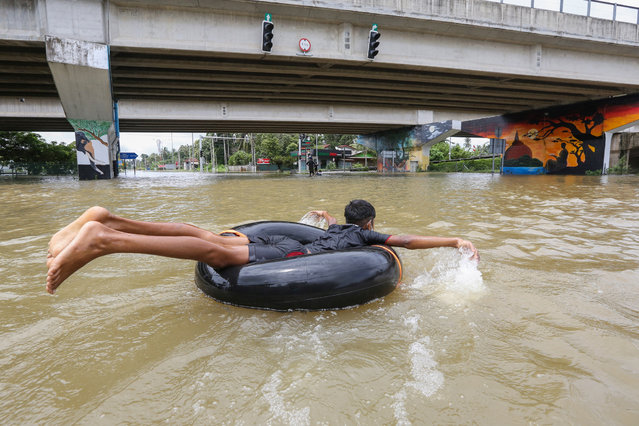
A Sri Lankan child uses an inflatable tube to wade through floodwaters after heavy rains in Biyagama suburb of Colombo, Sri Lanka, 06 June 2021. Many parts of the island have been inundated due to heavy monsoon rains. According to the Sri Lanka Disaster Management Center, at least 14 people have been killed so far and more than 245,212 people affected across the country. (Photo by Chamila Karunarathne/EPA/EFE)

A Sri Lankan child uses an inflatable tube to wade through floodwaters after heavy rains in Biyagama suburb of Colombo, Sri Lanka, 06 June 2021. Many parts of the island have been inundated due to heavy monsoon rains. According to the Sri Lanka Disaster Management Center, at least 14 people have been killed so far and more than 245,212 people affected across the country. (Photo by Chamila Karunarathne/EPA/EFE)
Details
01 Jul 2021 09:37:00
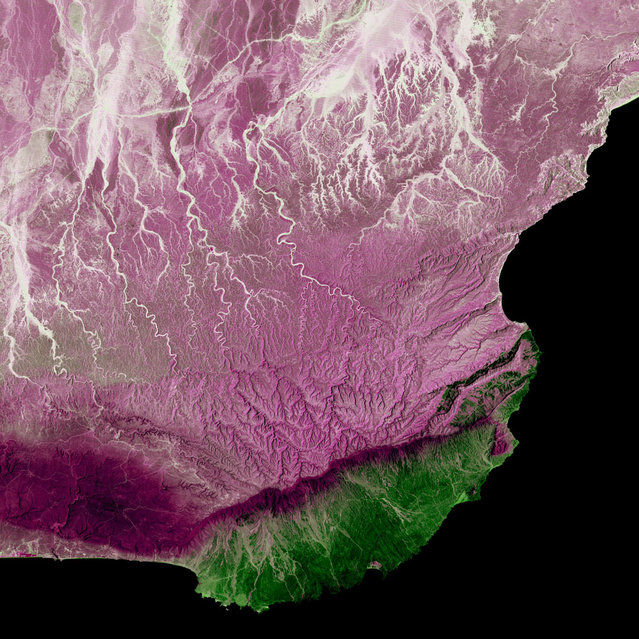
Dhofar Region, Oman. Much of Oman is desert, but the Arabian Sea coast in the Dhofar region represents a startling difference in climate. This coastal region catches the monsoon rains, or khareef, during the summer months. Drenching rains fall primarily on the mountainous ridge that separates the lush, fertile areas along the coast from the arid interior, recharging streams, waterfalls and springs that provide plentiful water supplies in the fertile lowlands for the remainder of the year. Image taken by Landsat 5 on April 2, 2005. (Photo by USGS/NASA)

Dhofar Region, Oman. Much of Oman is desert, but the Arabian Sea coast in the Dhofar region represents a startling difference in climate. This coastal region catches the monsoon rains, or khareef, during the summer months. Drenching rains fall primarily on the mountainous ridge that separates the lush, fertile areas along the coast from the arid interior, recharging streams, waterfalls and springs that provide plentiful water supplies in the fertile lowlands for the remainder of the year. Image taken by Landsat 5 on April 2, 2005. (Photo by USGS/NASA)
Details
25 Dec 2012 11:13:00
A female Marine prepares to throw a practice grenade during Marine Combat Training (MCT) on February 21, 2013 at Camp Lejeune, North Carolina.  Since 1988 all non-infantry enlisted male Marines have been required to complete 29 days of basic combat skills training at MCT after graduating from boot camp. MCT has been required for all enlisted female Marines since 1997. About six percent of enlisted Marines are female.  (Photo by Scott Olson)

A female Marine prepares to throw a practice grenade during Marine Combat Training (MCT) on February 21, 2013 at Camp Lejeune, North Carolina. Since 1988 all non-infantry enlisted male Marines have been required to complete 29 days of basic combat skills training at MCT after graduating from boot camp. MCT has been required for all enlisted female Marines since 1997. About six percent of enlisted Marines are female. (Photo by Scott Olson)
Details
22 Feb 2013 11:34:00
An infrared portrait from NASA's Spitzer Space Telescope which shows generations of stars is seen in this undated NASA handout image released February 14, 2013. In this wispy star-forming region, called W5, the oldest stars can be seen as blue dots in the centers of the two hollow cavities (other blue dots are background and foreground stars not associated with the region). Red shows heated dust that pervades the region's cavities, while green highlights dense clouds. (Photo by NASA/Reuters/JPL-Caltech/Harvard-Smithsonian/Handout)

An infrared portrait from NASA's Spitzer Space Telescope which shows generations of stars is seen in this undated NASA handout image released February 14, 2013. In this wispy star-forming region, called W5, the oldest stars can be seen as blue dots in the centers of the two hollow cavities (other blue dots are background and foreground stars not associated with the region). Red shows heated dust that pervades the region's cavities, while green highlights dense clouds. (Photo by NASA/Reuters/JPL-Caltech/Harvard-Smithsonian/Handout)
Details
03 Mar 2013 08:44:00
Crew in Britain's first ever full-size reconstructed sea-going Bronze Age boat, paddle out to sea near to the National Maritime Museum as it makes its maiden voyage on March 6, 2013 in Falmouth, England. With a crew of of 18, equipped with Bronze-Age-style wooden paddles, the 15 metre long experimental vessel – a replica of the sort of craft used for long-distance trade between Britain and the continent 4000 years ago – will be used to test prehistoric seafaring methods in a project in collaboration with the University of Exeter and the Falmouth-based National Maritime Museum Cornwall. (Photo by Matt Cardy)

Crew in Britain's first ever full-size reconstructed sea-going Bronze Age boat, paddle out to sea near to the National Maritime Museum as it makes its maiden voyage on March 6, 2013 in Falmouth, England. (Photo by Matt Cardy)
Details
07 Mar 2013 08:48:00