Loading...
Done
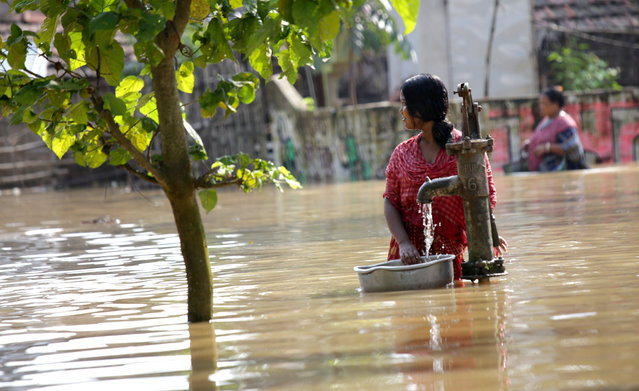
A photo made avialable on 05 August 2015 shows an Indian woman collecting drinking water from a water pump in the submerged village of Sreerampur, some 150 kilometers north of Calcutta, India, on 04 August 2015. At least 215 people have died in floods and a landslide following monsoon rains in India over the past week, 83 deaths were reported from the western state of Gujarat and 69 from eastern West Bengal. The worst-affected states were West Bengal, Gujarat and Rajasthan, the Home Ministry said. (Photo by Piyal Adhikary/EPA)

A photo made avialable on 05 August 2015 shows an Indian woman collecting drinking water from a water pump in the submerged village of Sreerampur, some 150 kilometers north of Calcutta, India, on 04 August 2015. At least 215 people have died in floods and a landslide following monsoon rains in India over the past week, 83 deaths were reported from the western state of Gujarat and 69 from eastern West Bengal. The worst-affected states were West Bengal, Gujarat and Rajasthan, the Home Ministry said. (Photo by Piyal Adhikary/EPA)
Details
08 Aug 2015 12:04:00
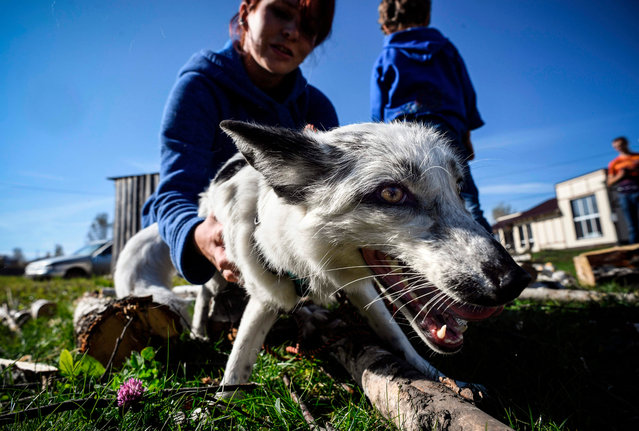
Tatyana Abramova, 33, plays with her home fox Plombir at her countryside house outside Siberian city of Novosibirsk on September 12, 2020. The official start of the Soviet experiment to better understand the domestication of animals by humans began in 1959, and was initiated by geneticists Dmitri Beliaiev and Lioudmila Trout on a farm in Akademgorodok, the scientific center of excellence in Siberia. Their primary objective was to domesticate foxes, to understand how the ancestor of wolves, another canine, evolved into a loyal and loving dog. And understand what this domestication tells us about the genetic evolution of species. (Photo by Alexander Nemenov/AFP Photo)

Tatyana Abramova, 33, plays with her home fox Plombir at her countryside house outside Siberian city of Novosibirsk on September 12, 2020. The official start of the Soviet experiment to better understand the domestication of animals by humans began in 1959, and was initiated by geneticists Dmitri Beliaiev and Lioudmila Trout on a farm in Akademgorodok, the scientific center of excellence in Siberia. Their primary objective was to domesticate foxes, to understand how the ancestor of wolves, another canine, evolved into a loyal and loving dog. And understand what this domestication tells us about the genetic evolution of species. (Photo by Alexander Nemenov/AFP Photo)
Details
25 Oct 2020 00:05:00


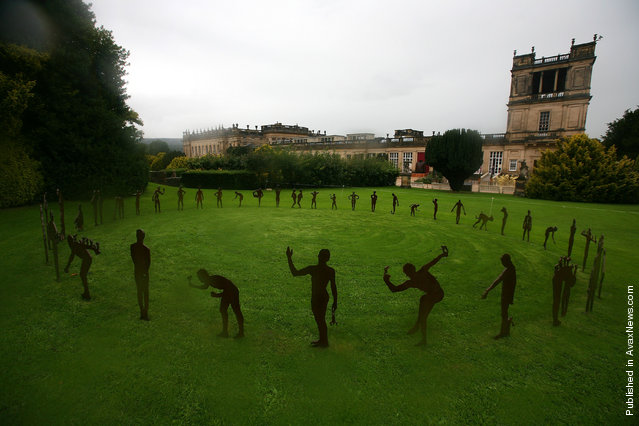
A giant sculpture of a seven-month-old baby by artist Marc Quinn entitled “Planet” contrasts against the stately grandeur of Chatsworth House and the Derbyshire countryside on 4 September, 2008, Chatsworth, England. The bronze sculpture painted white is part of the Beyond Limits exhibition of modern and contemporary sculpture displayed in the gardens of Chatsworth by Sotherby's. More than 20 works will be on display from 9 September to 2 November 2008. In past years acclaimed artists Damien Hirst, Antony Gormley, Salvador Dali and Henry Moore have had work exhibited. (Photo by Christopher Furlong/Getty Images)
Details
15 Mar 2011 09:57:00
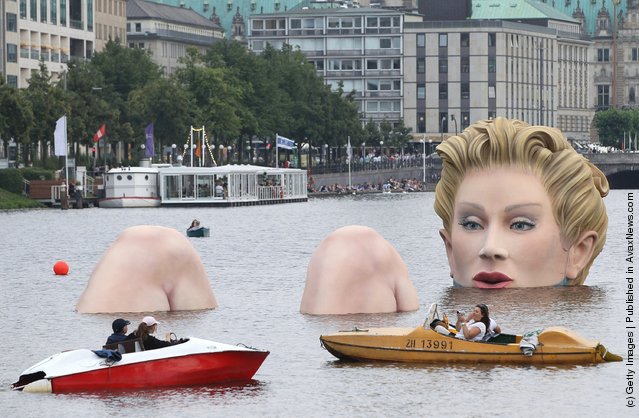
People in boats approach Die Badende (The Bather), a giant sculpture showing a woman's head and knees as if she were resting in the Binnenalster lake in Hamburg, Germany

People in boats approach “Die Badende” (“The Bather”), a giant sculpture showing a woman's head and knees as if she were resting in the Binnenalster lake on August 3, 2011 in Hamburg, Germany. The sculpture, which is made of styrofoam and steel and measures 4 meters high and 30 meters long, is a project by artist Oliver Voss and will be on display for the next ten days. (Photo by Sean Gallup/Getty Images)
Details
04 Aug 2011 11:36:00
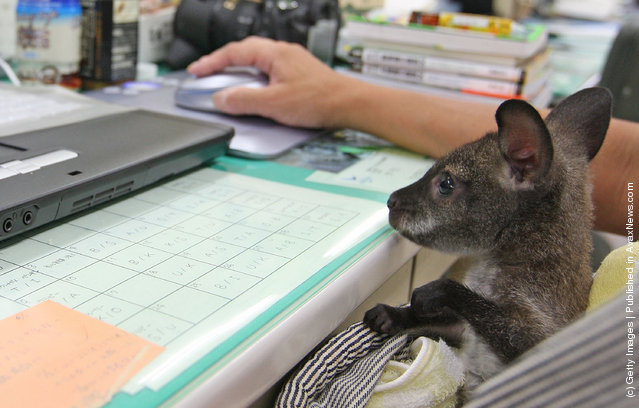
A baby wallaby

“Very small forest-dwelling wallabies are known as pademelons (genus Thylogale) and dorcopsises (genera Dorcopsis and Dorcopsulus). The name wallaby comes from the Eora Aboriginal tribe who were the original inhabitants of the Sydney area. Wallabies are herbivores whose diet consists of a wide range of grasses, vegetables, leaves, and other types of foliage”. – Wikipedia

Photo: A baby wallaby sits in a zoo attendant's lap at Edogawa Natural Zoo on August 4, 2009 in Tokyo, Japan. The staff of the zoo have raised the young wallaby after her mother neglected her. (Photo by Junko Kimura/Getty Images)
Details
07 Sep 2011 13:33:00
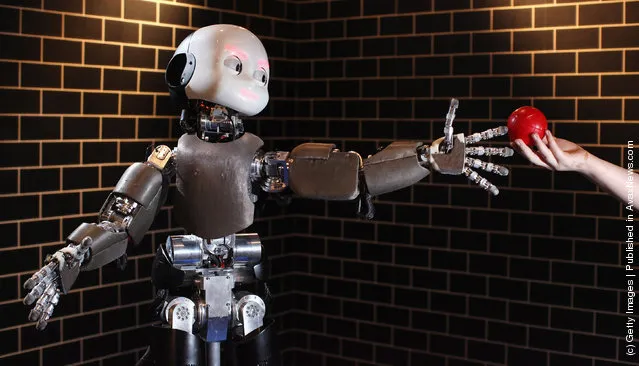
An iCub robot built by the Italian Institute of Technology tracks a ball in the Robotville exhibition at the Science Museum on November 29, 2011 in London, England

An iCub robot built by the Italian Institute of Technology tracks a ball in the Robotville exhibition at the Science Museum on November 29, 2011 in London, England. The Science Museum's Robotville exhibition showcases 20 unique and cutting-edge robots from European research laboratories, it is free to enter and runs from December 1–4, 2011. (Photo by Oli Scarff/Getty Images)
Details
30 Nov 2011 13:04:00
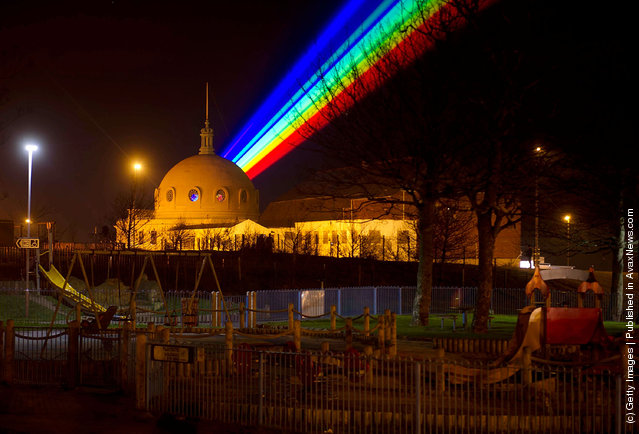
International artist Yvette Mattern shows her stunning laser rainbow projection, Global Rainbow

International artist Yvette Mattern shows her stunning laser rainbow projection, Global Rainbow, on March 1, 2012 in Whitley Bay, England. The light installation celebrates the London 2012 Cultural Olympiad in the north-east of England. The Global Rainbow has previously lit up the skies of Germany, France and the United States. The projection will shine along the North Tyneside coastline for 4 days, before moving to other locations in the UK. (Photo by Bethany Clarke/Getty Images)
Details
03 Mar 2012 10:51:00
Lisa Yu crawls through a mud pit under low slung barbed wire as she competes in The Tough Bloke Challenge

Lisa Yu crawls through a mud pit under low slung barbed wire as she competes in The Tough Bloke Challenge on March 4, 2012 in Melbourne, Australia. The Tough Bloke Challenge is one of the most gruelling adventure runs in Australia consisting of 18 obstacles over a 6 km cross-country course laden with thick mud-pits and ice-cold water crossings. (Photo by Scott Barbour/Getty Images)
Details
04 Mar 2012 12:36:00