Loading...
Done
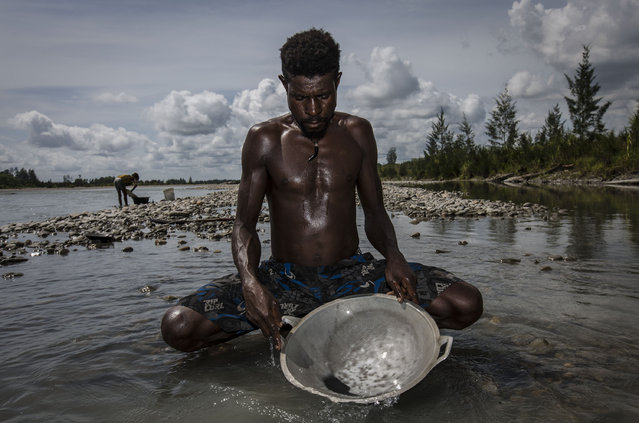
A illegal gold miner of Kamoro people, Tinus, pan for gold on February 4, 2017 in Timika, Papua Province, Indonesia. (Photo by Ulet Ifansasti/Getty Images)

A illegal gold miner of Kamoro people, Tinus, pan for gold on February 4, 2017 in Timika, Papua Province, Indonesia. Indonesia produces over 70 billion dollars in gold a year and is home to the largest gold mine and the third largest copper mine in the world, the Grasberg mine, which is located at West Papua. (Photo by Ulet Ifansasti/Getty Images)
Details
09 Feb 2017 00:05:00
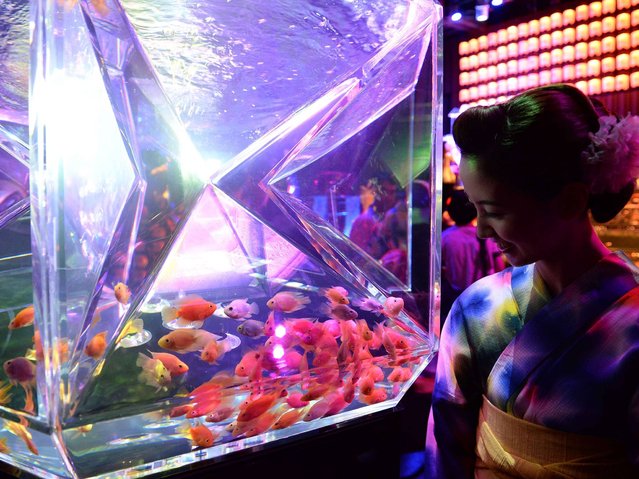
A young woman wearing the summer Kimono, “Yukata” watches the goldfishes during the press preview of “Eco Edo Nihombashi Art Aquarium 2014” exhibition in Tokyo on July 10, 2014. The two-month-long goldfish exhibition will starts July 11. (Photo by Toshifumi Kitamura/AFP Photo)

A young woman wearing the summer Kimono, “Yukata” watches the goldfishes during the press preview of “Eco Edo Nihombashi Art Aquarium 2014” exhibition in Tokyo on July 10, 2014. The two-month-long goldfish exhibition will starts July 11. (Photo by Toshifumi Kitamura/AFP Photo)
Details
14 Jul 2014 12:54:00
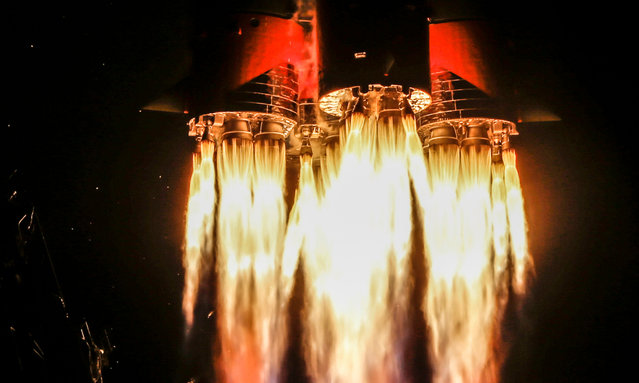
Soyuz MS-12 spacecraft with crew members of Expedition 59/60 Russian cosmonaut Alexey Ovchinin, NASA astronauts Christina Koch and Nick Hague lifts off from the launch pad at the Russian leased Baikonur cosmodrome, Kazakhstan, 15 March 2019. Hague, Koch, and Ovchinin will spend six-and-a-half months living and working aboard the International Space Station. (Photo by Sergei Ilnitsky/EPA/EFE)

Soyuz MS-12 spacecraft with crew members of Expedition 59/60 Russian cosmonaut Alexey Ovchinin, NASA astronauts Christina Koch and Nick Hague lifts off from the launch pad at the Russian leased Baikonur cosmodrome, Kazakhstan, 15 March 2019. Hague, Koch, and Ovchinin will spend six-and-a-half months living and working aboard the International Space Station. (Photo by Sergei Ilnitsky/EPA/EFE)
Details
11 Apr 2019 00:03:00
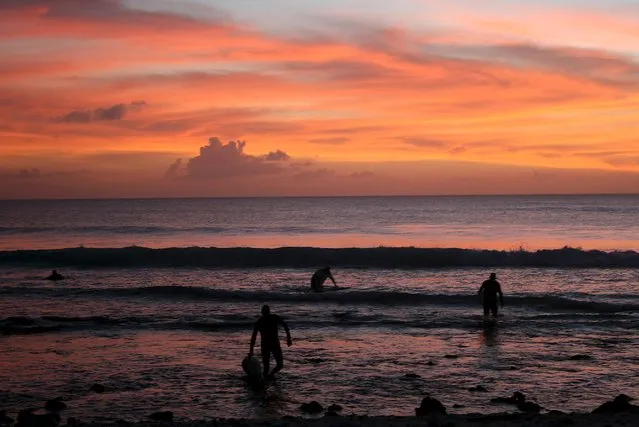
Surfers walk out of the water at sunset after surfing along the coast of Kiritimati Island, part of the Pacific Island nation of Kiribati, April 5, 2016. (Photo by Lincoln Feast/Reuters)


Kiritimati is a far-flung outpost of the Republic of Kiribati. The world's largest coral atoll, Kiritimati has just one flight a week to either Fiji or Hawaii, four-and-a-half hours in either direction. Tarawa, the capital of Kiribati lies nearly 3,300 km (2,000 miles) to the west – about three weeks by boat. No lawyers are based on Kiritimati and the High Court only comes once or twice a year to clear a backlog of the most serious cases, bringing a public lawyer for defendants who can't afford their own. (Photo by Lincoln Feast/Reuters)
Details
28 Apr 2016 12:01:00
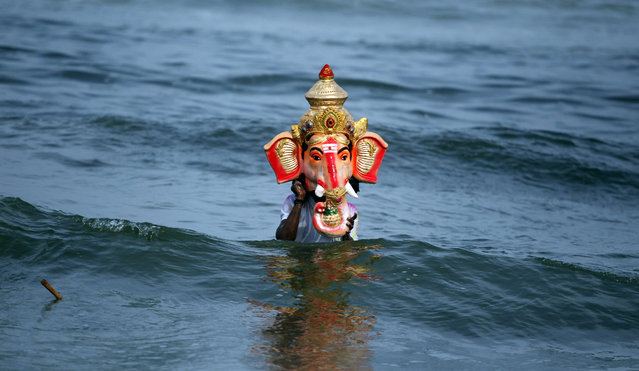
A man holds an idol of  Hindu God Ganesha before immersing it in the Bay of Bengal during Ganesh Chaturthi festival in Chennai, India, Sunday, September 20, 2015. The festival marks the birth of Ganesha who is widely worshiped by Hindus as the god of wisdom, prosperity and good fortune. (Photo by Arun Sankar K./AP Photo)

A man holds an idol of Hindu God Ganesha before immersing it in the Bay of Bengal during Ganesh Chaturthi festival in Chennai, India, Sunday, September 20, 2015. The festival marks the birth of Ganesha who is widely worshiped by Hindus as the god of wisdom, prosperity and good fortune. (Photo by Arun Sankar K./AP Photo)
Details
23 Sep 2015 08:04:00
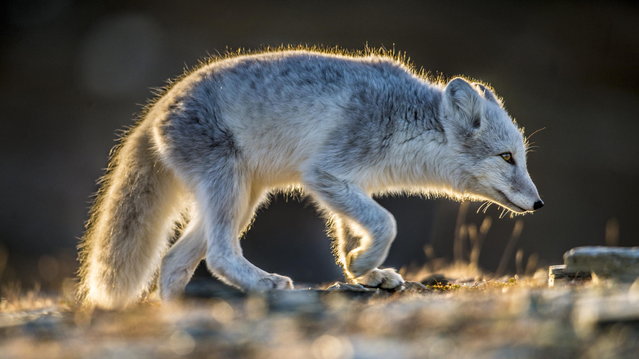
Arctic Fox. (Photo by Trond Eriksen)

“The arctic fox (Vulpes lagopus), also known as the white fox, polar fox, or snow fox, is a small fox native to the Arctic regions of the Northern Hemisphere and is common throughout the Arctic tundra biome. It is well adapted to living in cold environments. It has a deep thick fur which is brown in summer and white in winter. It averages in size at about 85.3 cm (33.6 in) in body length, with a generally rounded body shape to minimize the escape of body heat. – Wikipedia. (Photo by Trond Eriksen)
Details
26 May 2014 14:09:00


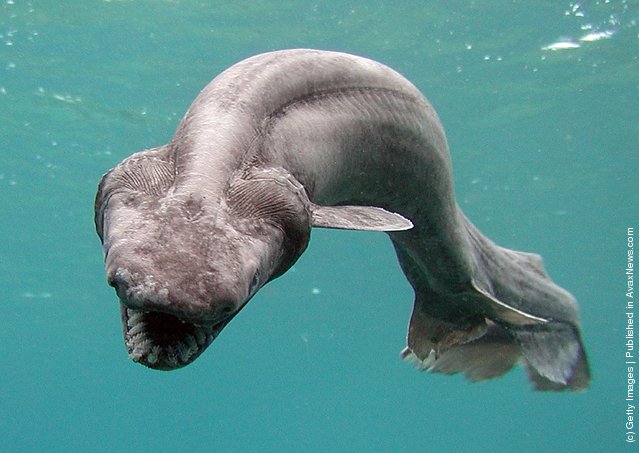
“The frilled shark (Chlamydoselachus anguineus) is one of two extant species of shark in the family Chlamydoselachidae, with a wide but patchy distribution in the Atlantic and Pacific Oceans. This uncommon species is found over the outer continental shelf and upper continental slope, generally near the bottom though there is evidence of substantial upward movements. It has been caught as deep as 1,570 m (5,150 ft), whereas in Suruga Bay, Japan it is most common at depths of 50–200 m (160–660 ft). Exhibiting several “primitive” features, the frilled shark has often been termed a «living fossil»”. – Wikipedia

Photo: A 1.6 meter long Frill shark swims in a tank after being found by a fisherman at a bay in Numazu, on January 21, 2007 in Numazu, Japan. The frill shark, also known as a Frilled shark usually lives in waters of a depth of 600 meters and so it is very rare that this shark is found alive at sea-level. It's body shape and the number of gill are similar to fossils of sharks which lived 350,000,000 years ago. (Photo by Awashima Marine Park/Getty Images)

Details
05 May 2011 10:01:00
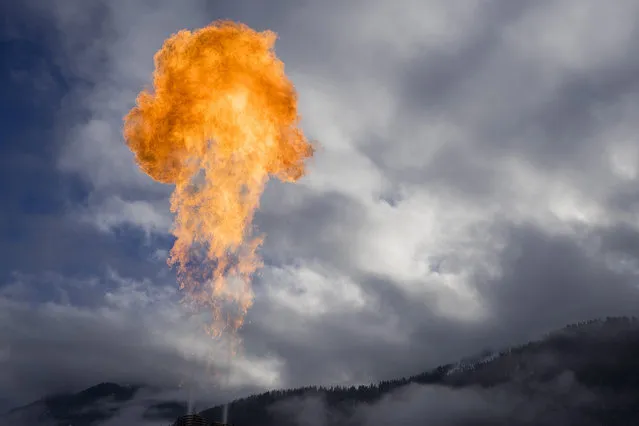
A pilot inflates a hot air balloon while taking part in the 38th International Balloon Festival of Chateau-d'oex, Switzerland, 23 January 2016. The festival takes place from 23 to 31 January. (Photo by Vincent Vannay/EPA)

A pilot inflates a hot air balloon while taking part in the 38th International Balloon Festival of Chateau-d'oex, Switzerland, 23 January 2016. The festival takes place from 23 to 31 January. (Photo by Vincent Vannay/EPA)
Details
27 Jan 2016 13:54:00