Loading...
Done
Surviving The Northeast Heatwave Part1

The northeastern United States sweltered this week in a scorching summer heat wave, complete with stagnant, sticky air and no winds for relief, forecasters said. Even in a summer already filled with stretches of very hot weather, this week will be stubbornly brutal, with no relief in sight until the weekend brings thunderstorms to the region, they said. "Plain and simple, this week may feel the worst of any week for this summer in the Northeast," said Accuweather.com meteorologist Alex Sosnowski. (Reuters)
Details
22 Aug 2013 10:28:00
Tiffany Noreuil at the Oregon Humane Society in Portland, Oregon, holds feline Hercules, a 20-pound stray whose girth got him stuck in a pet door while trying to plunder some dog food. (Photo by AP Photo)

Tiffany Noreuil at the Oregon Humane Society in Portland, Oregon, holds feline Hercules, a 20-pound stray whose girth got him stuck in a pet door while trying to plunder some dog food. (Photo by AP Photo)

See also: Large People

Details
27 Oct 2013 09:50:00
Gina Labianca (L) tries on a super woman outfit as Charlie Lucas tries a snow white Costume at the Halloween MegaStore

Gina Labianca (L) tries on a super woman outfit as Charlie Lucas tries a snow white Costume at the Halloween MegaStore Miami Beach on October 21, 2011 in Miami Beach, Florida. The megastore is a temporary location for the store which opened for the holiday to sell costumes, masks and other items to people needing to dress up for the evening of October 31 when costumed people around the world observe the day. (Photo by Joe Raedle/Getty Images)
Details
23 Oct 2011 14:04:00
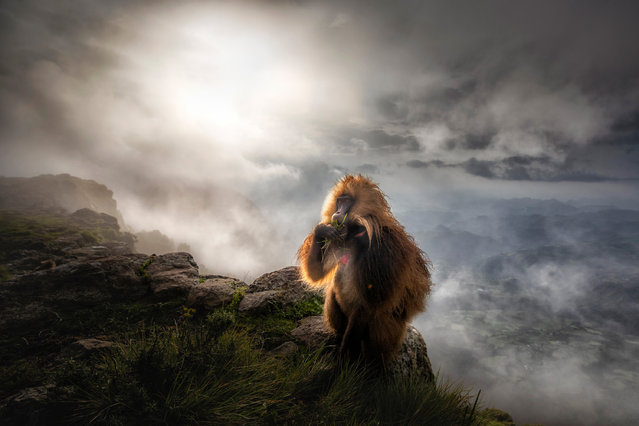
Highly commended, mammals: Gelada after the storm – Marco Gaiotti (Italy). “Gelada baboons are the only monkey species in the world that feed on grasses. They are native to the tableland of Ethiopia. Every morning large family groups wander from their sleeping places in the steep rock face, up to 1,000 metres high, to the feeding grounds at the tablelands. This image clearly depicts their feeding strategy: they pull out bunches of grass, sort the stalks and then lift them to their mouth. This shot was taken towards the end of the rainy season after a heavy storm”. (Photo by Marco Gaiotti/2019 GDT European Wildlife Photographer of the Year)

Highly commended, mammals: Gelada after the storm – Marco Gaiotti (Italy). “Gelada baboons are the only monkey species in the world that feed on grasses. They are native to the tableland of Ethiopia. Every morning large family groups wander from their sleeping places in the steep rock face, up to 1,000 metres high, to the feeding grounds at the tablelands. This image clearly depicts their feeding strategy: they pull out bunches of grass, sort the stalks and then lift them to their mouth. This shot was taken towards the end of the rainy season after a heavy storm”. (Photo by Marco Gaiotti/2019 GDT European Wildlife Photographer of the Year)
Details
31 Oct 2019 00:03:00
People perform during celebrations to commemorate the 70th anniversary of the establishment of the Vietnam Public Security police force at the National Convention Center in Hanoi August 18, 2015. The Vietnam Police force was founded on August 19, 1945, the day of the anti-colonial people's uprising known as the August Revolution. (Photo by Reuters/Kham)

People perform during celebrations to commemorate the 70th anniversary of the establishment of the Vietnam Public Security police force at the National Convention Center in Hanoi August 18, 2015. The Vietnam Police force was founded on August 19, 1945, the day of the anti-colonial people's uprising known as the August Revolution. (Photo by Reuters/Kham)
Details
19 Aug 2015 12:39:00
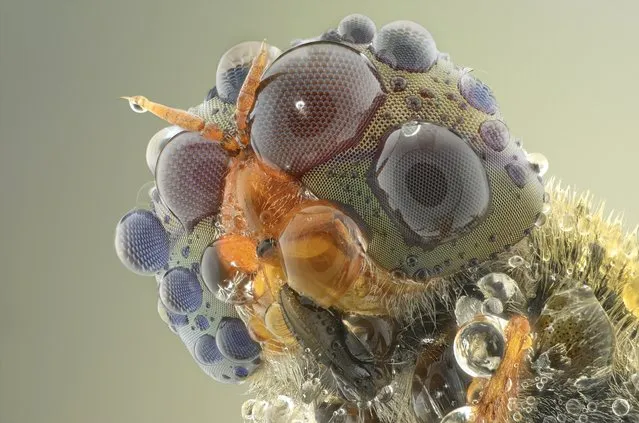
A close-up shot of dews of a soldier fly on August 2014, in Banten, Indonesia. Wildlife photographer takes incredible close-up images of tiny bugs. Yudy Sauw has captured close-up images of creepy crawlies – revealing their disturbing faces. The insects have an assortment bulging eyes and sharp pincers and look grotesque in the face-to-face shots. The miniature-models include a soldier fly, a red ant and a longhorn beetle. (Photo by Yudy Sauw/Barcroft Media)

A close-up shot of dews of a soldier fly on August 2014, in Banten, Indonesia. Wildlife photographer takes incredible close-up images of tiny bugs. Yudy Sauw has captured close-up images of creepy crawlies – revealing their disturbing faces. The insects have an assortment bulging eyes and sharp pincers and look grotesque in the face-to-face shots. The miniature-models include a soldier fly, a red ant and a longhorn beetle. The 33-year-old photographed the bugs at his home studio in Banten, Indonesia, placing them 2-10 centimeters away from the camera. (Photo by Yudy Sauw/Barcroft Media)
Details
22 Aug 2014 12:42:00
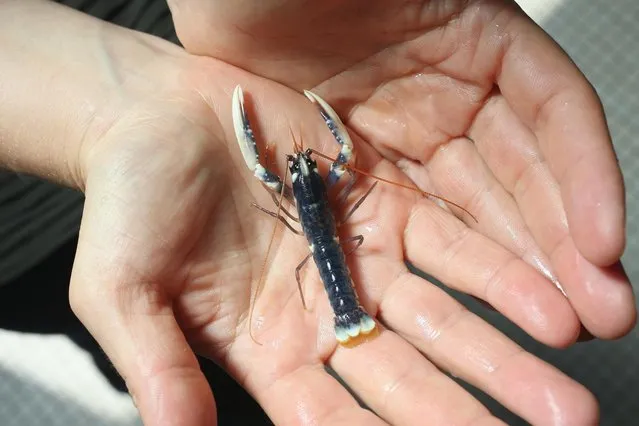
Isabel Schmalenbach, an environmental scientist with the Helgoland Biological Institute (Biologische Anstalt Helgoland), part of the Alfred Wegener Institute for Polar and Marine Research, holds a one-year old baby European lobster (Homarus gammarus) raised at the institute on August 3, 2013 on Helgoland Island, Germany. (Photo by Sean Gallup/Getty Images)

Isabel Schmalenbach, an environmental scientist with the Helgoland Biological Institute (Biologische Anstalt Helgoland), part of the Alfred Wegener Institute for Polar and Marine Research, holds a one-year old baby European lobster (Homarus gammarus) raised at the institute on August 3, 2013 on Helgoland Island, Germany. Later in the day Schmalenbach and her colleagues released a total of 415 one-year old lobsters into the North Sea as part of an effort to repopulate the lobster population around Helgoland (also called Heligoland). In the 19th century local fishermen caught up to 80,000 lobsters a year in the surrounding waters, combined with the heavy allied bombing of the island during and after World War II, as well as other environmental factors, decimated the lobster population. (Photo by Sean Gallup)
Details
05 Aug 2013 08:39:00
A member of security personnel stands on duty on an empty train platform inside a station on the Subway Line Number 1 on the eve of the Chinese Lunar New Year, in Beijing, China, February 7, 2016. According to local media, traffic in Beijing has seen a rare relief from its usual heavy pressure after 15 million people have left the city, heading for family reunions in their hometowns on the eve of the Chinese Lunar New Year of Monkey. (Photo by Jason Lee/Reuters)

A member of security personnel stands on duty on an empty train platform inside a station on the Subway Line Number 1 on the eve of the Chinese Lunar New Year, in Beijing, China, February 7, 2016. According to local media, traffic in Beijing has seen a rare relief from its usual heavy pressure after 15 million people have left the city, heading for family reunions in their hometowns on the eve of the Chinese Lunar New Year of Monkey. (Photo by Jason Lee/Reuters)
Details
08 Feb 2016 11:11:00