Loading...
Done

An important historic event: For the first time a container ship sailed the Northern Sea Route through the Russian Arctic, traveling from China to Amsterdam. The journey, which began on August 15 and was completed on September 10, is only now possible due to high levels of Arctic sea ice melt that have occurred in the past several years.
Details
23 Sep 2013 12:57:00
Marge Simspon in “Fire Suit”, Thierry Mugler.

Marge Simpson may be many things (doting mother, long-suffering wife, erratic driver), but she’s not usually a style icon. Thanks to artist Alexsandro Palombo – known for his irreverent and colourful fashion cartoons – she is now, as he re-imagines her in some of the most iconic dresses of all time. Photo: Marge Simspon in “Fire Suit”, Thierry Mugler.
Details
26 Nov 2013 09:06:00
Funny Illustrations by Glenn Jones

Glenn Jones is a graphic designer and illustrator from Auckland, New Zealand. Design is one of his great hobbies and he has worked in the industry for over 15 years. Glenn Jones submitted T-shirt designs to Threadless.com before, and worked there for a few success years. Now he is concentrating on his own range of T-shirts at Glennz Tees.
The following are some designs of his T-shirts. Have fun and course you can vote to elect your favorite one in his online t-shirt store.
Details
11 Jan 2013 14:55:00
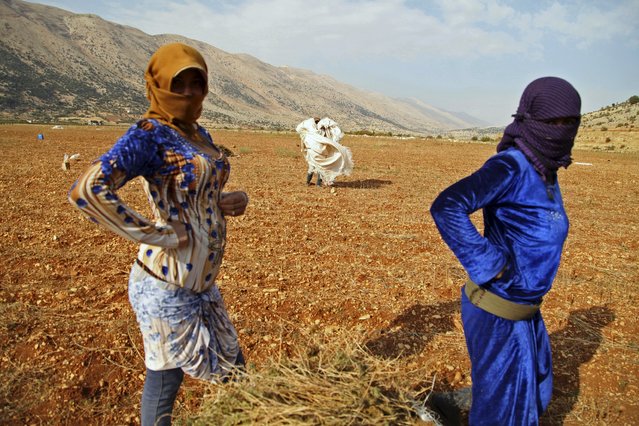
Aisha, 15, (L) (who asked to withhold her last name), a Syrian refugee from Raqqa, waits with a fellow refugee while harvesting cannabis in the Bekaa valley, Lebanon October 19, 2015. Syrian refugees work to harvest and process spiky-leafed cannabis plants in neighbouring Lebanon’s Bekaa Valley. (Photo by Alia Haju/Reuters)

Aisha, 15, (L) (who asked to withhold her last name), a Syrian refugee from Raqqa, waits with a fellow refugee while harvesting cannabis in the Bekaa valley, Lebanon October 19, 2015. Syrian refugees work to harvest and process spiky-leafed cannabis plants in neighbouring Lebanon’s Bekaa Valley. Often farmers of cotton and wheat back home in Raqqa province – now the de facto capital of Islamic State – the conflict in Syria drove them to seek safety in a region where Syrian migrant workers used to spend a few months a year before returning home. (Photo by Alia Haju/Reuters)
Details
24 Dec 2015 08:03:00
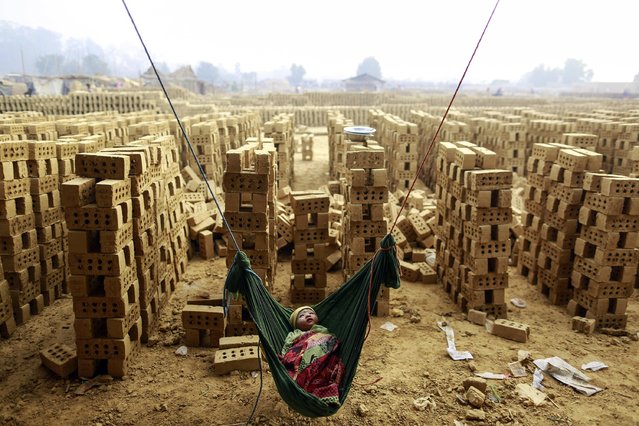
A boy sleeps in a hammock while his mother works at a brick kiln on the outskirts of Yangon February 1, 2015. (Photo by Soe Zeya Tun/Reuters)

A boy sleeps in a hammock while his mother works at a brick kiln on the outskirts of Yangon February 1, 2015. (Photo by Soe Zeya Tun/Reuters)
Details
02 Feb 2015 09:58:00
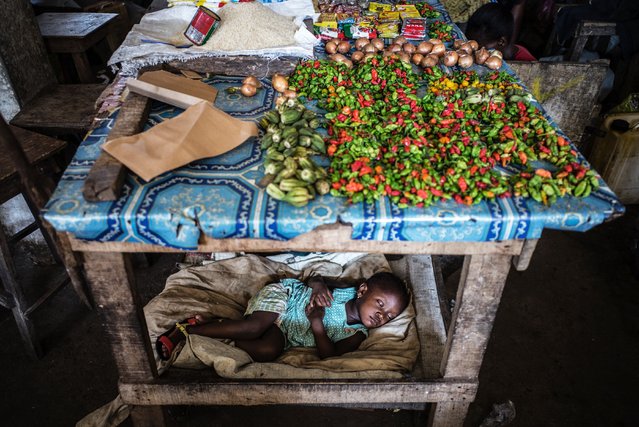
A child sleeps under a table at the Jorkpan market in Sinkor district in Monrovia, on May 2, 2016. (Photo by Marco Longari/AFP Photo)

A child sleeps under a table at the Jorkpan market in Sinkor district in Monrovia, Liberia on May 2, 2016. (Photo by Marco Longari/AFP Photo)
Details
10 May 2016 12:49:00


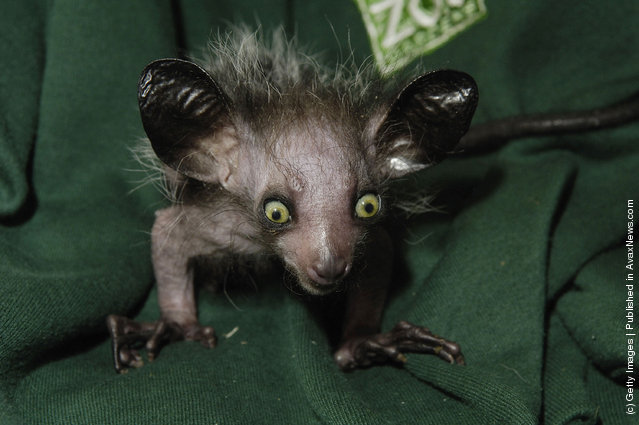
“The aye-aye (Daubentonia madagascariensis) is a lemur, a strepsirrhine primate native to Madagascar that combines rodent-like teeth and a special thin middle finger to fill the same ecological niche as a woodpecker. It is the world's largest nocturnal primate, and is characterized by its unusual method of finding food; it taps on trees to find grubs, then gnaws holes in the wood and inserts its narrow middle finger to pull the grubs out. The only other animal species known to find food in this way is the striped possum. From an ecological point of view the aye-aye fills the niche of a woodpecker as it is capable of penetrating wood to extract the invertebrates within”. – Wikipedia

Photo: In this handout image from Bristol Zoo is seen the first captive bred aye-aye in the UK named “Kintana” (meaning star in Malagasy) April 15, 2005 at Bristol Zoo Gardens, England. The zoo announced today only the second baby aye-aye to be hand-reared in the world (the first was in Jersey Zoo) and has now made his first public appearance since his birth on 11 February 2005. (Photo by Rob Cousins/Bristol Zoo via Getty Images)
Details
13 Apr 2011 13:33:00
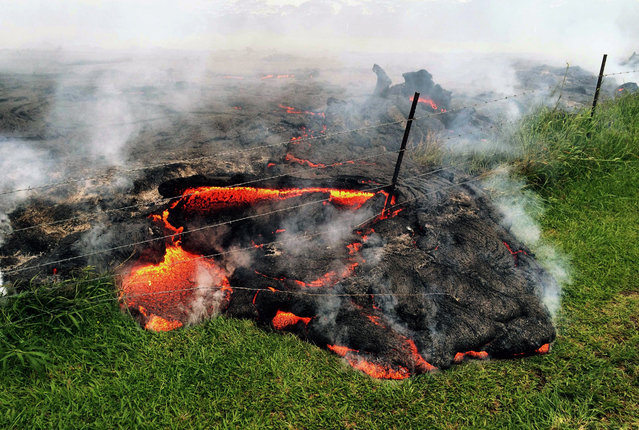
This October 25, 2014 photo provided by the U.S. Geological Survey shows lava flow advancing across the pasture between the Pahoa cemetery and Apa'a Street, engulfing a barbed wire fence, near the town of Pahoa on the Big Island of Hawaii. (Photo by AP Photo/U.S. Geological Survey)

This October 25, 2014 photo provided by the U.S. Geological Survey shows lava flow advancing across the pasture between the Pahoa cemetery and Apa'a Street, engulfing a barbed wire fence, near the town of Pahoa on the Big Island of Hawaii. Dozens of residents in this rural area of Hawaii were placed on alert as flowing lava continued to advance. Authorities on Sunday, October 26, 2014 said lava had advanced about 250 yards since Saturday morning and was moving at the rate of about 10 to 15 yards an hour, consistent with its advancement in recent days. The flow front passed through a predominantly Buddhist cemetery, covering grave sites in the mostly rural region of Puna, and was roughly a half-mile from Pahoa Village Road, the main street of Pahoa. (Photo by AP Photo/U.S. Geological Survey)

Details
27 Oct 2014 11:47:00