Loading...
Done
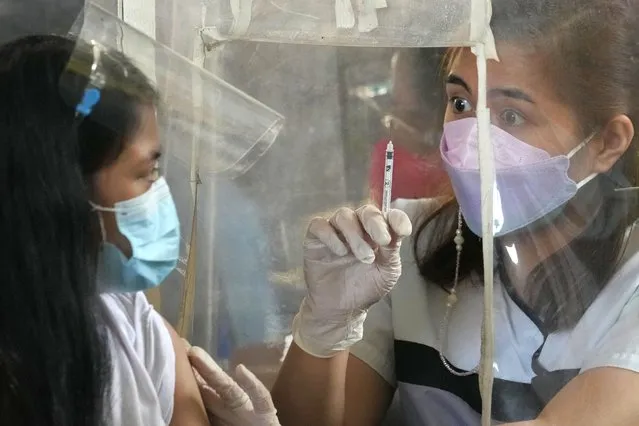
A health worker shows an empty syringe after inoculating a woman with AstraZeneca's COVID-19 vaccine during the first day of a nationwide three-day vaccination drive at a school in Quezon city, Philippines on Monday, November 29, 2021. There has been no reported infection so far caused by the new variant in the Philippines, a Southeast Asian pandemic hotspot where COVID-19 cases have considerably dropped to below 1,000 each day in recent days, but the emergence of the Omicron variant has set off a new alarm. (Photo by Aaron Favila/AP Photo)

A health worker shows an empty syringe after inoculating a woman with AstraZeneca's COVID-19 vaccine during the first day of a nationwide three-day vaccination drive at a school in Quezon city, Philippines on Monday, November 29, 2021. There has been no reported infection so far caused by the new variant in the Philippines, a Southeast Asian pandemic hotspot where COVID-19 cases have considerably dropped to below 1,000 each day in recent days, but the emergence of the Omicron variant has set off a new alarm. (Photo by Aaron Favila/AP Photo)
Details
30 Nov 2021 08:56:00
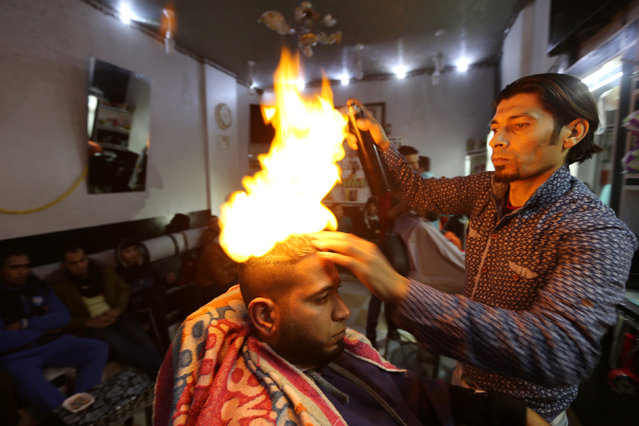
Palestinian barber Ramadan Odwan styles and straightens the hair of a customer with fire at his salon in Rafah, in the southern Gaza Strip February 2, 2017. In Ramadan Odwan's barbershop in Gaza, hair isn't just blow-dried, it's blowtorch-dried. “People have gone crazy about it, many people are curious to go through the experience and they are not afraid”, he told Reuters. “People here love adventures”. Odwan, 37, is not the first stylist in the world to use flame to straighten hair, but his craft is unique in the Gaza Strip. In his salon in the southern Gaza town of Rafah, Odwan applied what he described as a protective liquid coating to a customer's hair – he declined to disclose its contents – before aiming for the head and pressing the button on a small blowtorch. “I control how long I apply fire, I keep it on and off for 10 seconds or 15 seconds. It is completely safe and I have not encountered any accident since I started it two months ago”, Odwan added. Odwan charges 20 shekels ($5.20) for a haircut and fire-straightening. A barber for the past 18 years, he said part of the reason he uses the technique is to show that Palestinian barbers are as “professional as those out there around the world”. (Photo by Ibraheem Abu Mustafa/Reuters)

Palestinian barber Ramadan Odwan styles and straightens the hair of a customer with fire at his salon in Rafah, in the southern Gaza Strip February 2, 2017. In Ramadan Odwan's barbershop in Gaza, hair isn't just blow-dried, it's blowtorch-dried. “People have gone crazy about it, many people are curious to go through the experience and they are not afraid”, he told Reuters. “People here love adventures”. (Photo by Ibraheem Abu Mustafa/Reuters)
Details
11 Feb 2017 00:05:00
Traditonal balinese dancers

Meri Nirmala Sari, 11, poses in her traditional costume before a performance August 6, 2002 in Ubud, Bali, Indonesia. Meri dances with the Gunung Sari Peliatan dance group and has become a professional. She started dancing at age 5. (Photo by Paula Bronstein/Getty Images)
Details
04 Sep 2011 14:05:00
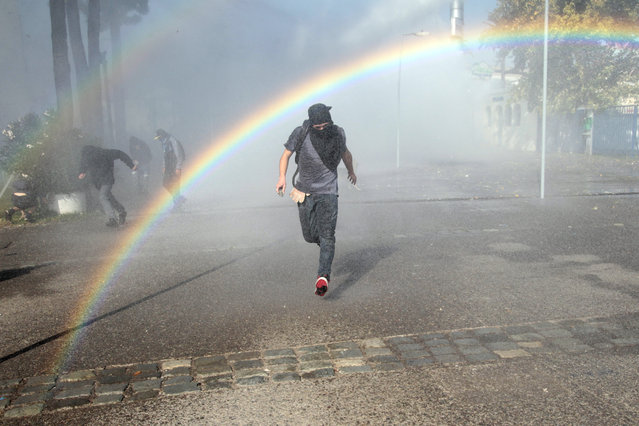
A protester runs from a jet of water shot from a police water cannon in the courtyard of the University of Santiago, during clashes between students and police, in Santiago, Chile, Thursday, May 14, 2015. (Photo by Luis Hidalgo/AP Photo)

A protester runs from a jet of water shot from a police water cannon in the courtyard of the University of Santiago, during clashes between students and police, in Santiago, Chile, Thursday, May 14, 2015. In the capital and other cities across the country, high school and university students marched, for the second time this year, to demand education reform. (Photo by Luis Hidalgo/AP Photo)
Details
15 May 2015 10:49:00


Japanese toy maker Takara Tomy's world's smallest humanoid robot “i-Sobot” is displayed during the Toy Forum 2007 on January 23, 2007 in Tokyo, Japan. The 165mm height robot is able to walk, play the drums and keep its balance. (Photo by Koichi Kamoshida/Getty Images)
Details
19 Apr 2011 13:01:00
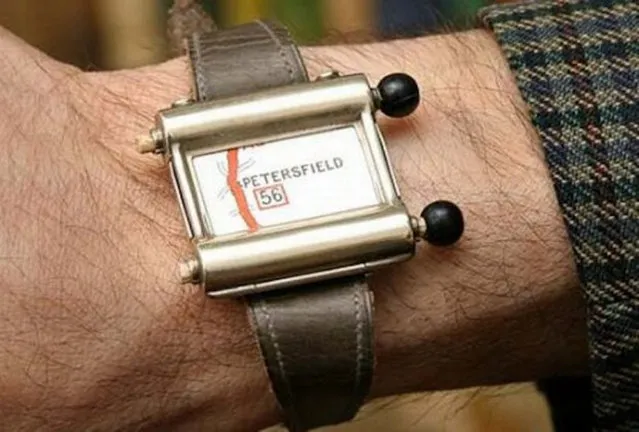
Plus Fours Routefinder - Worlds First Navigation System

Invented in 1920′s this could be world’s first navigation system. No satellites or digital screens were used in the making of this portable navigation system. Called Plus Fours Routefinder, this little invention was designed to be worn on your wrist, and the “maps” were printed on little wooden rollers which you would turn manually as you drove along.
Details
19 Mar 2014 15:14:00


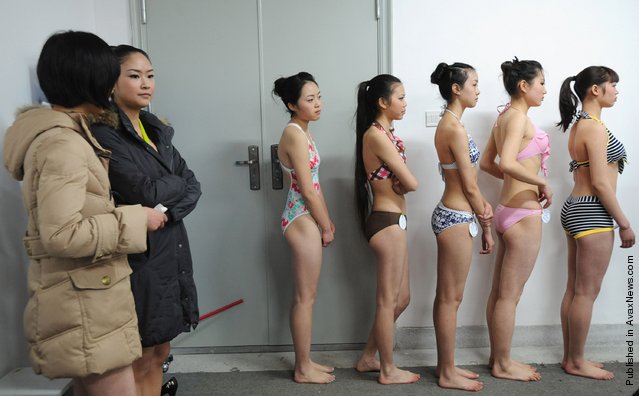
Students take part in a fashion and design entrance examination at Hubei Institute of fine Arts on February 28, 2011 in Wuhan, Hubei Province of China. 202 students took part in the exam and only 24, (10 percent) of them will be enrolled in Hubei Institute of fine Arts. (Photo by ChinaFotoPress/Getty Images). WUHAN, CHINA – FEBRUARY 28
Details
06 Mar 2011 13:42:00
Launch

A general view at the launch of Imitate Mordern: A Gallery With A Difference on March 10, 2011 in London, England.

Details
10 Mar 2011 22:55:00