Loading...
Done
Animal rights activists covered with fake blood sit on the floor during a protest against the use of animals in research to mark World Day for Animals in Laboratories in central Madrid April 24, 2014. The sign reads, “How many rabbits do your shampoo kill?”. (Photo by Andrea Comas/Reuters)

Animal rights activists covered with fake blood sit on the floor during a protest against the use of animals in research to mark World Day for Animals in Laboratories in central Madrid April 24, 2014. The sign reads, “How many rabbits do your shampoo kill?”. (Photo by Andrea Comas/Reuters)
Details
26 Apr 2014 11:44:00
Brett Throckmorten of Barnes Bullets shows Logan Wingo how to sight down an electronic rifle in the trade booth area during the National Rifle Association's annual meeting in Nashville, Tennessee, April 11, 2015. (Photo by Harrison McClary/Reuters)

Brett Throckmorten of Barnes Bullets shows Logan Wingo how to sight down an electronic rifle in the trade booth area during the National Rifle Association's annual meeting in Nashville, Tennessee, April 11, 2015. (Photo by Harrison McClary/Reuters)
Details
12 Apr 2015 08:33:00


A Galapagos Tortoise shell is used as a foot rest at Heathrow Airport's Animal Reception Centre on January 25, 2011 in London, England. Many animals pass through the centre's doors ranging from exotic animals such as snow leopards and elephants, snakes and crocodiles, to the more common such as cats and dogs. In 2010 alone the centre processed approximately 10,500 cats and dogs, 1,300 birds, 105,000 day old chicks, 246,000 reptiles, 230 horses and 29 million fish. Most animals are part of zoo transfer schemes, the pet trade, or are pets in transit. (Photo by Dan Kitwood/Getty Images)
Details
21 Mar 2011 12:30:00
People walk on a sightseeing platform in Zhangjiajie, Hunan Province, China, August 1, 2016. (Photo by Reuters/Stringer)

People walk on a sightseeing platform in Zhangjiajie, Hunan Province, China, August 1, 2016. China has opened a 100-metre-long glass skywalk stretching around a cliff on the side of the Tianmen Mountain. The skywalk provides a view of a 300-metre drop and overlooks Tongtian Avenue, a mountain road with 99 turns that snakes up the mountain. When translated in English, it means “Avenue to the Sky”. (Photo by Reuters/Stringer)
Details
04 Aug 2016 10:39:00
Assimilation By Dillon Marsh

Captured by South African photographer Dillon Marsh, these fantastic photographs depict the many designs employed by sociable weavers to build sturdy nests that are safe from intruders such as cobras and tree snakes. They are also nice cool during the day, and stay warm during cold desert nights. A University of Stellenbosch graduate, Marsh is currently interested in landscape photographer who seeks out anomalies that can be arranged in a photographic series. Assimilation depicts scores of intricate weaver’s nests atop utility poles in Southern Africa. Colonies of sociable weavers have been known to stay attached to one particular nest for up to 100 years, according to The San Diego Zoo.
Details
15 Feb 2014 14:47:00
Human Billboard Billy Gibby

Billy Gibby is a boxer, and frankly he has no chance of ever becoming world star in the sport. That's why Billy Gibby decided to earn some $$ by branding his body. He turned his skin into a billboard where everyone is welcome to advertise their website. GoldenPalace paid $21,000 to put a tattoo of their website on his back. Billy Gibby has gone even further recently and changed his name to Hostgator dot com
Details
23 Mar 2013 13:59:00
Motorhead fans. (Photo by James Mollison)

“Over three years I photographed fans outside different concerts. I was fascinated by the different tribes of people that attended them, and how people emulated celebrity to form their identity. As I photographed the project I began to see how the concerts became events for people to come together with surrogate “families”, a chance to relive their youth or try and be part of a scene that happened before they were born” – James Mollison.

Photo: Madonna fans. (Photo by James Mollison)
Details
25 Jun 2015 12:45:00
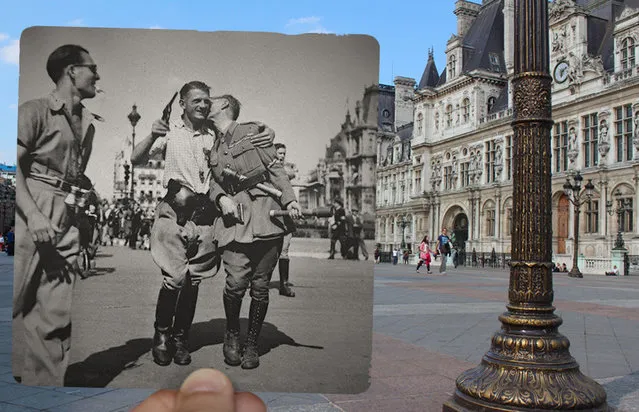
Soldiers outside the Hotel De Ville in the 1940s. (Photo by Julien Knez/Caters News)

It is already one of the world’s most iconic cities, but this incredible collection shows how much Paris has changed over the course of the past century. The collection, by French photographer Julien Knez, shows Paris in the 1940s against a backdrop of how the same places look today. Knez says he put the striking collection together to celebrate the 71st anniversary of the city’s liberation from Nazi control in August 1944. Here: Soldiers outside the Hotel De Ville in the 1940s. (Photo by Julien Knez/Caters News)
Details
07 May 2015 13:16:00