Loading...
Done
Lenticular clouds hover of the mountains of the Kamchatka Peninsula in Russia. (Photo by Denis Budkov/Caters News)

“These eerie formations in the sky may look like alien ships. But as the Daily Mail points out, they’re actually a natural occurrence called lenticular clouds”. – Claudine Zap. Photo: Lenticular clouds hover of the mountains of the Kamchatka Peninsula in Russia. (Photos by Denis Budkov/Caters News)
Details
11 Jun 2013 09:26:00
Things Cut in Half

HalfPics is a Twitter feed pointing to things cut in half like a bowl of ramen, a Mini Cooper, and toothpaste. Their tagline: “Ever wonder what stuff looks like when it’s cut in half?” Yes. We previously posted about “Cut Food,” a photo series of foods cut neatly in half by food photographer Beth Galton and food stylist Charlotte Omnès.


See also:Things Cut in Half Part2
Details
07 Sep 2013 10:32:00


A picture composed by the French street artist JR is plastered to a wall under a highway as part of a community project called “Through A Mother's Eyes”, which involves members of the economically distressed neighborhood of Hunts Point in images taken by and of themselves on June 30, 2011 in New York City. JR, a recent TED prize winner, has staged similar projects around the world that look to transform high crime and impoverished neighborhoods into spaces for street art combined with the celebration of community. (Photo by Spencer Platt/Getty Images)
Details
01 Jul 2011 11:43:00
An African migrant stranded in Costa Rica bathes at a makeshift camp at the border between Costa Rica and Nicaragua, in Penas Blancas, Costa Rica, July 14, 2016. (Photo by Juan Carlos Ulate/Reuters)

An African migrant stranded in Costa Rica bathes at a makeshift camp at the border between Costa Rica and Nicaragua, in Penas Blancas, Costa Rica, July 14, 2016. Thousands of African migrants are currently stranded in Costa Rica after they were denied entry into neighbouring Nicaragua, which they have been using as a crossing point in order to reach the United States. According to the Costa Rican Red Cross, most of these people from Africa, Asia and Haiti. It has been reported that many of them paid smugglers to reach Central America. However, when they arrived at the border gates, they were denied entry and were left with nowhere to go. (Photo by Juan Carlos Ulate/Reuters)
Details
16 Jul 2016 08:17:00
Andy Goldfarb, a staff biologist at the Point Defiance Zoo & Aquarium, plays with one of the four clouded leopard cubs currently at the zoo Friday, June 5, 2015 in Tacoma, Wash. The quadruplets were born on May 12, 2015 and now weigh about 1.7 lbs. each. Friday was their first official day on display for public viewing, usually during their every-four-hours bottle-feeding sessions, which were started after the cubs' mother did not show enough interest in continuing to nurse them. (AP Photo/Ted S. Warren)

Andy Goldfarb, a staff biologist at the Point Defiance Zoo & Aquarium, plays with one of the four clouded leopard cubs currently at the zoo Friday, June 5, 2015 in Tacoma, Wash. The quadruplets were born on May 12, 2015 and now weigh about 1.7 lbs. each. Friday was their first official day on display for public viewing, usually during their every-four-hours bottle-feeding sessions, which were started after the cubs' mother did not show enough interest in continuing to nurse them. (AP Photo/Ted S. Warren)
Details
19 Jun 2015 09:06:00
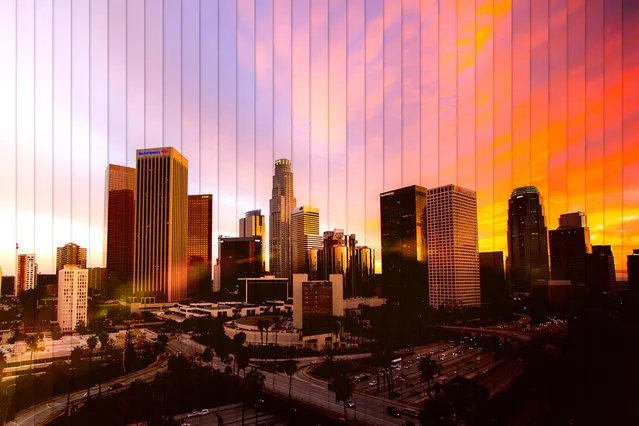
Chicago: 35 photographs, 15 minutes. (Photo by Daniel Marker-Moors/Caters News)

A photographer is using a unique method to show the shift from day to night across famous cities in spectacular images. Daniel Marker-Moors' take on time-lapse photography – which he calls time slice – sees the photographer snap image after image, before combining them to create beautiful, vibrant works. His images usually focus on a point in the day with the most dramatic change in light, such as sunrise or sunset. Marker-Moors, from Los Angeles, begins by shooting hundreds and sometimes thousands of images from the same spot. Here: Chicago – 35 photographs, 15 minutes. (Photo by Daniel Marker-Moors/Caters News)
Details
21 Dec 2015 08:04:00
Elio Angulo (bottom C) lies inside a cardboard coffin next to Alejandro Blanchard as they introduce their product to potential customers at a mortuary in Valencia, in the state of Carabobo, Venezuela August 25, 2016. (Photo by Marco Bello/Reuters)

Elio Angulo (bottom C) lies inside a cardboard coffin next to Alejandro Blanchard as they introduce their product to potential customers at a mortuary in Valencia, in the state of Carabobo, Venezuela August 25, 2016. When Venezuelan entrepreneurs Alejandro Blanchard and Elio Angulo decided to create cardboard coffins, they were looking for an ecological selling point to compete against classic wood and brass caskets. Three years on, with the oil-rich country mired in deep economic crisis, their “bio-coffins” are becoming a viable option because of high prices for wooden coffins and shortages of brass ones. (Photo by Marco Bello/Reuters)
Details
27 Aug 2016 11:18:00
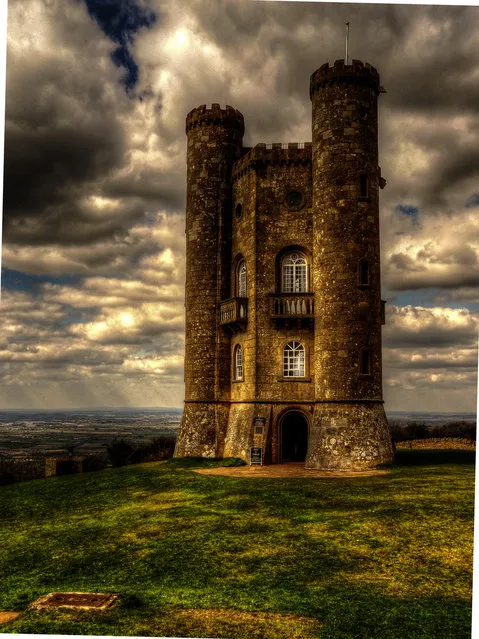
Broadway Tower In English

Broadway Tower is a folly located on Broadway Hill, near the village of Broadway, in the English county of Worcestershire, at the second highest point of the Cotswolds after Cleeve Hill. Broadway Tower's base is 1,024 feet (312 metres) above sea level. The tower itself stands 55 feet (17 metres) high. The “Saxon” tower was designed by James Wyatt in 1794 in the form of a castle, and built for Lady Coventry in 1799. The tower was built on a “beacon” hill, where beacons were lit on special occasions. Lady Coventry wondered if a beacon on this hill could be seen from her house in Worcester – approximately 22 miles (35 km) away – and sponsored the construction of the folly to find out. The beacon could be seen clearly.
Details
19 Dec 2013 10:06:00